Zhen Zhang , Lu Yang , Kuikui Wang , Xiaoming Xi , Xiushan Nie , Gongping Yang , Yilong Yin
{"title":"Consistency and label constrained transfer low-rank representation for cross-light finger vein recognition","authors":"Zhen Zhang , Lu Yang , Kuikui Wang , Xiaoming Xi , Xiushan Nie , Gongping Yang , Yilong Yin","doi":"10.1016/j.patcog.2024.111208","DOIUrl":null,"url":null,"abstract":"<div><div>Finger vein sensors are embedded into all kinds of electronic devices for personal identification, and the upgrading of sensors is unavoidable. Therefore, the concern about cross-sensor finger vein recognition is raised recently. However, little attention is paid to cross-sensor finger vein recognition. The imaging light variation is one main difference between different sensors, and it brings large image differences, seriously degrading finger vein recognition performance. This paper focuses on cross-light finger vein recognition problem, in which we assume that the training and testing finger vein images are captured by different near-infrared lights, and proposes a consistency and label constrained transfer low-rank representation (CLTLRR) method for dealing with cross-light finger vein recognition. In the proposed method, we first transfer cross-light finger vein images into a common feature space to narrow the gap between training images and testing images, and achieve the low-rank linear representations of images. Then, we develop a consistency constraint between the low-rank coefficients in the common feature space and the sparse coefficients in the original feature space to enhance the discrimination of linear representation. In addition, we design a class label constraint for the projection matrix to guide image transfer. Finally, the low-rank coefficients and the projected features in the common feature space are integrated for recognition. Experiments are performed on single-light and cross-light finger palmar vein databases and finger dorsal vein databases, and the experimental results prove the effectiveness of our CLTLRR.</div></div>","PeriodicalId":49713,"journal":{"name":"Pattern Recognition","volume":"161 ","pages":"Article 111208"},"PeriodicalIF":7.6000,"publicationDate":"2025-05-01","publicationTypes":"Journal Article","fieldsOfStudy":null,"isOpenAccess":false,"openAccessPdf":"","citationCount":"0","resultStr":null,"platform":"Semanticscholar","paperid":null,"PeriodicalName":"Pattern Recognition","FirstCategoryId":"94","ListUrlMain":"https://www.sciencedirect.com/science/article/pii/S0031320324009592","RegionNum":1,"RegionCategory":"计算机科学","ArticlePicture":[],"TitleCN":null,"AbstractTextCN":null,"PMCID":null,"EPubDate":"2024/11/23 0:00:00","PubModel":"Epub","JCR":"Q1","JCRName":"COMPUTER SCIENCE, ARTIFICIAL INTELLIGENCE","Score":null,"Total":0}
引用次数: 0
Abstract
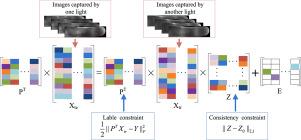
Finger vein sensors are embedded into all kinds of electronic devices for personal identification, and the upgrading of sensors is unavoidable. Therefore, the concern about cross-sensor finger vein recognition is raised recently. However, little attention is paid to cross-sensor finger vein recognition. The imaging light variation is one main difference between different sensors, and it brings large image differences, seriously degrading finger vein recognition performance. This paper focuses on cross-light finger vein recognition problem, in which we assume that the training and testing finger vein images are captured by different near-infrared lights, and proposes a consistency and label constrained transfer low-rank representation (CLTLRR) method for dealing with cross-light finger vein recognition. In the proposed method, we first transfer cross-light finger vein images into a common feature space to narrow the gap between training images and testing images, and achieve the low-rank linear representations of images. Then, we develop a consistency constraint between the low-rank coefficients in the common feature space and the sparse coefficients in the original feature space to enhance the discrimination of linear representation. In addition, we design a class label constraint for the projection matrix to guide image transfer. Finally, the low-rank coefficients and the projected features in the common feature space are integrated for recognition. Experiments are performed on single-light and cross-light finger palmar vein databases and finger dorsal vein databases, and the experimental results prove the effectiveness of our CLTLRR.
期刊介绍:
The field of Pattern Recognition is both mature and rapidly evolving, playing a crucial role in various related fields such as computer vision, image processing, text analysis, and neural networks. It closely intersects with machine learning and is being applied in emerging areas like biometrics, bioinformatics, multimedia data analysis, and data science. The journal Pattern Recognition, established half a century ago during the early days of computer science, has since grown significantly in scope and influence.



 京公网安备 11010802042870号
京ICP备2023020795号-1
京公网安备 11010802042870号
京ICP备2023020795号-1

 分享
分享
 求助内容:
求助内容: 应助结果提醒方式:
 扫码关注我们
