Charlotte E. Teunissen, Rachel Kolster, Gallen Triana-Baltzer, Shorena Janelidze, Henrik Zetterberg, Hartmuth C. Kolb
{"title":"Plasma p-tau immunoassays in clinical research for Alzheimer's disease","authors":"Charlotte E. Teunissen, Rachel Kolster, Gallen Triana-Baltzer, Shorena Janelidze, Henrik Zetterberg, Hartmuth C. Kolb","doi":"10.1002/alz.14397","DOIUrl":null,"url":null,"abstract":"<div>\n \n \n <section>\n \n <p>The revised biomarker framework for diagnosis and staging of Alzheimer's disease (AD) relies on amyloid beta (Aβ) and tau pathologies as core markers, and markers for adjacent pathophysiology, such as neurodegeneration and inflammation. Many of the core fluid biomarkers are phosphorylated tau (p-tau) fragments, with p-tau217 showing a prominent association with Aβ and tau. While positron emission tomography (PET) imaging is well established, plasma p-tau assays are newer and likely to reduce the use of expensive, and less accessible cerebrospinal fluid and PET imaging tests, thereby promoting wider access to AD screening. There is a need for greater understanding of how the various plasma p-tau species reflect different pathological processes of AD and how different immunoassays perform. This review surveys the available immunoassays and highlights their strengths and limitations in different contexts of use. Assays need to be standardized to maximize their impact on AD clinical research, and patient diagnosis and management.</p>\n </section>\n \n <section>\n \n <h3> Highlights</h3>\n \n <div>\n <ul>\n \n <li>Different plasma phosphorylated tau (p-tau) species reflect different pathological processes of Alzheimer's disease (AD), with p-tau231 showing the greatest association with the earliest increases in brain amyloid beta (Aβ) accumulation, while p-tau217 shows greater association with both brain Aβ and early tau pathology, and other p-tau and tau fragment species show greater association with later stages of brain tau pathology.</li>\n \n <li>Plasma p-tau217 has proven to be an excellent biomarker for AD pathology due to its close association with both brain Aβ and tau pathology, as well as its large dynamic range.</li>\n \n <li>Many different assays with varying performance exist for the same p-tau species, with mass spectrometry assays performing uniformly well, and several immunoassays achieving comparable performance.</li>\n \n <li>“Round robin” head-to-head studies have been performed to compare different assays for several key plasma biomarkers, including p-tau181 and p-tau217, but additional head-to-head studies are needed, especially for new analytes and for measuring performance in diverse populations.</li>\n \n <li>Plasma immunoassays have the potential to increase accessibility of early diagnostic testing for a broad population, including diverse historically under-represented and under-served populations, due to the potential to be implemented globally, including in primary care settings; however, further research is needed to validate the optimal cutoffs for each assay for real-world clinical usage.</li>\n \n <li>Eventually, clinical implementation of a two-step workflow may allow standalone use of plasma testing in certain contexts, minimizing the need for confirmation with costly and less accessible cerebrospinal fluid/positron emission tomography testing.</li>\n </ul>\n </div>\n </section>\n </div>","PeriodicalId":7471,"journal":{"name":"Alzheimer's & Dementia","volume":"21 1","pages":""},"PeriodicalIF":11.1000,"publicationDate":"2024-12-03","publicationTypes":"Journal Article","fieldsOfStudy":null,"isOpenAccess":false,"openAccessPdf":"https://onlinelibrary.wiley.com/doi/epdf/10.1002/alz.14397","citationCount":"0","resultStr":null,"platform":"Semanticscholar","paperid":null,"PeriodicalName":"Alzheimer's & Dementia","FirstCategoryId":"3","ListUrlMain":"https://alz-journals.onlinelibrary.wiley.com/doi/10.1002/alz.14397","RegionNum":1,"RegionCategory":"医学","ArticlePicture":[],"TitleCN":null,"AbstractTextCN":null,"PMCID":null,"EPubDate":"","PubModel":"","JCR":"Q1","JCRName":"CLINICAL NEUROLOGY","Score":null,"Total":0}
引用次数: 0
Abstract
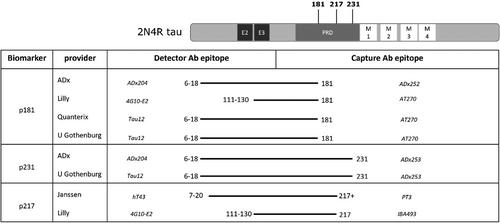
The revised biomarker framework for diagnosis and staging of Alzheimer's disease (AD) relies on amyloid beta (Aβ) and tau pathologies as core markers, and markers for adjacent pathophysiology, such as neurodegeneration and inflammation. Many of the core fluid biomarkers are phosphorylated tau (p-tau) fragments, with p-tau217 showing a prominent association with Aβ and tau. While positron emission tomography (PET) imaging is well established, plasma p-tau assays are newer and likely to reduce the use of expensive, and less accessible cerebrospinal fluid and PET imaging tests, thereby promoting wider access to AD screening. There is a need for greater understanding of how the various plasma p-tau species reflect different pathological processes of AD and how different immunoassays perform. This review surveys the available immunoassays and highlights their strengths and limitations in different contexts of use. Assays need to be standardized to maximize their impact on AD clinical research, and patient diagnosis and management.
Highlights
Different plasma phosphorylated tau (p-tau) species reflect different pathological processes of Alzheimer's disease (AD), with p-tau231 showing the greatest association with the earliest increases in brain amyloid beta (Aβ) accumulation, while p-tau217 shows greater association with both brain Aβ and early tau pathology, and other p-tau and tau fragment species show greater association with later stages of brain tau pathology.
Plasma p-tau217 has proven to be an excellent biomarker for AD pathology due to its close association with both brain Aβ and tau pathology, as well as its large dynamic range.
Many different assays with varying performance exist for the same p-tau species, with mass spectrometry assays performing uniformly well, and several immunoassays achieving comparable performance.
“Round robin” head-to-head studies have been performed to compare different assays for several key plasma biomarkers, including p-tau181 and p-tau217, but additional head-to-head studies are needed, especially for new analytes and for measuring performance in diverse populations.
Plasma immunoassays have the potential to increase accessibility of early diagnostic testing for a broad population, including diverse historically under-represented and under-served populations, due to the potential to be implemented globally, including in primary care settings; however, further research is needed to validate the optimal cutoffs for each assay for real-world clinical usage.
Eventually, clinical implementation of a two-step workflow may allow standalone use of plasma testing in certain contexts, minimizing the need for confirmation with costly and less accessible cerebrospinal fluid/positron emission tomography testing.
期刊介绍:
Alzheimer's & Dementia is a peer-reviewed journal that aims to bridge knowledge gaps in dementia research by covering the entire spectrum, from basic science to clinical trials to social and behavioral investigations. It provides a platform for rapid communication of new findings and ideas, optimal translation of research into practical applications, increasing knowledge across diverse disciplines for early detection, diagnosis, and intervention, and identifying promising new research directions. In July 2008, Alzheimer's & Dementia was accepted for indexing by MEDLINE, recognizing its scientific merit and contribution to Alzheimer's research.





 京公网安备 11010802042870号
京ICP备2023020795号-1
京公网安备 11010802042870号
京ICP备2023020795号-1

 分享
分享
 求助内容:
求助内容: 应助结果提醒方式:
 扫码关注我们
