Multi-function radar work mode recognition based on residual shrinkage reconstruction recurrent neural network

IF 1.5 4区 管理学 Q3 ENGINEERING, ELECTRICAL & ELECTRONIC Iet Radar Sonar and Navigation Pub Date : 2024-10-11 DOI:10.1049/rsn2.12650
Lihong Wang, Kai Xie
{"title":"Multi-function radar work mode recognition based on residual shrinkage reconstruction recurrent neural network","authors":"Lihong Wang,&nbsp;Kai Xie","doi":"10.1049/rsn2.12650","DOIUrl":null,"url":null,"abstract":"<div>\n \n \n <section>\n \n <p>In modern electronic warfare, multi-function radar work mode recognition is increasingly crucial. However, the challenges posed by complex electromagnetic environments, such as lost pulses, spurious pulses, and measurement errors, along with the reliance of traditional multi-task learning strategies on clean samples, make it difficult for existing algorithms to achieve satisfactory recognition performance in real-world scenarios. To address these issues, this paper introduces a novel residual shrinkage reconstruction recurrent neural network (RS-RRNN). The network uses a Gated Recurrent Unit as its backbone to extract temporal features and enhances feature extraction by reconstructing the GRU's input, while also reducing dependence on clean samples. These features are then processed through a residual shrinkage structure to reduce noise, which significantly improves the model's robustness in non-ideal scenarios. Simulations demonstrate that RS-RNN has better performances in accuracy and robustness than existing networks.</p>\n </section>\n </div>","PeriodicalId":50377,"journal":{"name":"Iet Radar Sonar and Navigation","volume":"18 11","pages":"2362-2376"},"PeriodicalIF":1.5000,"publicationDate":"2024-10-11","publicationTypes":"Journal Article","fieldsOfStudy":null,"isOpenAccess":false,"openAccessPdf":"https://onlinelibrary.wiley.com/doi/epdf/10.1049/rsn2.12650","citationCount":"0","resultStr":null,"platform":"Semanticscholar","paperid":null,"PeriodicalName":"Iet Radar Sonar and Navigation","FirstCategoryId":"94","ListUrlMain":"https://ietresearch.onlinelibrary.wiley.com/doi/10.1049/rsn2.12650","RegionNum":4,"RegionCategory":"管理学","ArticlePicture":[],"TitleCN":null,"AbstractTextCN":null,"PMCID":null,"EPubDate":"","PubModel":"","JCR":"Q3","JCRName":"ENGINEERING, ELECTRICAL & ELECTRONIC","Score":null,"Total":0}
引用次数: 0

Abstract

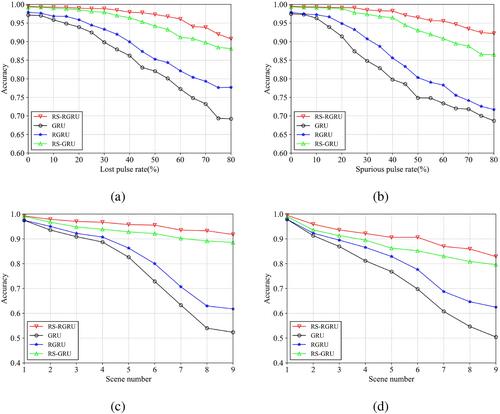
In modern electronic warfare, multi-function radar work mode recognition is increasingly crucial. However, the challenges posed by complex electromagnetic environments, such as lost pulses, spurious pulses, and measurement errors, along with the reliance of traditional multi-task learning strategies on clean samples, make it difficult for existing algorithms to achieve satisfactory recognition performance in real-world scenarios. To address these issues, this paper introduces a novel residual shrinkage reconstruction recurrent neural network (RS-RRNN). The network uses a Gated Recurrent Unit as its backbone to extract temporal features and enhances feature extraction by reconstructing the GRU's input, while also reducing dependence on clean samples. These features are then processed through a residual shrinkage structure to reduce noise, which significantly improves the model's robustness in non-ideal scenarios. Simulations demonstrate that RS-RNN has better performances in accuracy and robustness than existing networks.

Abstract Image

Abstract Image

查看原文
分享 分享
微信好友 朋友圈 QQ好友 复制链接
本刊更多论文
基于残差收缩重构递归神经网络的多功能雷达工作模式识别
在现代电子战中,多功能雷达工作模式识别日益重要。然而,复杂的电磁环境带来的挑战,如丢失脉冲、假脉冲和测量误差,以及传统的多任务学习策略对干净样本的依赖,使得现有算法难以在现实场景中获得令人满意的识别性能。为了解决这些问题,本文提出了一种新的残余收缩重构递归神经网络(RS-RRNN)。该网络使用门控循环单元作为其主干来提取时间特征,并通过重建GRU的输入来增强特征提取,同时也减少了对干净样本的依赖。然后通过残余收缩结构对这些特征进行处理以降低噪声,从而显着提高了模型在非理想情况下的鲁棒性。仿真结果表明,RS-RNN在精度和鲁棒性方面都优于现有网络。
本文章由计算机程序翻译,如有差异,请以英文原文为准。
求助全文
约1分钟内获得全文 去求助
来源期刊
Iet Radar Sonar and Navigation
Iet Radar Sonar and Navigation 工程技术-电信学
CiteScore
4.10
自引率
11.80%
发文量
137
审稿时长
3.4 months
期刊介绍: IET Radar, Sonar & Navigation covers the theory and practice of systems and signals for radar, sonar, radiolocation, navigation, and surveillance purposes, in aerospace and terrestrial applications. Examples include advances in waveform design, clutter and detection, electronic warfare, adaptive array and superresolution methods, tracking algorithms, synthetic aperture, and target recognition techniques.
期刊最新文献
Rapid Target Search Method for Distributed Aperture Radar via Role Reversal Convolutional Neural Network Based Joint Estimation of Direction of Arrival and Polarisation Parameters Direction Finding Techniques for Over-the-Horizon Radars Adaptive Fast Track Association for Small Samples in Distributed Multi-Sensor Systems Boundary-Aware Learning for Robust Automatic Modulation Recognition Based on Adaptive Pyramid Network
×
引用
GB/T 7714-2015
复制
MLA
复制
APA
复制
导出至
BibTeX EndNote RefMan NoteFirst NoteExpress
×
×
提示
您的信息不完整,为了账户安全,请先补充。
现在去补充
×
提示
您因"违规操作"
具体请查看互助需知
我知道了
×
提示
现在去查看 取消
×
提示
确定
0
微信
客服QQ
Book学术公众号 扫码关注我们
反馈
×
意见反馈
请填写您的意见或建议
请填写您的手机或邮箱
已复制链接
已复制链接
快去分享给好友吧!
我知道了
×
扫码分享
扫码分享
Book学术官方微信
Book学术文献互助
Book学术文献互助群
群 号:604180095
Book学术
文献互助 智能选刊 最新文献 互助须知 联系我们:info@booksci.cn
Book学术提供免费学术资源搜索服务,方便国内外学者检索中英文文献。致力于提供最便捷和优质的服务体验。
Copyright © 2023 Book学术 All rights reserved.
ghs 京公网安备 11010802042870号 京ICP备2023020795号-1