{"title":"Classical Models of Hydroxide for Proton Hopping Simulations.","authors":"Ankita Dutta, Themis Lazaridis","doi":"10.1021/acs.jpcb.4c05499","DOIUrl":null,"url":null,"abstract":"<p><p>Hydronium (H<sub>3</sub>O<sup>+</sup>) and hydroxide (OH<sup>-</sup>) ions perform structural diffusion in water via sequential proton transfers (\"Grotthuss hopping\"). This phenomenon can be accounted for by interspersing stochastic proton transfer events in classical molecular dynamics simulations. The implementation of OH<sup>-</sup>-mediated proton hopping is particularly challenging because classical force fields are known to produce overcoordinated solvation structures around the OH<sup>-</sup> ion. Here, we first explore the ability of two-particle point-charge models to reproduce both the solvation free energy and coordination number in TIP3P water. We find that this is possible only with unphysical changes in the nonbonded parameters which create problems in proton hopping simulations. We then construct a classical OH<sup>-</sup> model with the charge of oxygen distributed among three auxiliary particles. This model favors a lower coordination number by accepting three hydrogen bonds and weakly donating one. The model was implemented in the MOBHY module of the CHARMM program and was fit to reproduce the experimental aqueous diffusion coefficient of OH<sup>-</sup>. This parameterization gave reasonable electrophoretic mobilities and the expected accelerated transport under nanoconfinement.</p>","PeriodicalId":60,"journal":{"name":"The Journal of Physical Chemistry B","volume":" ","pages":"12161-12170"},"PeriodicalIF":2.9000,"publicationDate":"2024-12-12","publicationTypes":"Journal Article","fieldsOfStudy":null,"isOpenAccess":false,"openAccessPdf":"https://www.ncbi.nlm.nih.gov/pmc/articles/PMC11647885/pdf/","citationCount":"0","resultStr":null,"platform":"Semanticscholar","paperid":null,"PeriodicalName":"The Journal of Physical Chemistry B","FirstCategoryId":"1","ListUrlMain":"https://doi.org/10.1021/acs.jpcb.4c05499","RegionNum":2,"RegionCategory":"化学","ArticlePicture":[],"TitleCN":null,"AbstractTextCN":null,"PMCID":null,"EPubDate":"2024/12/3 0:00:00","PubModel":"Epub","JCR":"Q3","JCRName":"CHEMISTRY, PHYSICAL","Score":null,"Total":0}
引用次数: 0
Abstract
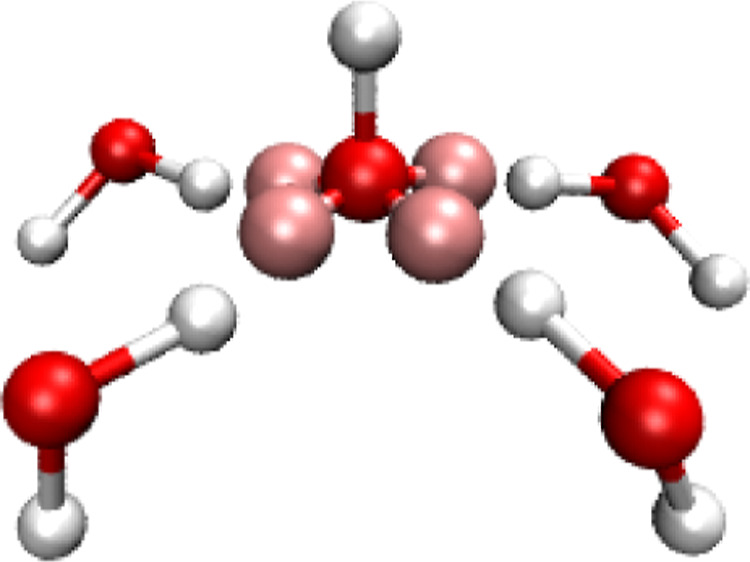
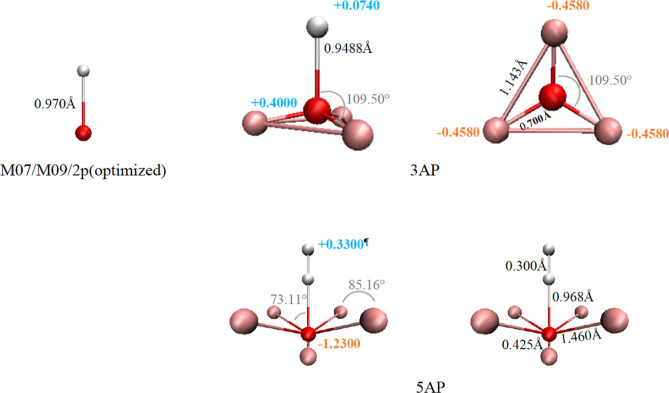
Hydronium (H3O+) and hydroxide (OH-) ions perform structural diffusion in water via sequential proton transfers ("Grotthuss hopping"). This phenomenon can be accounted for by interspersing stochastic proton transfer events in classical molecular dynamics simulations. The implementation of OH--mediated proton hopping is particularly challenging because classical force fields are known to produce overcoordinated solvation structures around the OH- ion. Here, we first explore the ability of two-particle point-charge models to reproduce both the solvation free energy and coordination number in TIP3P water. We find that this is possible only with unphysical changes in the nonbonded parameters which create problems in proton hopping simulations. We then construct a classical OH- model with the charge of oxygen distributed among three auxiliary particles. This model favors a lower coordination number by accepting three hydrogen bonds and weakly donating one. The model was implemented in the MOBHY module of the CHARMM program and was fit to reproduce the experimental aqueous diffusion coefficient of OH-. This parameterization gave reasonable electrophoretic mobilities and the expected accelerated transport under nanoconfinement.
期刊介绍:
An essential criterion for acceptance of research articles in the journal is that they provide new physical insight. Please refer to the New Physical Insights virtual issue on what constitutes new physical insight. Manuscripts that are essentially reporting data or applications of data are, in general, not suitable for publication in JPC B.



 京公网安备 11010802042870号
京ICP备2023020795号-1
京公网安备 11010802042870号
京ICP备2023020795号-1

 分享
分享

 求助内容:
求助内容: 应助结果提醒方式:
 扫码关注我们
