Lina Münker, Martin Køster Rimvall, Lisbeth Frostholm, Eva Ørnbøl, Kaare Bro Wellnitz, Pia Jeppesen, Judith Gerarda Maria Rosmalen, Charlotte Ulrikka Rask
{"title":"Infancy predictors of functional somatic symptoms in pre- and late adolescence: a longitudinal cohort study.","authors":"Lina Münker, Martin Køster Rimvall, Lisbeth Frostholm, Eva Ørnbøl, Kaare Bro Wellnitz, Pia Jeppesen, Judith Gerarda Maria Rosmalen, Charlotte Ulrikka Rask","doi":"10.1007/s00431-024-05850-7","DOIUrl":null,"url":null,"abstract":"<p><p>Physiological regulatory problems in infancy (i.e., problems with sleeping, feeding, and tactile reactivity) have been associated with impairing functional somatic symptoms (FSS) at ages 5-7. We aimed to extend this finding by examining not only the association of physiological regulatory problems but also other infancy factors (i.e., emotion dysregulation and contact problems) with FSS in pre- and late adolescence. Standardized behavioral assessments and self-report questionnaire data from assessment waves at 0-1, 11-12, and 16-17 years of the population-based Copenhagen Child Cohort (CCC2000) were linked with Danish register data on maternal postpartum psychiatric illness and family adversity as covariates. Multiple linear regression analyses were performed to examine the association between infancy factors and FSS in pre- and late adolescence. Only infancy physiological regulatory problems significantly predicted preadolescent FSS (b = 0.38, 95% CI [0.14, 0.62]), also when accounting for maternal postpartum psychiatric illness and family adversity. The association was attenuated for late adolescent FSS.</p><p><strong>Conclusion: </strong>Infancy physiological regulatory problems may represent early signs of a dysregulated stress system and were found to significantly predict FSS in pre- but not late adolescence. Implications for early FSS prevention could include testing interventions promoting infants' regulation of sleep, feeding, and tactile reactivity.</p><p><strong>What is known: </strong>• Functional somatic symptoms (FSS) are common in adolescence. • Explanatory models of FSS emphasize a multifactorial etiology involving interactions between early child-related vulnerabilities and contextual factors. • Infancy physiological regulatory problems (i.e., problems in the area of sleeping, feeding, and tactile reactivity) might represent early signs of a dysregulated stress system, and have been shown to predict impairing FSS in preschool childhood.</p><p><strong>What is new: </strong>• This study investigated the association between infancy factors, namely physiological regulatory problems with feeding, sleeping, and/or tactile reactivity, emotion dysregulation, and contact problems, and FSS in pre- and late adolescence. • Only a combination of infancy physiological regulatory problems significantly predicted preadolescent FSS, with the association attenuating for FSS in late adolescence. • Implications for early FSS prevention could include parent-mediated interventions aiming to promote infants' physiological regulatory skills.</p>","PeriodicalId":11997,"journal":{"name":"European Journal of Pediatrics","volume":"184 1","pages":"57"},"PeriodicalIF":2.6000,"publicationDate":"2024-12-02","publicationTypes":"Journal Article","fieldsOfStudy":null,"isOpenAccess":false,"openAccessPdf":"https://www.ncbi.nlm.nih.gov/pmc/articles/PMC11611932/pdf/","citationCount":"0","resultStr":null,"platform":"Semanticscholar","paperid":null,"PeriodicalName":"European Journal of Pediatrics","FirstCategoryId":"3","ListUrlMain":"https://doi.org/10.1007/s00431-024-05850-7","RegionNum":3,"RegionCategory":"医学","ArticlePicture":[],"TitleCN":null,"AbstractTextCN":null,"PMCID":null,"EPubDate":"","PubModel":"","JCR":"Q1","JCRName":"PEDIATRICS","Score":null,"Total":0}
引用次数: 0
Abstract
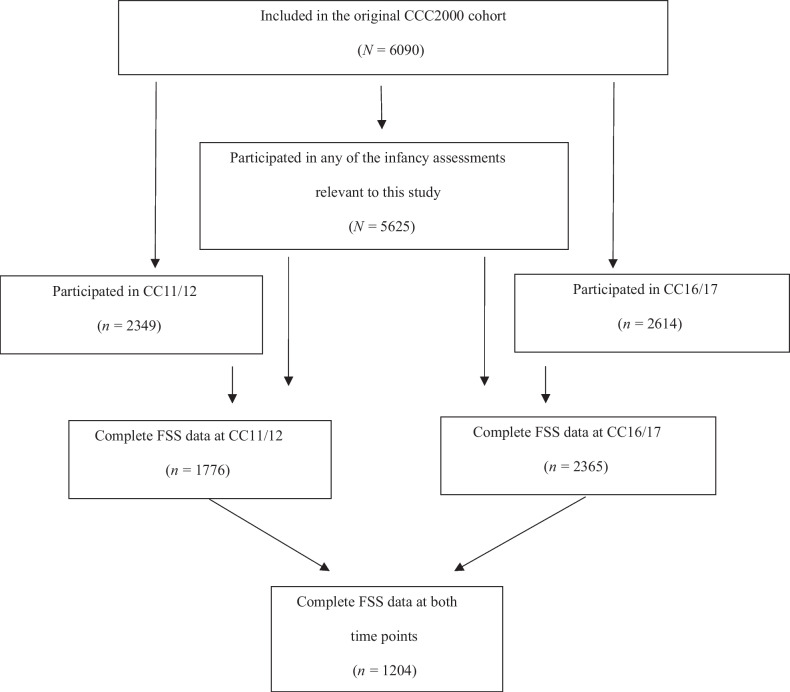
Physiological regulatory problems in infancy (i.e., problems with sleeping, feeding, and tactile reactivity) have been associated with impairing functional somatic symptoms (FSS) at ages 5-7. We aimed to extend this finding by examining not only the association of physiological regulatory problems but also other infancy factors (i.e., emotion dysregulation and contact problems) with FSS in pre- and late adolescence. Standardized behavioral assessments and self-report questionnaire data from assessment waves at 0-1, 11-12, and 16-17 years of the population-based Copenhagen Child Cohort (CCC2000) were linked with Danish register data on maternal postpartum psychiatric illness and family adversity as covariates. Multiple linear regression analyses were performed to examine the association between infancy factors and FSS in pre- and late adolescence. Only infancy physiological regulatory problems significantly predicted preadolescent FSS (b = 0.38, 95% CI [0.14, 0.62]), also when accounting for maternal postpartum psychiatric illness and family adversity. The association was attenuated for late adolescent FSS.
Conclusion: Infancy physiological regulatory problems may represent early signs of a dysregulated stress system and were found to significantly predict FSS in pre- but not late adolescence. Implications for early FSS prevention could include testing interventions promoting infants' regulation of sleep, feeding, and tactile reactivity.
What is known: • Functional somatic symptoms (FSS) are common in adolescence. • Explanatory models of FSS emphasize a multifactorial etiology involving interactions between early child-related vulnerabilities and contextual factors. • Infancy physiological regulatory problems (i.e., problems in the area of sleeping, feeding, and tactile reactivity) might represent early signs of a dysregulated stress system, and have been shown to predict impairing FSS in preschool childhood.
What is new: • This study investigated the association between infancy factors, namely physiological regulatory problems with feeding, sleeping, and/or tactile reactivity, emotion dysregulation, and contact problems, and FSS in pre- and late adolescence. • Only a combination of infancy physiological regulatory problems significantly predicted preadolescent FSS, with the association attenuating for FSS in late adolescence. • Implications for early FSS prevention could include parent-mediated interventions aiming to promote infants' physiological regulatory skills.
期刊介绍:
The European Journal of Pediatrics (EJPE) is a leading peer-reviewed medical journal which covers the entire field of pediatrics. The editors encourage authors to submit original articles, reviews, short communications, and correspondence on all relevant themes and topics.
EJPE is particularly committed to the publication of articles on important new clinical research that will have an immediate impact on clinical pediatric practice. The editorial office very much welcomes ideas for publications, whether individual articles or article series, that fit this goal and is always willing to address inquiries from authors regarding potential submissions. Invited review articles on clinical pediatrics that provide comprehensive coverage of a subject of importance are also regularly commissioned.
The short publication time reflects both the commitment of the editors and publishers and their passion for new developments in the field of pediatrics.
EJPE is active on social media (@EurJPediatrics) and we invite you to participate.
EJPE is the official journal of the European Academy of Paediatrics (EAP) and publishes guidelines and statements in cooperation with the EAP.




 京公网安备 11010802042870号
京ICP备2023020795号-1
京公网安备 11010802042870号
京ICP备2023020795号-1

 分享
分享
 求助内容:
求助内容: 应助结果提醒方式:
 扫码关注我们
