Wenjie Liu, Suqin He, Hao Liu, Zeyu Shou, Kaiyuan Huo, Hongping Xiang, Aihan Feng, Wei Lu, Na Li
{"title":"A green, versatile, and facile strategy for anti-biofouling surface with ultra-high graft density polyethylene glycol.","authors":"Wenjie Liu, Suqin He, Hao Liu, Zeyu Shou, Kaiyuan Huo, Hongping Xiang, Aihan Feng, Wei Lu, Na Li","doi":"10.1186/s12951-024-03026-x","DOIUrl":null,"url":null,"abstract":"<p><p>Implantable catheters are susceptible to severe complications due to non-specific protein adhesion on their surfaces. Polyethylene glycol (PEG) coatings, the gold standard for resistance to non-specific protein adhesion, present a challenge in achieving high-density grafting, which significantly restricts their use as anti-biofouling coatings. Herein, we exploited the strong interaction between polyphenols (PCs) and polycations (K6-PEG) to graft PEG onto the surface of PC-Cu (A network of metal polyphenols composed of proanthocyanidins and metal copper ions, with expectation for the coating with excellent resistance to non-specific protein adhesion (PC-Cu@K6-PEG). The introduction of K6-PEG resulted in enhanced stability and modulus of PC-Cu, as well as a reduction in the surface adhesion energy and contact angle of PC-Cu. In contrast to previously reported PEG coatings, PC-Cu@K6-PEG exhibited a markedly elevated grafting density of PEG (4.06 chains/nm²), which was more than double the highest value previously reported (1.9 chains/nm²), due to the diffusing ability of K6-PEG throughout the PC-Cu networks. PC-Cu@K6-PEG displays robust resistance to a variety of proteins, microbials, and platelet attachment, thereby preventing thrombosis. The coating ability of PC-Cu onto diverse substrates, combined with the simple, straightforward and environmentally benign process of fabricating PC-Cu@K6-PEG, suggests that this strategy has significant potential for use in anti-biofouling surfaces.</p>","PeriodicalId":16383,"journal":{"name":"Journal of Nanobiotechnology","volume":"22 1","pages":"746"},"PeriodicalIF":12.6000,"publicationDate":"2024-12-02","publicationTypes":"Journal Article","fieldsOfStudy":null,"isOpenAccess":false,"openAccessPdf":"https://www.ncbi.nlm.nih.gov/pmc/articles/PMC11610065/pdf/","citationCount":"0","resultStr":null,"platform":"Semanticscholar","paperid":null,"PeriodicalName":"Journal of Nanobiotechnology","FirstCategoryId":"5","ListUrlMain":"https://doi.org/10.1186/s12951-024-03026-x","RegionNum":1,"RegionCategory":"生物学","ArticlePicture":[],"TitleCN":null,"AbstractTextCN":null,"PMCID":null,"EPubDate":"","PubModel":"","JCR":"Q1","JCRName":"BIOTECHNOLOGY & APPLIED MICROBIOLOGY","Score":null,"Total":0}
引用次数: 0
Abstract
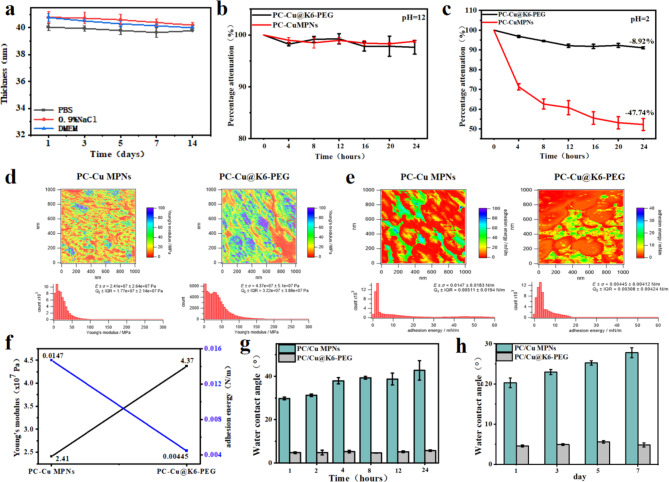
Implantable catheters are susceptible to severe complications due to non-specific protein adhesion on their surfaces. Polyethylene glycol (PEG) coatings, the gold standard for resistance to non-specific protein adhesion, present a challenge in achieving high-density grafting, which significantly restricts their use as anti-biofouling coatings. Herein, we exploited the strong interaction between polyphenols (PCs) and polycations (K6-PEG) to graft PEG onto the surface of PC-Cu (A network of metal polyphenols composed of proanthocyanidins and metal copper ions, with expectation for the coating with excellent resistance to non-specific protein adhesion (PC-Cu@K6-PEG). The introduction of K6-PEG resulted in enhanced stability and modulus of PC-Cu, as well as a reduction in the surface adhesion energy and contact angle of PC-Cu. In contrast to previously reported PEG coatings, PC-Cu@K6-PEG exhibited a markedly elevated grafting density of PEG (4.06 chains/nm²), which was more than double the highest value previously reported (1.9 chains/nm²), due to the diffusing ability of K6-PEG throughout the PC-Cu networks. PC-Cu@K6-PEG displays robust resistance to a variety of proteins, microbials, and platelet attachment, thereby preventing thrombosis. The coating ability of PC-Cu onto diverse substrates, combined with the simple, straightforward and environmentally benign process of fabricating PC-Cu@K6-PEG, suggests that this strategy has significant potential for use in anti-biofouling surfaces.
期刊介绍:
Journal of Nanobiotechnology is an open access peer-reviewed journal communicating scientific and technological advances in the fields of medicine and biology, with an emphasis in their interface with nanoscale sciences. The journal provides biomedical scientists and the international biotechnology business community with the latest developments in the growing field of Nanobiotechnology.





 京公网安备 11010802042870号
京ICP备2023020795号-1
京公网安备 11010802042870号
京ICP备2023020795号-1

 分享
分享
 求助内容:
求助内容: 应助结果提醒方式:
 扫码关注我们
