Alexander Atamian, Marcella Birtele, Negar Hosseini, Giorgia Quadrato
{"title":"Generation and long-term culture of human cerebellar organoids from pluripotent stem cells","authors":"Alexander Atamian, Marcella Birtele, Negar Hosseini, Giorgia Quadrato","doi":"10.1038/s41596-024-01093-w","DOIUrl":null,"url":null,"abstract":"The advancement of research on human cerebellar development and diseases has been hindered by the lack of a cell-based system that mirrors the cellular diversity and functional characteristics of the human cerebellum. Here, we describe our protocol for a human pluripotent stem cell-derived human cerebellar organoid (hCerO) model, which successfully replicates the cellular diversity of the fetal cerebellum along with some of its distinct cytoarchitectural features. Our approach involves the patterning of human pluripotent stem cells, resulting in the generation of both cerebellar excitatory and inhibitory progenitor populations—specifically, the rhombic lip and ventricular zone progenitors, respectively. This patterning strategy leads to the reproducible differentiation of the major neurons of the cerebellum such as granule cells and Purkinje cells within just one month of culture. hCerOs serve as platforms for molecular, cellular and functional assays, including single-cell transcriptomics, immunohistochemistry and investigations into calcium dynamics and electrophysiological properties. Remarkably, the cultivation of hCerOs for up to 8 months enables the healthy survival and maturation of Purkinje cells, which exhibit molecular and electrophysiological features akin to their in vivo counterparts. Overall, our protocol generates and allows for the long-term culture of all major cell types within the cerebellum. Consequently, this significant advancement provides the developmental neurobiology field with a robust platform for exploring both cerebellar development and diseases within an all-human system. This protocol can be easily implemented by a technician with cell culture experience and takes 1–2 months to complete with an option for extended maturation over the course of several months. Generation and long-term culture of a human pluripotent stem cell-derived human cerebellar organoid model, which successfully replicates the cellular diversity of the fetal cerebellum along with some of its distinct cytoarchitectural features.","PeriodicalId":18901,"journal":{"name":"Nature Protocols","volume":"20 6","pages":"1584-1615"},"PeriodicalIF":16.0000,"publicationDate":"2024-12-02","publicationTypes":"Journal Article","fieldsOfStudy":null,"isOpenAccess":false,"openAccessPdf":"","citationCount":"0","resultStr":null,"platform":"Semanticscholar","paperid":null,"PeriodicalName":"Nature Protocols","FirstCategoryId":"99","ListUrlMain":"https://www.nature.com/articles/s41596-024-01093-w","RegionNum":1,"RegionCategory":"生物学","ArticlePicture":[],"TitleCN":null,"AbstractTextCN":null,"PMCID":null,"EPubDate":"","PubModel":"","JCR":"Q1","JCRName":"BIOCHEMICAL RESEARCH METHODS","Score":null,"Total":0}
引用次数: 0
Abstract
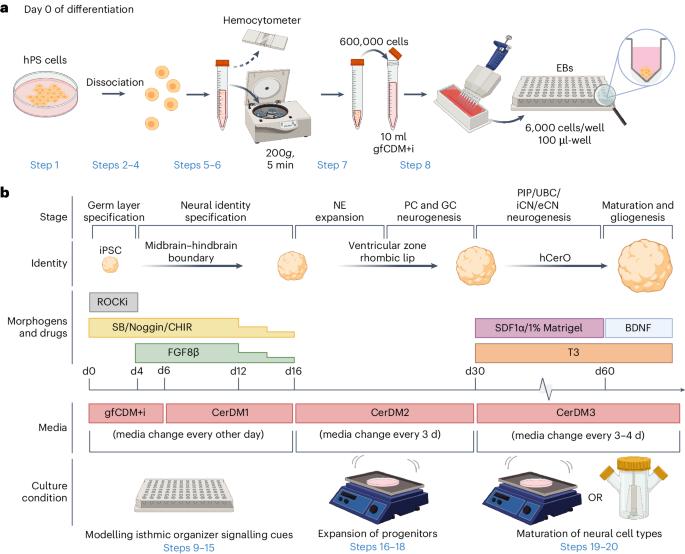
The advancement of research on human cerebellar development and diseases has been hindered by the lack of a cell-based system that mirrors the cellular diversity and functional characteristics of the human cerebellum. Here, we describe our protocol for a human pluripotent stem cell-derived human cerebellar organoid (hCerO) model, which successfully replicates the cellular diversity of the fetal cerebellum along with some of its distinct cytoarchitectural features. Our approach involves the patterning of human pluripotent stem cells, resulting in the generation of both cerebellar excitatory and inhibitory progenitor populations—specifically, the rhombic lip and ventricular zone progenitors, respectively. This patterning strategy leads to the reproducible differentiation of the major neurons of the cerebellum such as granule cells and Purkinje cells within just one month of culture. hCerOs serve as platforms for molecular, cellular and functional assays, including single-cell transcriptomics, immunohistochemistry and investigations into calcium dynamics and electrophysiological properties. Remarkably, the cultivation of hCerOs for up to 8 months enables the healthy survival and maturation of Purkinje cells, which exhibit molecular and electrophysiological features akin to their in vivo counterparts. Overall, our protocol generates and allows for the long-term culture of all major cell types within the cerebellum. Consequently, this significant advancement provides the developmental neurobiology field with a robust platform for exploring both cerebellar development and diseases within an all-human system. This protocol can be easily implemented by a technician with cell culture experience and takes 1–2 months to complete with an option for extended maturation over the course of several months. Generation and long-term culture of a human pluripotent stem cell-derived human cerebellar organoid model, which successfully replicates the cellular diversity of the fetal cerebellum along with some of its distinct cytoarchitectural features.
期刊介绍:
Nature Protocols focuses on publishing protocols used to address significant biological and biomedical science research questions, including methods grounded in physics and chemistry with practical applications to biological problems. The journal caters to a primary audience of research scientists and, as such, exclusively publishes protocols with research applications. Protocols primarily aimed at influencing patient management and treatment decisions are not featured.
The specific techniques covered encompass a wide range, including but not limited to: Biochemistry, Cell biology, Cell culture, Chemical modification, Computational biology, Developmental biology, Epigenomics, Genetic analysis, Genetic modification, Genomics, Imaging, Immunology, Isolation, purification, and separation, Lipidomics, Metabolomics, Microbiology, Model organisms, Nanotechnology, Neuroscience, Nucleic-acid-based molecular biology, Pharmacology, Plant biology, Protein analysis, Proteomics, Spectroscopy, Structural biology, Synthetic chemistry, Tissue culture, Toxicology, and Virology.




 京公网安备 11010802042870号
京ICP备2023020795号-1
京公网安备 11010802042870号
京ICP备2023020795号-1

 分享
分享
 求助内容:
求助内容: 应助结果提醒方式:
 扫码关注我们
