You Luo, Yang Zhang, Zuofu Tang, Jinhua Zhang, Ning Na, Hengjun Xiao
{"title":"The effect of intraoperative inosine infusion on transplant outcomes in deceased-donor kidney transplant recipients.","authors":"You Luo, Yang Zhang, Zuofu Tang, Jinhua Zhang, Ning Na, Hengjun Xiao","doi":"10.1080/0886022X.2024.2436629","DOIUrl":null,"url":null,"abstract":"<p><strong>Objectives: </strong>It is unknown when inosine was first employed as a renoprotective agent in the context of kidney transplantation procedures. However, there is no clinical evidence to support a protective role of inosine. The aim of this study was to investigate the effect of inosine on graft recovery.</p><p><strong>Patients and methods: </strong>Data related to donors and recipients were retrieved from relevant records between 2015 and 2023. A total of 1138 kidney transplant cases were identified, including 1005 recipients who received a bolus of 1000 mg inosine and 133 recipients who did not receive inosine during transplantation surgery. The endpoints of the analysis included recipient recovery after transplantation as assessed by delayed graft function (DGF), peak estimated glomerular filtration rate (eGFR) after transplantation, and unfavorable graft function recovery.</p><p><strong>Results: </strong>Given the high dimensionality of the donor and recipient variables, propensity score weighting analyses were conducted. No significant differences in the risk of DGF (OR = 0.80 [0.52, 1.22], <i>p</i> = 0.301), unfavorable graft function recovery (OR = 0.95 [0.61, 1.51], <i>p</i> = 0.842) or peak eGFR after transplantation (β = 1.61 [-4.33, 7.56], <i>p</i> = 0.594) were observed between the inosine and no-inosine groups <i>via</i> overlap weighting analysis.</p><p><strong>Conclusions: </strong>Intraoperative infusion of 1000 mg of inosine has no effect on graft recovery after kidney transplantation. Therefore, the practice of using inosine during kidney transplantation surgery is not supported by evidence.</p>","PeriodicalId":20839,"journal":{"name":"Renal Failure","volume":"46 2","pages":"2436629"},"PeriodicalIF":3.0000,"publicationDate":"2024-12-01","publicationTypes":"Journal Article","fieldsOfStudy":null,"isOpenAccess":false,"openAccessPdf":"https://www.ncbi.nlm.nih.gov/pmc/articles/PMC11616739/pdf/","citationCount":"0","resultStr":null,"platform":"Semanticscholar","paperid":null,"PeriodicalName":"Renal Failure","FirstCategoryId":"3","ListUrlMain":"https://doi.org/10.1080/0886022X.2024.2436629","RegionNum":3,"RegionCategory":"医学","ArticlePicture":[],"TitleCN":null,"AbstractTextCN":null,"PMCID":null,"EPubDate":"2024/12/3 0:00:00","PubModel":"Epub","JCR":"Q1","JCRName":"UROLOGY & NEPHROLOGY","Score":null,"Total":0}
引用次数: 0
Abstract
Objectives: It is unknown when inosine was first employed as a renoprotective agent in the context of kidney transplantation procedures. However, there is no clinical evidence to support a protective role of inosine. The aim of this study was to investigate the effect of inosine on graft recovery.
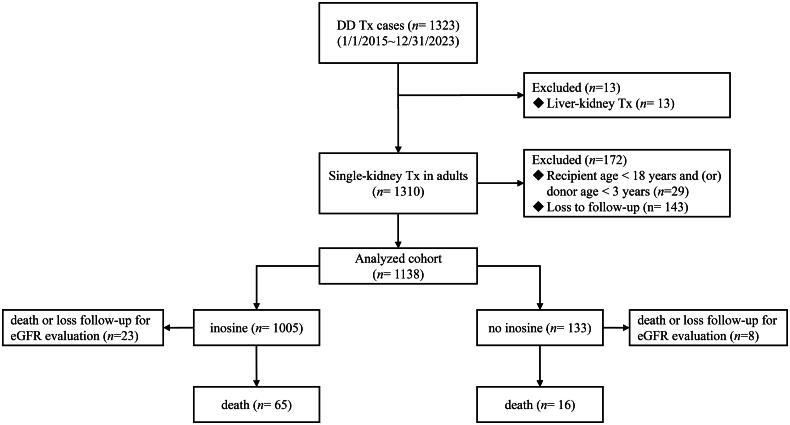
Patients and methods: Data related to donors and recipients were retrieved from relevant records between 2015 and 2023. A total of 1138 kidney transplant cases were identified, including 1005 recipients who received a bolus of 1000 mg inosine and 133 recipients who did not receive inosine during transplantation surgery. The endpoints of the analysis included recipient recovery after transplantation as assessed by delayed graft function (DGF), peak estimated glomerular filtration rate (eGFR) after transplantation, and unfavorable graft function recovery.
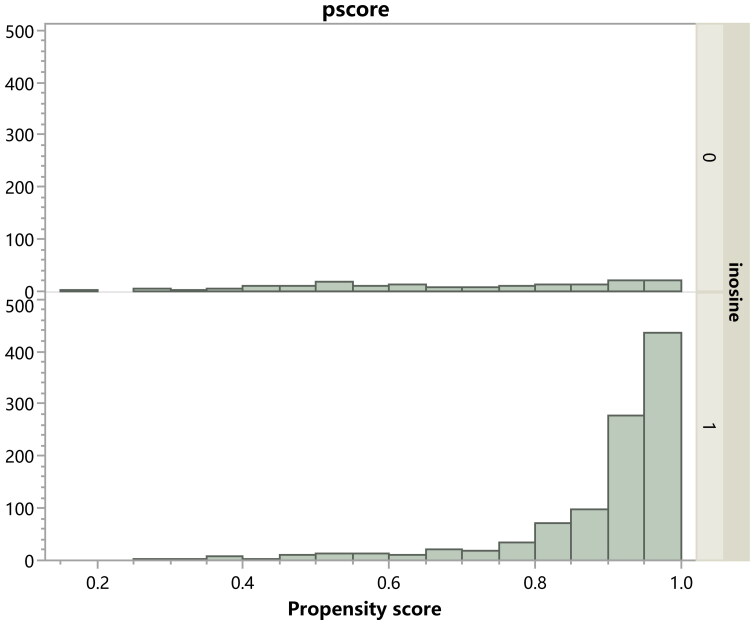
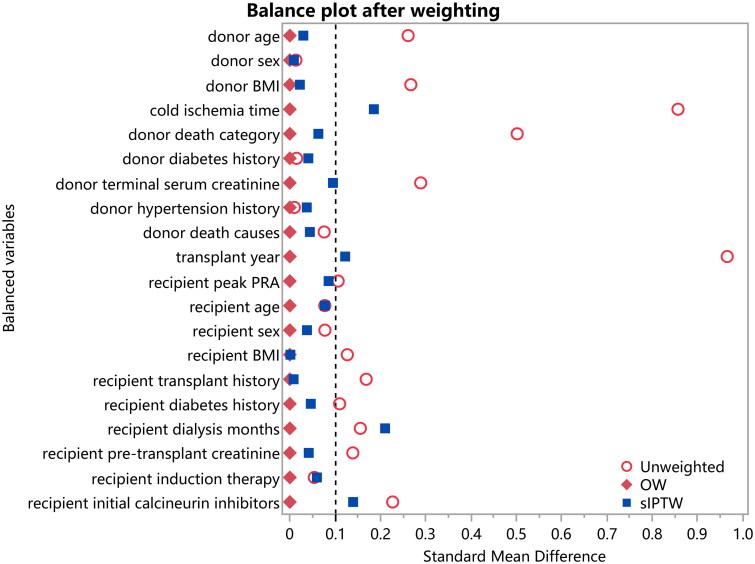
Results: Given the high dimensionality of the donor and recipient variables, propensity score weighting analyses were conducted. No significant differences in the risk of DGF (OR = 0.80 [0.52, 1.22], p = 0.301), unfavorable graft function recovery (OR = 0.95 [0.61, 1.51], p = 0.842) or peak eGFR after transplantation (β = 1.61 [-4.33, 7.56], p = 0.594) were observed between the inosine and no-inosine groups via overlap weighting analysis.
Conclusions: Intraoperative infusion of 1000 mg of inosine has no effect on graft recovery after kidney transplantation. Therefore, the practice of using inosine during kidney transplantation surgery is not supported by evidence.
期刊介绍:
Renal Failure primarily concentrates on acute renal injury and its consequence, but also addresses advances in the fields of chronic renal failure, hypertension, and renal transplantation. Bringing together both clinical and experimental aspects of renal failure, this publication presents timely, practical information on pathology and pathophysiology of acute renal failure; nephrotoxicity of drugs and other substances; prevention, treatment, and therapy of renal failure; renal failure in association with transplantation, hypertension, and diabetes mellitus.




 京公网安备 11010802042870号
京ICP备2023020795号-1
京公网安备 11010802042870号
京ICP备2023020795号-1

 分享
分享
 求助内容:
求助内容: 应助结果提醒方式:
 扫码关注我们
