{"title":"Healthcare professionals' knowledge and practices in managing ototoxicity in children with cancer.","authors":"Kajal Ramnarian, Jessica Paken","doi":"10.4102/sajcd.v71i1.1064","DOIUrl":null,"url":null,"abstract":"<p><strong>Background: </strong> Platinum-based chemotherapy poses a risk of ototoxic hearing loss, the effects of which can be devastating in paediatrics with cancer. Childhood hearing loss significantly impacts speech and language acquisition, and educational, psychosocial and emotional development, consequently negatively impacting quality of life. Adequate knowledge and effective management by healthcare professionals in the team managing paediatrics with cancer are, therefore, pivotal to mitigating the severity and impact on quality of life.</p><p><strong>Objectives: </strong> To describe the knowledge and practices of healthcare professionals on the management of ototoxic hearing loss in children receiving platinum-based chemotherapy drugs.</p><p><strong>Method: </strong> Using a descriptive survey design, data were collected from self-administered questionnaires completed by 74 healthcare professionals from two hospitals in KwaZulu-Natal, South Africa.</p><p><strong>Results: </strong> While 45 participants (60.8%) identified ototoxicity as a side effect of platinum-based chemotherapeutic drugs, 43 (58.1%) identified dose, duration and mode of administration as risk factors, and 43 participants (72.9%) did not know the duration of an ototoxicity monitoring programme post-treatment. Fifty participants (68%) accurately identified most of their roles within the ototoxicity monitoring programme. Most participants (n = 73; 99%) did not fully adhere to Health Professions Council of South Africa (HPCSA) ototoxicity monitoring guidelines. However, a positive outcome was that 70 participants (94.6%) acknowledged the importance of the ototoxicity monitoring programme for children receiving platinum-based chemotherapy.</p><p><strong>Conclusion: </strong> The current study demonstrates a clear correlation between healthcare professionals' practices and their level of knowledge. These findings underscore the importance of improving the knowledge base of healthcare professionals involved in ototoxicity monitoring programme to enhance their practices effectively.Contribution: This study identified areas requiring improvement in managing ototoxicity in this patient group, prompting the inclusion of ototoxicity training. This study supports audiologists in effectively implementing and overseeing ototoxicity monitoring programme.</p>","PeriodicalId":44003,"journal":{"name":"SOUTH AFRICAN JOURNAL OF COMMUNICATION DISORDERS","volume":"71 1","pages":"e1-e15"},"PeriodicalIF":1.4000,"publicationDate":"2024-11-25","publicationTypes":"Journal Article","fieldsOfStudy":null,"isOpenAccess":false,"openAccessPdf":"https://www.ncbi.nlm.nih.gov/pmc/articles/PMC11622129/pdf/","citationCount":"0","resultStr":null,"platform":"Semanticscholar","paperid":null,"PeriodicalName":"SOUTH AFRICAN JOURNAL OF COMMUNICATION DISORDERS","FirstCategoryId":"1085","ListUrlMain":"https://doi.org/10.4102/sajcd.v71i1.1064","RegionNum":0,"RegionCategory":null,"ArticlePicture":[],"TitleCN":null,"AbstractTextCN":null,"PMCID":null,"EPubDate":"","PubModel":"","JCR":"Q3","JCRName":"AUDIOLOGY & SPEECH-LANGUAGE PATHOLOGY","Score":null,"Total":0}
引用次数: 0
Abstract
Background: Platinum-based chemotherapy poses a risk of ototoxic hearing loss, the effects of which can be devastating in paediatrics with cancer. Childhood hearing loss significantly impacts speech and language acquisition, and educational, psychosocial and emotional development, consequently negatively impacting quality of life. Adequate knowledge and effective management by healthcare professionals in the team managing paediatrics with cancer are, therefore, pivotal to mitigating the severity and impact on quality of life.
Objectives: To describe the knowledge and practices of healthcare professionals on the management of ototoxic hearing loss in children receiving platinum-based chemotherapy drugs.
Method: Using a descriptive survey design, data were collected from self-administered questionnaires completed by 74 healthcare professionals from two hospitals in KwaZulu-Natal, South Africa.
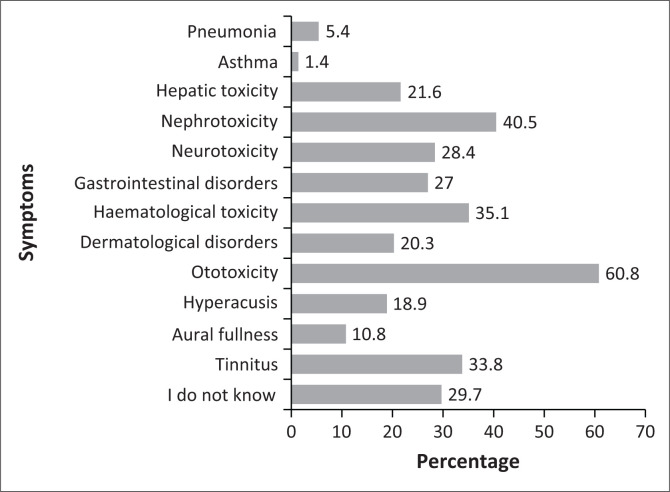
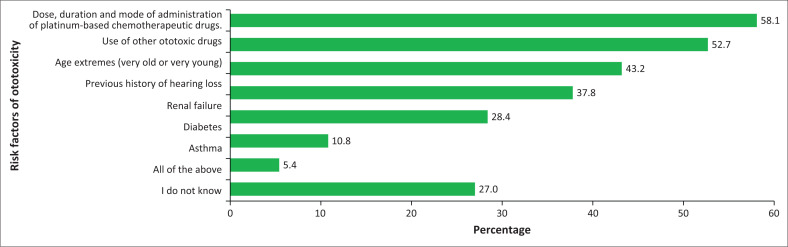
Results: While 45 participants (60.8%) identified ototoxicity as a side effect of platinum-based chemotherapeutic drugs, 43 (58.1%) identified dose, duration and mode of administration as risk factors, and 43 participants (72.9%) did not know the duration of an ototoxicity monitoring programme post-treatment. Fifty participants (68%) accurately identified most of their roles within the ototoxicity monitoring programme. Most participants (n = 73; 99%) did not fully adhere to Health Professions Council of South Africa (HPCSA) ototoxicity monitoring guidelines. However, a positive outcome was that 70 participants (94.6%) acknowledged the importance of the ototoxicity monitoring programme for children receiving platinum-based chemotherapy.
Conclusion: The current study demonstrates a clear correlation between healthcare professionals' practices and their level of knowledge. These findings underscore the importance of improving the knowledge base of healthcare professionals involved in ototoxicity monitoring programme to enhance their practices effectively.Contribution: This study identified areas requiring improvement in managing ototoxicity in this patient group, prompting the inclusion of ototoxicity training. This study supports audiologists in effectively implementing and overseeing ototoxicity monitoring programme.




 京公网安备 11010802042870号
京ICP备2023020795号-1
京公网安备 11010802042870号
京ICP备2023020795号-1

 分享
分享
 求助内容:
求助内容: 应助结果提醒方式:
 扫码关注我们
