The mediating effects of self-efficacy, family health, and perceived stress on the relationship between perceived social support and eHealth literacy in nursing students: a structural equation model.
Xinji Shi, Jiang Li, Xiaotong Ji, Yibo Wu, Shuang Zang
{"title":"The mediating effects of self-efficacy, family health, and perceived stress on the relationship between perceived social support and eHealth literacy in nursing students: a structural equation model.","authors":"Xinji Shi, Jiang Li, Xiaotong Ji, Yibo Wu, Shuang Zang","doi":"10.1186/s12912-024-02546-z","DOIUrl":null,"url":null,"abstract":"<p><strong>Background: </strong>This study aimed to explore the association between perceived social support and eHealth literacy in Chinese nursing students, with a particular emphasis on the mediating effects of self-efficacy, family health, and perceived stress within this relationship.</p><p><strong>Method: </strong>This study utilized data drawn from the 2023 Psychology and Behavior Investigation of Chinese Residents (PBICR) survey, which involved a sample of 967 nursing students. Structural equation modeling was utilized to examine the relationships among the study variables.</p><p><strong>Results: </strong>The mediating effect analysis revealed a negative direct relationship between perceived social support and eHealth literacy in Chinese nursing students (β = -0.149, p < 0.001). Both self-efficacy (β = 0.124, p < 0.05) and family health (β = 0.148, p < 0.05) acted as mediators in the association between perceived social support and eHealth literacy. Additionally, perceived social support positively affected eHealth literacy through a chain mediation of self-efficacy, perceived stress, and family health (β = 0.008, p < 0.05).</p><p><strong>Conclusion: </strong>This study provides valuable insights for developing strategies to enhance nursing students' eHealth literacy, ultimately contributing to their professional development and the quality of healthcare services they provide.</p>","PeriodicalId":48580,"journal":{"name":"BMC Nursing","volume":"23 1","pages":"868"},"PeriodicalIF":3.9000,"publicationDate":"2024-11-30","publicationTypes":"Journal Article","fieldsOfStudy":null,"isOpenAccess":false,"openAccessPdf":"https://www.ncbi.nlm.nih.gov/pmc/articles/PMC11607907/pdf/","citationCount":"0","resultStr":null,"platform":"Semanticscholar","paperid":null,"PeriodicalName":"BMC Nursing","FirstCategoryId":"3","ListUrlMain":"https://doi.org/10.1186/s12912-024-02546-z","RegionNum":2,"RegionCategory":"医学","ArticlePicture":[],"TitleCN":null,"AbstractTextCN":null,"PMCID":null,"EPubDate":"","PubModel":"","JCR":"Q1","JCRName":"NURSING","Score":null,"Total":0}
引用次数: 0
Abstract
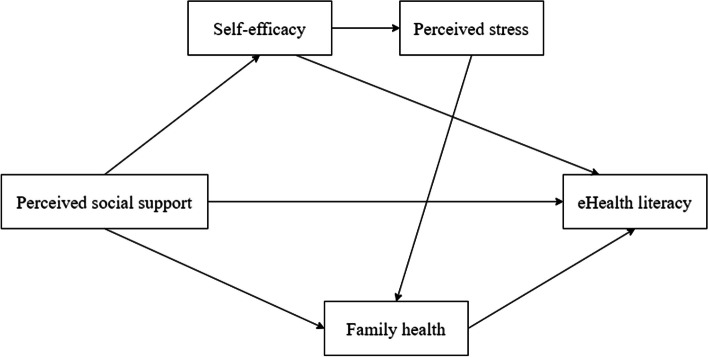
Background: This study aimed to explore the association between perceived social support and eHealth literacy in Chinese nursing students, with a particular emphasis on the mediating effects of self-efficacy, family health, and perceived stress within this relationship.
Method: This study utilized data drawn from the 2023 Psychology and Behavior Investigation of Chinese Residents (PBICR) survey, which involved a sample of 967 nursing students. Structural equation modeling was utilized to examine the relationships among the study variables.
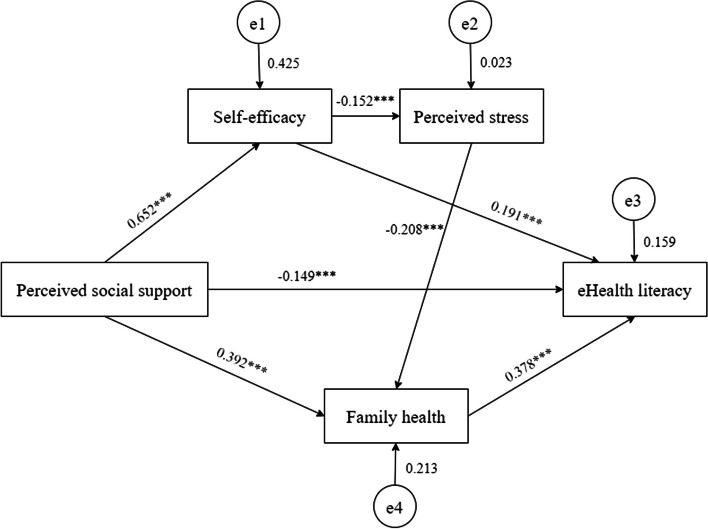
Results: The mediating effect analysis revealed a negative direct relationship between perceived social support and eHealth literacy in Chinese nursing students (β = -0.149, p < 0.001). Both self-efficacy (β = 0.124, p < 0.05) and family health (β = 0.148, p < 0.05) acted as mediators in the association between perceived social support and eHealth literacy. Additionally, perceived social support positively affected eHealth literacy through a chain mediation of self-efficacy, perceived stress, and family health (β = 0.008, p < 0.05).
Conclusion: This study provides valuable insights for developing strategies to enhance nursing students' eHealth literacy, ultimately contributing to their professional development and the quality of healthcare services they provide.
期刊介绍:
BMC Nursing is an open access, peer-reviewed journal that considers articles on all aspects of nursing research, training, education and practice.



 京公网安备 11010802042870号
京ICP备2023020795号-1
京公网安备 11010802042870号
京ICP备2023020795号-1

 分享
分享
 求助内容:
求助内容: 应助结果提醒方式:
 扫码关注我们
