Adeola Bamgboje-Ayodele, Meredith Makeham, Diane Kancijanic, Nicki Newton, Kavisha Shah, Miranda Shaw, Adam Johnston, Fiona Robinson, Owen Hutchings, Sarah Norris, Jagdev Singh, Melissa Baysari, Clara K Chow, Tim Shaw, Liliana Laranjo
{"title":"How primary and tertiary care services collaborate in urgent care delivery: an evaluation of general practice advice lines.","authors":"Adeola Bamgboje-Ayodele, Meredith Makeham, Diane Kancijanic, Nicki Newton, Kavisha Shah, Miranda Shaw, Adam Johnston, Fiona Robinson, Owen Hutchings, Sarah Norris, Jagdev Singh, Melissa Baysari, Clara K Chow, Tim Shaw, Liliana Laranjo","doi":"10.1186/s12875-024-02649-1","DOIUrl":null,"url":null,"abstract":"<p><strong>Background: </strong>To address the rising demand for urgent care and decrease hospital use, health systems are implementing different strategies to support urgent care patients (i.e. patients who would have typically been treated in hospital) in the community, such as general practitioner (GP) advice lines. The aims of this study were to: identify the support and resources GPs need to manage urgent care patients in the community; assess the need for GP advice lines by primary care services in Australia; and identify the facilitators and barriers to adoption, and strategies to support the sustainability of GP advice lines.</p><p><strong>Methods: </strong>Qualitative study involving semi-structured interviews with GPs, hospital-based healthcare providers, consumers, and healthcare management, recruited via existing investigator networks and snowballing approach. The interviews were conducted between February and August 2023. Major themes were identified by an iterative and inductive thematic analysis.</p><p><strong>Results: </strong>We interviewed 16 participants (median age 50, IQR 38-59). Based on the aims of the study, three themes emerged: support and resources for GPs; motivation for GP advice lines; and factors influencing the uptake and sustainability of GP advice lines. Participants reported that better communication from hospital services with GPs is critical to ensure continuity of care between tertiary and primary settings. They also noted that GP advice lines can help increase capacity to manage urgent care patients in the community by providing timely decision-support to GPs. However, a reported barrier to the uptake and ongoing use of GP advice lines was the limited hours of the service. To sustain GP advice lines, participants highlighted a need to broaden the scope of the service beyond the pandemic, conduct rigorous evaluation on health outcomes, and further digitise the service so that a tiered level of support could be provided based on risk stratification.</p><p><strong>Conclusions: </strong>The benefits of GP advice lines are yet to be fully realised. With increasing technology sophistication, there remain opportunities to further digitise and optimise GP advice lines, whilst ensuring better integration within and across primary and tertiary care services. This is however dependent on continued financial and policy support from the government.</p>","PeriodicalId":72428,"journal":{"name":"BMC primary care","volume":"25 1","pages":"406"},"PeriodicalIF":2.6000,"publicationDate":"2024-12-02","publicationTypes":"Journal Article","fieldsOfStudy":null,"isOpenAccess":false,"openAccessPdf":"https://www.ncbi.nlm.nih.gov/pmc/articles/PMC11610272/pdf/","citationCount":"0","resultStr":null,"platform":"Semanticscholar","paperid":null,"PeriodicalName":"BMC primary care","FirstCategoryId":"1085","ListUrlMain":"https://doi.org/10.1186/s12875-024-02649-1","RegionNum":0,"RegionCategory":null,"ArticlePicture":[],"TitleCN":null,"AbstractTextCN":null,"PMCID":null,"EPubDate":"","PubModel":"","JCR":"Q2","JCRName":"MEDICINE, GENERAL & INTERNAL","Score":null,"Total":0}
引用次数: 0
Abstract
Background: To address the rising demand for urgent care and decrease hospital use, health systems are implementing different strategies to support urgent care patients (i.e. patients who would have typically been treated in hospital) in the community, such as general practitioner (GP) advice lines. The aims of this study were to: identify the support and resources GPs need to manage urgent care patients in the community; assess the need for GP advice lines by primary care services in Australia; and identify the facilitators and barriers to adoption, and strategies to support the sustainability of GP advice lines.
Methods: Qualitative study involving semi-structured interviews with GPs, hospital-based healthcare providers, consumers, and healthcare management, recruited via existing investigator networks and snowballing approach. The interviews were conducted between February and August 2023. Major themes were identified by an iterative and inductive thematic analysis.
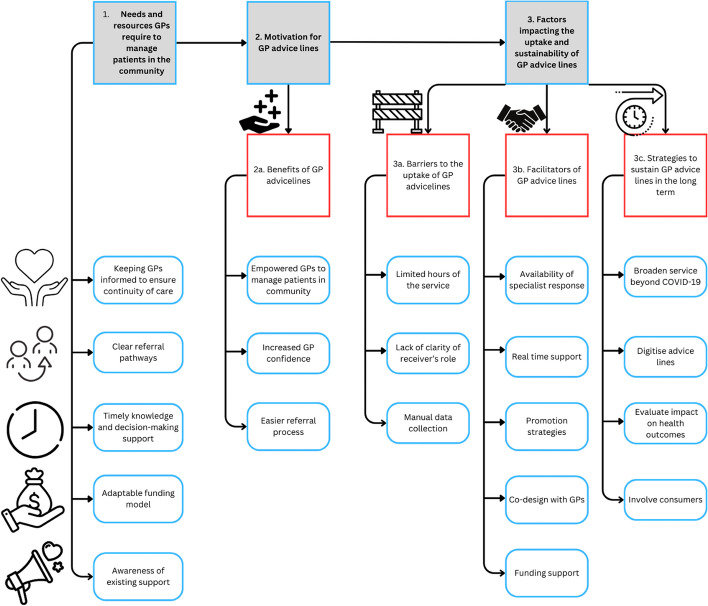
Results: We interviewed 16 participants (median age 50, IQR 38-59). Based on the aims of the study, three themes emerged: support and resources for GPs; motivation for GP advice lines; and factors influencing the uptake and sustainability of GP advice lines. Participants reported that better communication from hospital services with GPs is critical to ensure continuity of care between tertiary and primary settings. They also noted that GP advice lines can help increase capacity to manage urgent care patients in the community by providing timely decision-support to GPs. However, a reported barrier to the uptake and ongoing use of GP advice lines was the limited hours of the service. To sustain GP advice lines, participants highlighted a need to broaden the scope of the service beyond the pandemic, conduct rigorous evaluation on health outcomes, and further digitise the service so that a tiered level of support could be provided based on risk stratification.
Conclusions: The benefits of GP advice lines are yet to be fully realised. With increasing technology sophistication, there remain opportunities to further digitise and optimise GP advice lines, whilst ensuring better integration within and across primary and tertiary care services. This is however dependent on continued financial and policy support from the government.



 京公网安备 11010802042870号
京ICP备2023020795号-1
京公网安备 11010802042870号
京ICP备2023020795号-1

 分享
分享

 求助内容:
求助内容: 应助结果提醒方式:
 扫码关注我们
