{"title":"Gastrointestinal: Biliary Obstruction From Hepatic Artery Aneurysms: Implications for Treatment Selection","authors":"Derek Ngan-Wa Wong, Rex Wan-Hin Hui, Lung-Yi Mak, Wai-Kay Seto, Man-Fung Yuen","doi":"10.1111/jgh.16841","DOIUrl":null,"url":null,"abstract":"<p>A 58-year-old man presented in March 2021 with obstructive jaundice (bilirubin 65 μmol/L, ALP 578 U/L, ALT 529 U/L, AST 263 U/L, GGT 1283 U/L). Contrast CT revealed common and bilateral hepatic artery aneurysms with mass effect on the distal common bile duct (CBD). Endoscopic retrograde cholangiopancreatography (ERCP) identified a CBD stricture from extrinsic compression, and a 7 Fr–7 cm CBD stent was inserted.</p><p>Vascular reconstruction was planned, and ERCP was repeated in May 2021 for stent exchange while pending surgery. The patient developed hemobilia after ERCP, and CT noted active contrast extravasation into the duodenum (Figure 1), suggesting vascular injury with aneurysmal bleeding. Urgent coiling of the common hepatic artery aneurysm was performed with satisfactory hemostasis achieved. The patient had no further bleeding or biliary obstruction after vascular coiling and was managed as an outpatient up till April 2024.</p><p>The patient was admitted again in April 2024 with cholangitis, and CT showed hepatic artery coils adjacent to a dilated CBD. Due to history of vascular injury from ERCP, external–internal percutaneous transhepatic biliary-drainage (PTBD) was first performed, which was successful with no post-procedural bleeding (Figure 2). ERCP was performed 3 weeks later with an 11.5 Fr–7 cm straight-stent inserted, enabling subsequent removal of the PTBD catheter. The patient has since remained asymptomatic with normalized liver enzymes.</p><p>Hepatic artery aneurysms account for 20% of visceral artery aneurysms. Most patients either present with incidental finding of aneurysms on imaging or with ruptured aneurysms [<span>1</span>]. While uncommon, hepatic artery aneurysms can cause biliary obstruction. Multiple treatment approaches including endovascular, endoscopic, and open surgical techniques can be adopted [<span>2</span>]; hence, multidisciplinary care and careful treatment selection is essential to achieve biliary drainage while avoiding iatrogenic vascular injury.</p>","PeriodicalId":15877,"journal":{"name":"Journal of Gastroenterology and Hepatology","volume":"40 3","pages":"557-558"},"PeriodicalIF":3.4000,"publicationDate":"2024-12-04","publicationTypes":"Journal Article","fieldsOfStudy":null,"isOpenAccess":false,"openAccessPdf":"https://onlinelibrary.wiley.com/doi/epdf/10.1111/jgh.16841","citationCount":"0","resultStr":null,"platform":"Semanticscholar","paperid":null,"PeriodicalName":"Journal of Gastroenterology and Hepatology","FirstCategoryId":"3","ListUrlMain":"https://onlinelibrary.wiley.com/doi/10.1111/jgh.16841","RegionNum":3,"RegionCategory":"医学","ArticlePicture":[],"TitleCN":null,"AbstractTextCN":null,"PMCID":null,"EPubDate":"","PubModel":"","JCR":"Q2","JCRName":"GASTROENTEROLOGY & HEPATOLOGY","Score":null,"Total":0}
引用次数: 0
Abstract
A 58-year-old man presented in March 2021 with obstructive jaundice (bilirubin 65 μmol/L, ALP 578 U/L, ALT 529 U/L, AST 263 U/L, GGT 1283 U/L). Contrast CT revealed common and bilateral hepatic artery aneurysms with mass effect on the distal common bile duct (CBD). Endoscopic retrograde cholangiopancreatography (ERCP) identified a CBD stricture from extrinsic compression, and a 7 Fr–7 cm CBD stent was inserted.
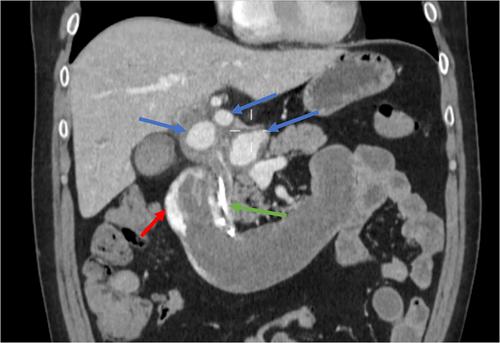
Vascular reconstruction was planned, and ERCP was repeated in May 2021 for stent exchange while pending surgery. The patient developed hemobilia after ERCP, and CT noted active contrast extravasation into the duodenum (Figure 1), suggesting vascular injury with aneurysmal bleeding. Urgent coiling of the common hepatic artery aneurysm was performed with satisfactory hemostasis achieved. The patient had no further bleeding or biliary obstruction after vascular coiling and was managed as an outpatient up till April 2024.
The patient was admitted again in April 2024 with cholangitis, and CT showed hepatic artery coils adjacent to a dilated CBD. Due to history of vascular injury from ERCP, external–internal percutaneous transhepatic biliary-drainage (PTBD) was first performed, which was successful with no post-procedural bleeding (Figure 2). ERCP was performed 3 weeks later with an 11.5 Fr–7 cm straight-stent inserted, enabling subsequent removal of the PTBD catheter. The patient has since remained asymptomatic with normalized liver enzymes.
Hepatic artery aneurysms account for 20% of visceral artery aneurysms. Most patients either present with incidental finding of aneurysms on imaging or with ruptured aneurysms [1]. While uncommon, hepatic artery aneurysms can cause biliary obstruction. Multiple treatment approaches including endovascular, endoscopic, and open surgical techniques can be adopted [2]; hence, multidisciplinary care and careful treatment selection is essential to achieve biliary drainage while avoiding iatrogenic vascular injury.
期刊介绍:
Journal of Gastroenterology and Hepatology is produced 12 times per year and publishes peer-reviewed original papers, reviews and editorials concerned with clinical practice and research in the fields of hepatology, gastroenterology and endoscopy. Papers cover the medical, radiological, pathological, biochemical, physiological and historical aspects of the subject areas. All submitted papers are reviewed by at least two referees expert in the field of the submitted paper.




 京公网安备 11010802042870号
京ICP备2023020795号-1
京公网安备 11010802042870号
京ICP备2023020795号-1

 分享
分享
 求助内容:
求助内容: 应助结果提醒方式:
 扫码关注我们
