{"title":"Systemic Inflammatory Indices as New Biomarkers for Hemodynamically Significant Ductus Arteriosus.","authors":"Ufuk Cakir, Cuneyt Tayman","doi":"10.36660/abc.20240211","DOIUrl":null,"url":null,"abstract":"<p><strong>Background: </strong>Increased oxygen tension and decreased prostaglandin levels cause ductal closure. The diagnostic role of systemic inflammatory indices in hemodynamically significant ductus arteriosus (hsPDA) in premature infants is unknown.</p><p><strong>Objectives: </strong>We aimed to evaluate the role of systemic inflammatory indices in the predictivity of hsPDA.</p><p><strong>Methods: </strong>Premature infants with gestational weeks (GW) of <32 weeks were evaluated retrospectively. Systemic inflammatory indices neutrophil-lymphocyte ratio (NLR), monocyte-lymphocyte ratio (MLR), platelet-lymphocyte ratio (PLR), systemic immune-inflammation index (SII), pan-immune- inflammation value (PIV), and systemic inflammation response index (SIRI) were calculated. Systemic inflammatory indices were compared between hsPDA and non-hsPDA groups. A p <0.05 was considered as statistically significant.</p><p><strong>Results: </strong>A total of 1228 patients were included in the study, including 447 patients in the hsPDA group and 781 patients in the non-hsPDA group. The PIV value [median (Q1 - Q3): 5.18 (2.38-10.42)] in the hsPDA group was statistically significantly higher than the PIV value [median (Q1 - Q3): 3.52 (1.41-6.45)] in the non-hsPDA group (p<0.001). According to the ROC analysis, the AUC value of PIV for the predictivity of hsPDA was 0.618, and the cutoff level was >8.66. After even multiple logistic regression analyses, PIV was shown to be a significant parameter for the diagnosis of hsPDA (OR 1.972, 95% CI 1.114-3.011. p=0.001).</p><p><strong>Conclusions: </strong>A high PIV value may be a quickly used indicator with low-cost, simple, and easily accessible for the early diagnosis of hsPDA.</p>","PeriodicalId":93887,"journal":{"name":"Arquivos brasileiros de cardiologia","volume":"121 11","pages":"e20240211"},"PeriodicalIF":1.9000,"publicationDate":"2024-11-01","publicationTypes":"Journal Article","fieldsOfStudy":null,"isOpenAccess":false,"openAccessPdf":"https://www.ncbi.nlm.nih.gov/pmc/articles/PMC11634317/pdf/","citationCount":"0","resultStr":null,"platform":"Semanticscholar","paperid":null,"PeriodicalName":"Arquivos brasileiros de cardiologia","FirstCategoryId":"1085","ListUrlMain":"https://doi.org/10.36660/abc.20240211","RegionNum":0,"RegionCategory":null,"ArticlePicture":[],"TitleCN":null,"AbstractTextCN":null,"PMCID":null,"EPubDate":"","PubModel":"","JCR":"","JCRName":"","Score":null,"Total":0}
引用次数: 0
Abstract
Background: Increased oxygen tension and decreased prostaglandin levels cause ductal closure. The diagnostic role of systemic inflammatory indices in hemodynamically significant ductus arteriosus (hsPDA) in premature infants is unknown.
Objectives: We aimed to evaluate the role of systemic inflammatory indices in the predictivity of hsPDA.
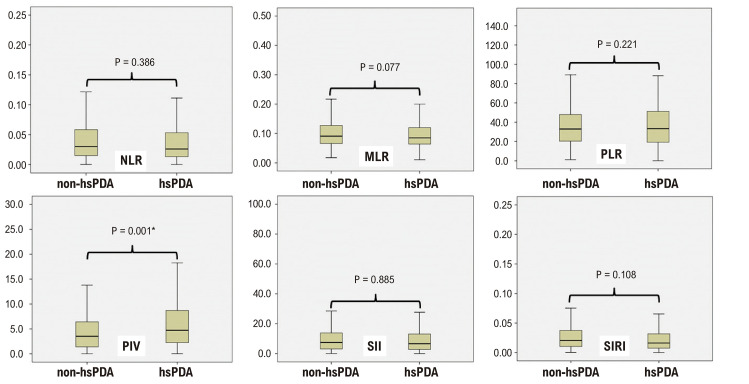
Methods: Premature infants with gestational weeks (GW) of <32 weeks were evaluated retrospectively. Systemic inflammatory indices neutrophil-lymphocyte ratio (NLR), monocyte-lymphocyte ratio (MLR), platelet-lymphocyte ratio (PLR), systemic immune-inflammation index (SII), pan-immune- inflammation value (PIV), and systemic inflammation response index (SIRI) were calculated. Systemic inflammatory indices were compared between hsPDA and non-hsPDA groups. A p <0.05 was considered as statistically significant.
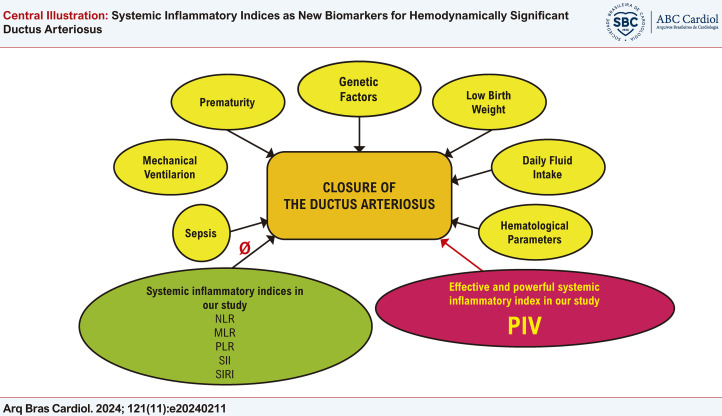
Results: A total of 1228 patients were included in the study, including 447 patients in the hsPDA group and 781 patients in the non-hsPDA group. The PIV value [median (Q1 - Q3): 5.18 (2.38-10.42)] in the hsPDA group was statistically significantly higher than the PIV value [median (Q1 - Q3): 3.52 (1.41-6.45)] in the non-hsPDA group (p<0.001). According to the ROC analysis, the AUC value of PIV for the predictivity of hsPDA was 0.618, and the cutoff level was >8.66. After even multiple logistic regression analyses, PIV was shown to be a significant parameter for the diagnosis of hsPDA (OR 1.972, 95% CI 1.114-3.011. p=0.001).
Conclusions: A high PIV value may be a quickly used indicator with low-cost, simple, and easily accessible for the early diagnosis of hsPDA.





 京公网安备 11010802042870号
京ICP备2023020795号-1
京公网安备 11010802042870号
京ICP备2023020795号-1

 分享
分享

 求助内容:
求助内容: 应助结果提醒方式:
 扫码关注我们
