Wisnu Baskoro, Muhammad Fakhri Raiyan Pratama, Early Isnaeni Nur Fauziah, Hanan Anwar Rusidi, Bidari Kameswari
{"title":"L5 giant cell tumor in 28-year-old female.","authors":"Wisnu Baskoro, Muhammad Fakhri Raiyan Pratama, Early Isnaeni Nur Fauziah, Hanan Anwar Rusidi, Bidari Kameswari","doi":"10.25259/SNI_533_2024","DOIUrl":null,"url":null,"abstract":"<p><strong>Background: </strong>Giant cell tumor of bone (GCTB) is a rare benign tumor that may also exhibit aggressive local behavior. Recurrence of GCTB is common even after complete resection. GCTB typically occurs in long bones, and only 2.7% are found in the spine. Here, a 28-year-old female with a magnetic resonance (MR)-documented L5 lumbar spine GCTB presented with a cauda equina syndrome effectively managed with a decompressive laminectomy/L4-S1 fusion.</p><p><strong>Case description: </strong>A 28-year-old female presented with a 1-year history of lower extremity pain/paresthesia that had exacerbated over the previous 1 month. When the MR imaging revealed cauda equina compression due to a L5 hypodense lesion, the patient successfully underwent a decompressive laminectomy/L4-S1 fusion. The histopathology examination confirmed the presence of a GCTB.</p><p><strong>Conclusion: </strong>While gross total excision for GCTB is the treatment of choice, for those undergoing only subtotal/partial resections, additional adjuvant therapy may be warranted. Notably, even despite extensive resections, these lesions have a high rate of recurrence.</p>","PeriodicalId":94217,"journal":{"name":"Surgical neurology international","volume":"15 ","pages":"436"},"PeriodicalIF":0.0000,"publicationDate":"2024-11-29","publicationTypes":"Journal Article","fieldsOfStudy":null,"isOpenAccess":false,"openAccessPdf":"https://www.ncbi.nlm.nih.gov/pmc/articles/PMC11618681/pdf/","citationCount":"0","resultStr":null,"platform":"Semanticscholar","paperid":null,"PeriodicalName":"Surgical neurology international","FirstCategoryId":"1085","ListUrlMain":"https://doi.org/10.25259/SNI_533_2024","RegionNum":0,"RegionCategory":null,"ArticlePicture":[],"TitleCN":null,"AbstractTextCN":null,"PMCID":null,"EPubDate":"2024/1/1 0:00:00","PubModel":"eCollection","JCR":"","JCRName":"","Score":null,"Total":0}
引用次数: 0
Abstract
Background: Giant cell tumor of bone (GCTB) is a rare benign tumor that may also exhibit aggressive local behavior. Recurrence of GCTB is common even after complete resection. GCTB typically occurs in long bones, and only 2.7% are found in the spine. Here, a 28-year-old female with a magnetic resonance (MR)-documented L5 lumbar spine GCTB presented with a cauda equina syndrome effectively managed with a decompressive laminectomy/L4-S1 fusion.
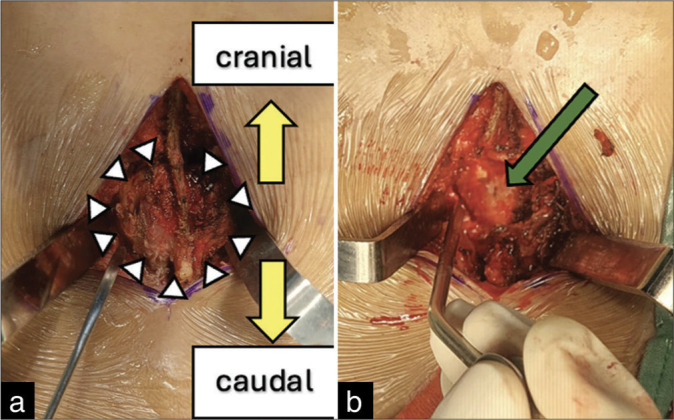
Case description: A 28-year-old female presented with a 1-year history of lower extremity pain/paresthesia that had exacerbated over the previous 1 month. When the MR imaging revealed cauda equina compression due to a L5 hypodense lesion, the patient successfully underwent a decompressive laminectomy/L4-S1 fusion. The histopathology examination confirmed the presence of a GCTB.
Conclusion: While gross total excision for GCTB is the treatment of choice, for those undergoing only subtotal/partial resections, additional adjuvant therapy may be warranted. Notably, even despite extensive resections, these lesions have a high rate of recurrence.






 京公网安备 11010802042870号
京ICP备2023020795号-1
京公网安备 11010802042870号
京ICP备2023020795号-1

 分享
分享

 求助内容:
求助内容: 应助结果提醒方式:
 扫码关注我们
