{"title":"Betaine and aging: A narrative review of findings, possible mechanisms, research perspectives, and practical recommendations","authors":"Emilia Zawieja, Agata Chmurzynska","doi":"10.1016/j.arr.2024.102634","DOIUrl":null,"url":null,"abstract":"<div><div>The rapid aging of the global population necessitates addressing age-related conditions through innovative strategies. Nutritional supplements have emerged as potential interventions for preventing or slowing age-related changes, with betaine being a promising candidate. This systematic review aims to provide a comprehensive analysis of current literature on the impact of betaine on the aging process. Specifically, we summarize the mechanisms through which betaine is proposed to affect aging, we integrate existing findings, we identify gaps in the literature, and we discuss practical implications for promoting healthy aging. Evidence suggests that betaine may counteract aging-related changes in methylation potential by increasing concentration of S-adenosylmethionine, a key methyl donor. Additionally, betaine reduces homocysteine concentrations, potentially mitigating vascular, neurodegenerative, and oxidative damage. Betaine has also been shown to enhance mitochondrial function, to reduce oxidative stress, and to attenuate inflammation. It may serve as a preventive agent against sarcopenia by promoting anabolic signaling pathways and improving muscle strength in younger adults. Betaine may also exert an effect on bone remodeling and adipose tissue metabolism, with animal studies indicating enhanced fat oxidation and reduced fat synthesis. Although certain limited studies have suggested betaine’s potential in mitigating age-related neurodegenerative diseases, the currently available evidence does not establish a clear link between dietary betaine intake and the incidence of cardiovascular diseases or type-2 diabetes. In conclusion, emerging evidence highlights the potential of betaine in attenuating age-related changes. However, further research is required to elucidate the efficacy and safety of betaine supplementation in older populations.</div></div>","PeriodicalId":55545,"journal":{"name":"Ageing Research Reviews","volume":"104 ","pages":"Article 102634"},"PeriodicalIF":12.4000,"publicationDate":"2025-02-01","publicationTypes":"Journal Article","fieldsOfStudy":null,"isOpenAccess":false,"openAccessPdf":"","citationCount":"0","resultStr":null,"platform":"Semanticscholar","paperid":null,"PeriodicalName":"Ageing Research Reviews","FirstCategoryId":"3","ListUrlMain":"https://www.sciencedirect.com/science/article/pii/S1568163724004525","RegionNum":1,"RegionCategory":"医学","ArticlePicture":[],"TitleCN":null,"AbstractTextCN":null,"PMCID":null,"EPubDate":"2024/12/6 0:00:00","PubModel":"Epub","JCR":"Q1","JCRName":"CELL BIOLOGY","Score":null,"Total":0}
引用次数: 0
Abstract
The rapid aging of the global population necessitates addressing age-related conditions through innovative strategies. Nutritional supplements have emerged as potential interventions for preventing or slowing age-related changes, with betaine being a promising candidate. This systematic review aims to provide a comprehensive analysis of current literature on the impact of betaine on the aging process. Specifically, we summarize the mechanisms through which betaine is proposed to affect aging, we integrate existing findings, we identify gaps in the literature, and we discuss practical implications for promoting healthy aging. Evidence suggests that betaine may counteract aging-related changes in methylation potential by increasing concentration of S-adenosylmethionine, a key methyl donor. Additionally, betaine reduces homocysteine concentrations, potentially mitigating vascular, neurodegenerative, and oxidative damage. Betaine has also been shown to enhance mitochondrial function, to reduce oxidative stress, and to attenuate inflammation. It may serve as a preventive agent against sarcopenia by promoting anabolic signaling pathways and improving muscle strength in younger adults. Betaine may also exert an effect on bone remodeling and adipose tissue metabolism, with animal studies indicating enhanced fat oxidation and reduced fat synthesis. Although certain limited studies have suggested betaine’s potential in mitigating age-related neurodegenerative diseases, the currently available evidence does not establish a clear link between dietary betaine intake and the incidence of cardiovascular diseases or type-2 diabetes. In conclusion, emerging evidence highlights the potential of betaine in attenuating age-related changes. However, further research is required to elucidate the efficacy and safety of betaine supplementation in older populations.
期刊介绍:
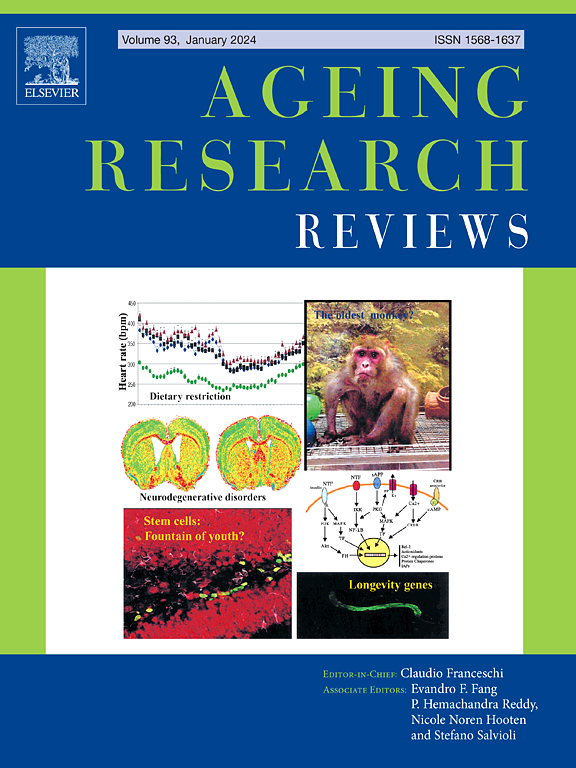
With the rise in average human life expectancy, the impact of ageing and age-related diseases on our society has become increasingly significant. Ageing research is now a focal point for numerous laboratories, encompassing leaders in genetics, molecular and cellular biology, biochemistry, and behavior. Ageing Research Reviews (ARR) serves as a cornerstone in this field, addressing emerging trends.
ARR aims to fill a substantial gap by providing critical reviews and viewpoints on evolving discoveries concerning the mechanisms of ageing and age-related diseases. The rapid progress in understanding the mechanisms controlling cellular proliferation, differentiation, and survival is unveiling new insights into the regulation of ageing. From telomerase to stem cells, and from energy to oxyradical metabolism, we are witnessing an exciting era in the multidisciplinary field of ageing research.
The journal explores the cellular and molecular foundations of interventions that extend lifespan, such as caloric restriction. It identifies the underpinnings of manipulations that extend lifespan, shedding light on novel approaches for preventing age-related diseases. ARR publishes articles on focused topics selected from the expansive field of ageing research, with a particular emphasis on the cellular and molecular mechanisms of the aging process. This includes age-related diseases like cancer, cardiovascular disease, diabetes, and neurodegenerative disorders. The journal also covers applications of basic ageing research to lifespan extension and disease prevention, offering a comprehensive platform for advancing our understanding of this critical field.



 京公网安备 11010802042870号
京ICP备2023020795号-1
京公网安备 11010802042870号
京ICP备2023020795号-1

 分享
分享
 求助内容:
求助内容: 应助结果提醒方式:
 扫码关注我们
