{"title":"Stabilizing *CO intermediate on nitrogen-doped carbon-coated CuxOy derived from metal–organic framework for enhanced electrochemical CO2-to-ethylene†","authors":"Na Zhang and Yunlong Zhang","doi":"10.1039/D4TA06722C","DOIUrl":null,"url":null,"abstract":"<p >The electrochemical CO<small><sub>2</sub></small> reduction reaction (CO<small><sub>2</sub></small>RR) provides a means for producing ethylene, but its selectivity and stability still need further improvement. Therefore, the development of high-performance electrocatalysts is particularly important. Here, we designed a catalyst Cu<small><sub><em>x</em></sub></small>O<small><sub><em>y</em></sub></small>/CN with a nitrogen-doped carbon (CN) coating, which was prepared by pyrolysis of a nitrogen-containing Cu-based MOF with high porosity, using it as a sacrificial template. For the CO<small><sub>2</sub></small>RR, the Cu<small><sub><em>x</em></sub></small>O<small><sub><em>y</em></sub></small>/CN catalyst demonstrates very good ethylene selectivity, achieving a faradaic efficiency (FE) of 44% at a current density of 500 mA cm<small><sup>−2</sup></small>. Impressively, the Cu<small><sub><em>x</em></sub></small>O<small><sub><em>y</em></sub></small>/CN catalyst has a higher partial current density for ethylene in the CO<small><sub>2</sub></small>RR process, reaching about 220 mA cm<small><sup>−2</sup></small>, compared with other catalysts recorded in the literature. After the CO<small><sub>2</sub></small>RR, the Cu<small><sub><em>x</em></sub></small>O<small><sub><em>y</em></sub></small>/CN catalyst exposed the Cu(100) facet and the Cu<small><sup>+</sup></small>/Cu<small><sup>0</sup></small> interface, which favored the generation of ethylene. <em>Operando</em> Raman spectroscopy indicates that the CN coating efficiently stabilizes Cu<small><sup>+</sup></small> species under CO<small><sub>2</sub></small> electroreduction conditions. Density functional theory (DFT) calculations demonstrate that the CN coating stabilizes *CO intermediates. The CN-coated Cu<small><sup>+</sup></small>/Cu<small><sup>0</sup></small> interface sites on the Cu<small><sub><em>x</em></sub></small>O<small><sub><em>y</em></sub></small>/CN catalyst enhance *CO adsorption, increase *CO coverage, promote C–C coupling, and thus improve ethylene selectivity and stability.</p>","PeriodicalId":82,"journal":{"name":"Journal of Materials Chemistry A","volume":" 4","pages":" 2902-2910"},"PeriodicalIF":9.5000,"publicationDate":"2024-12-10","publicationTypes":"Journal Article","fieldsOfStudy":null,"isOpenAccess":false,"openAccessPdf":"","citationCount":"0","resultStr":null,"platform":"Semanticscholar","paperid":null,"PeriodicalName":"Journal of Materials Chemistry A","FirstCategoryId":"88","ListUrlMain":"https://pubs.rsc.org/en/content/articlelanding/2025/ta/d4ta06722c","RegionNum":2,"RegionCategory":"材料科学","ArticlePicture":[],"TitleCN":null,"AbstractTextCN":null,"PMCID":null,"EPubDate":"","PubModel":"","JCR":"Q1","JCRName":"CHEMISTRY, PHYSICAL","Score":null,"Total":0}
引用次数: 0
Abstract
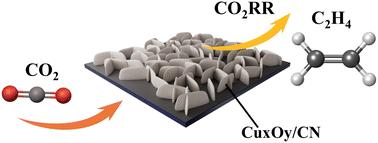
The electrochemical CO2 reduction reaction (CO2RR) provides a means for producing ethylene, but its selectivity and stability still need further improvement. Therefore, the development of high-performance electrocatalysts is particularly important. Here, we designed a catalyst CuxOy/CN with a nitrogen-doped carbon (CN) coating, which was prepared by pyrolysis of a nitrogen-containing Cu-based MOF with high porosity, using it as a sacrificial template. For the CO2RR, the CuxOy/CN catalyst demonstrates very good ethylene selectivity, achieving a faradaic efficiency (FE) of 44% at a current density of 500 mA cm−2. Impressively, the CuxOy/CN catalyst has a higher partial current density for ethylene in the CO2RR process, reaching about 220 mA cm−2, compared with other catalysts recorded in the literature. After the CO2RR, the CuxOy/CN catalyst exposed the Cu(100) facet and the Cu+/Cu0 interface, which favored the generation of ethylene. Operando Raman spectroscopy indicates that the CN coating efficiently stabilizes Cu+ species under CO2 electroreduction conditions. Density functional theory (DFT) calculations demonstrate that the CN coating stabilizes *CO intermediates. The CN-coated Cu+/Cu0 interface sites on the CuxOy/CN catalyst enhance *CO adsorption, increase *CO coverage, promote C–C coupling, and thus improve ethylene selectivity and stability.
电化学CO2还原反应(CO2RR)为乙烯的制备提供了一种手段,但其选择性和稳定性有待进一步提高。因此,开发高性能电催化剂就显得尤为重要。本课题设计了一种催化剂CuxOy/CN,采用高孔隙率含氮cu基MOF热解制备氮掺杂碳(CN)涂层,并将其作为牺牲模板。对于CO2RR, CuxOy/CN催化剂表现出非常好的乙烯选择性,在电流密度为500 mA cm-2时,法拉第效率(FE)达到44%。令人印象深刻的是,与文献中记录的其他催化剂相比,CuxOy/CN催化剂在CO2RR过程中对乙烯具有更高的偏电流密度,达到约220 mA cm-2。CO2RR后,CuxOy/CN催化剂暴露Cu(100)面和Cu+/Cu0界面,有利于乙烯的生成。Operando拉曼光谱表明,在CO2电还原条件下,CN涂层能有效地稳定Cu+。密度泛函理论(DFT)计算表明,CN涂层稳定了*CO中间体。CuxOy/CN催化剂上的Cu+/Cu0界面位通过CN包覆Cu+/Cu0增强了*CO吸附,增加了*CO覆盖率,促进了C - C偶联,从而提高了乙烯选择性和稳定性。
期刊介绍:
The Journal of Materials Chemistry A, B & C covers a wide range of high-quality studies in the field of materials chemistry, with each section focusing on specific applications of the materials studied. Journal of Materials Chemistry A emphasizes applications in energy and sustainability, including topics such as artificial photosynthesis, batteries, and fuel cells. Journal of Materials Chemistry B focuses on applications in biology and medicine, while Journal of Materials Chemistry C covers applications in optical, magnetic, and electronic devices. Example topic areas within the scope of Journal of Materials Chemistry A include catalysis, green/sustainable materials, sensors, and water treatment, among others.



 京公网安备 11010802042870号
京ICP备2023020795号-1
京公网安备 11010802042870号
京ICP备2023020795号-1

 分享
分享
 求助内容:
求助内容: 应助结果提醒方式:
 扫码关注我们
