Chunzheng Wu, Jingyuan Lin, Zhuojiong Xie, Xuan Kai, Xiao Yu, Zhenyu Yan, Jinwei Fang, Shanliang Chen, Jianzhong Guo, Wei Wang and Fengping Peng
{"title":"Near-infrared driven N2 fixation on ZnO–MXene (Ti3C2) heterostructures through pyroelectric catalysis†","authors":"Chunzheng Wu, Jingyuan Lin, Zhuojiong Xie, Xuan Kai, Xiao Yu, Zhenyu Yan, Jinwei Fang, Shanliang Chen, Jianzhong Guo, Wei Wang and Fengping Peng","doi":"10.1039/D4TA07166B","DOIUrl":null,"url":null,"abstract":"<p >Temperature fluctuations caused by sunlight represent a form of low-quality thermal energy that is generally insufficient for driving chemical reactions. Here, we designed a ZnO–MXene (Ti<small><sub>3</sub></small>C<small><sub>2</sub></small>) heterostructure catalyst, which can harvest solar near-infrared (NIR) energy to drive the sluggish ammonia production reaction using water and N<small><sub>2</sub></small> as the feedstock. Our research confirmed that ammonia was produced through a pyroelectric process, rather than a photocatalytic process. The ZnO–MXene heterostructure with ∼20 wt% of Ti<small><sub>3</sub></small>C<small><sub>2</sub></small> exhibited a 6.5-fold improvement in activity compared to bare ZnO. The Ti<small><sub>3</sub></small>C<small><sub>2</sub></small> not only harvests NIR energy to heat up the pyroelectric ZnO, but also traps the pyro electrons from ZnO and co-catalyzes the reduction of N<small><sub>2</sub></small> to ammonia. This work offers a novel strategy for ammonia production utilizing the abundant solar NIR energy under ambient conditions.</p>","PeriodicalId":82,"journal":{"name":"Journal of Materials Chemistry A","volume":" 3","pages":" 2251-2262"},"PeriodicalIF":9.5000,"publicationDate":"2024-12-10","publicationTypes":"Journal Article","fieldsOfStudy":null,"isOpenAccess":false,"openAccessPdf":"","citationCount":"0","resultStr":null,"platform":"Semanticscholar","paperid":null,"PeriodicalName":"Journal of Materials Chemistry A","FirstCategoryId":"88","ListUrlMain":"https://pubs.rsc.org/en/content/articlelanding/2025/ta/d4ta07166b","RegionNum":2,"RegionCategory":"材料科学","ArticlePicture":[],"TitleCN":null,"AbstractTextCN":null,"PMCID":null,"EPubDate":"","PubModel":"","JCR":"Q1","JCRName":"CHEMISTRY, PHYSICAL","Score":null,"Total":0}
引用次数: 0
Abstract
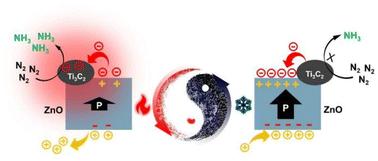
Temperature fluctuations caused by sunlight represent a form of low-quality thermal energy that is generally insufficient for driving chemical reactions. Here, we designed a ZnO–MXene (Ti3C2) heterostructure catalyst, which can harvest solar near-infrared (NIR) energy to drive the sluggish ammonia production reaction using water and N2 as the feedstock. Our research confirmed that ammonia was produced through a pyroelectric process, rather than a photocatalytic process. The ZnO–MXene heterostructure with ∼20 wt% of Ti3C2 exhibited a 6.5-fold improvement in activity compared to bare ZnO. The Ti3C2 not only harvests NIR energy to heat up the pyroelectric ZnO, but also traps the pyro electrons from ZnO and co-catalyzes the reduction of N2 to ammonia. This work offers a novel strategy for ammonia production utilizing the abundant solar NIR energy under ambient conditions.
期刊介绍:
The Journal of Materials Chemistry A, B & C covers a wide range of high-quality studies in the field of materials chemistry, with each section focusing on specific applications of the materials studied. Journal of Materials Chemistry A emphasizes applications in energy and sustainability, including topics such as artificial photosynthesis, batteries, and fuel cells. Journal of Materials Chemistry B focuses on applications in biology and medicine, while Journal of Materials Chemistry C covers applications in optical, magnetic, and electronic devices. Example topic areas within the scope of Journal of Materials Chemistry A include catalysis, green/sustainable materials, sensors, and water treatment, among others.



 京公网安备 11010802042870号
京ICP备2023020795号-1
京公网安备 11010802042870号
京ICP备2023020795号-1

 分享
分享
 求助内容:
求助内容: 应助结果提醒方式:
 扫码关注我们
