Optical assessment of scars after endoscopic mucosal resection of large colorectal polyps in a multicenter, community hospital setting: is routine biopsy still necessary?
Lonne W T Meulen, Roel M M Bogie, Peter D Siersema, Bjorn Winkens, Marije S Vlug, Frank H J Wolfhagen, Martine A M C Baven-Pronk, Michael P J A van der Voorn, Matthijs P Schwartz, Lauran Vogelaar, Tom C J Seerden, Wouter L Hazen, Ruud W M Schrauwen, Lorenza Alvarez Herrero, Ramon-Michel Schreuder, Annick B van Nunen, Gijs J de Bruin, Willem A Marsman, Marc de Bièvre, Robert Roomer, Rogier J J de Ridder, Maria Pellisé, Michael J Bourke, Ad A M Masclee, Leon M G Moons
{"title":"Optical assessment of scars after endoscopic mucosal resection of large colorectal polyps in a multicenter, community hospital setting: is routine biopsy still necessary?","authors":"Lonne W T Meulen, Roel M M Bogie, Peter D Siersema, Bjorn Winkens, Marije S Vlug, Frank H J Wolfhagen, Martine A M C Baven-Pronk, Michael P J A van der Voorn, Matthijs P Schwartz, Lauran Vogelaar, Tom C J Seerden, Wouter L Hazen, Ruud W M Schrauwen, Lorenza Alvarez Herrero, Ramon-Michel Schreuder, Annick B van Nunen, Gijs J de Bruin, Willem A Marsman, Marc de Bièvre, Robert Roomer, Rogier J J de Ridder, Maria Pellisé, Michael J Bourke, Ad A M Masclee, Leon M G Moons","doi":"10.1055/a-2498-7114","DOIUrl":null,"url":null,"abstract":"<p><strong>Background: </strong> Piecemeal endoscopic mucosal resection (EMR) of large (≥ 20 mm) nonpedunculated colorectal polyps (LNPCPs) is succeeded by a 6-month surveillance endoscopy to evaluate the post-EMR scar for recurrence. Data from expert centers suggest that routine tattoo placement and scar biopsies can be omitted, but data from community hospitals are lacking.</p><p><strong>Methods: </strong> The agreement between optical assessment and histological confirmation by routine biopsies was evaluated in a post-hoc analysis of the STAR-LNPCP study (NTR7477), containing prospective data on 6-month post-EMR scar assessments in 30 Dutch community hospitals (October 2019 to May 2022). A standardized protocol was followed for documentation of optical characteristics, imaging, and biopsy of the post-EMR scar. RESULTS : In 1277 post-EMR scar assessments, identification of the scar was achieved in 1215/1277 (95 %). Tattoo placement did not influence scar identification. Scar biopsy was performed in 1050/1215 cases (86 %). Recurrences were seen in 200/1050 cases (19 %). There was good agreement between optical assessment of recurrence and histological confirmation (Cohen's kappa 0.78 [95 %CI 0.73-0.83]). The negative and positive predictive values were 98 % (95 %CI 97 %-99 %) and 74 % (95 %CI 68 %-80 %), respectively. A higher false-positive rate was seen after prior use of clips (11 % vs. 5 %; <i>P</i> = 0.02). Dedicated endoscopists identified the scar more often (96 % vs. 88 %; <i>P</i> < 0.001), and showed a lower optical recurrence miss rate (1 % vs. 3 %; <i>P</i> = 0.11) compared with nondedicated endoscopists. CONCLUSION : Based on this multicenter community hospital study, routine tattoo placement and scar biopsies of the post-EMR scar can be omitted. Assessment of post-EMR scars by dedicated endoscopists is advised.</p>","PeriodicalId":11516,"journal":{"name":"Endoscopy","volume":" ","pages":"620-628"},"PeriodicalIF":12.8000,"publicationDate":"2025-06-01","publicationTypes":"Journal Article","fieldsOfStudy":null,"isOpenAccess":false,"openAccessPdf":"https://www.ncbi.nlm.nih.gov/pmc/articles/PMC12119144/pdf/","citationCount":"0","resultStr":null,"platform":"Semanticscholar","paperid":null,"PeriodicalName":"Endoscopy","FirstCategoryId":"3","ListUrlMain":"https://doi.org/10.1055/a-2498-7114","RegionNum":1,"RegionCategory":"医学","ArticlePicture":[],"TitleCN":null,"AbstractTextCN":null,"PMCID":null,"EPubDate":"2024/12/9 0:00:00","PubModel":"Epub","JCR":"Q1","JCRName":"GASTROENTEROLOGY & HEPATOLOGY","Score":null,"Total":0}
引用次数: 0
Abstract
Background: Piecemeal endoscopic mucosal resection (EMR) of large (≥ 20 mm) nonpedunculated colorectal polyps (LNPCPs) is succeeded by a 6-month surveillance endoscopy to evaluate the post-EMR scar for recurrence. Data from expert centers suggest that routine tattoo placement and scar biopsies can be omitted, but data from community hospitals are lacking.
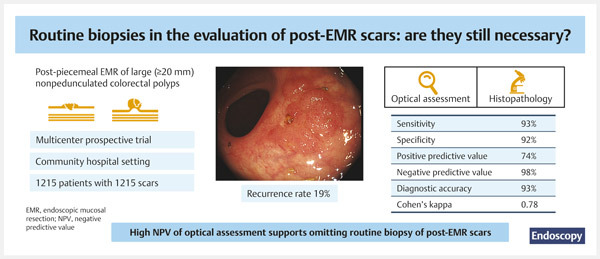
Methods: The agreement between optical assessment and histological confirmation by routine biopsies was evaluated in a post-hoc analysis of the STAR-LNPCP study (NTR7477), containing prospective data on 6-month post-EMR scar assessments in 30 Dutch community hospitals (October 2019 to May 2022). A standardized protocol was followed for documentation of optical characteristics, imaging, and biopsy of the post-EMR scar. RESULTS : In 1277 post-EMR scar assessments, identification of the scar was achieved in 1215/1277 (95 %). Tattoo placement did not influence scar identification. Scar biopsy was performed in 1050/1215 cases (86 %). Recurrences were seen in 200/1050 cases (19 %). There was good agreement between optical assessment of recurrence and histological confirmation (Cohen's kappa 0.78 [95 %CI 0.73-0.83]). The negative and positive predictive values were 98 % (95 %CI 97 %-99 %) and 74 % (95 %CI 68 %-80 %), respectively. A higher false-positive rate was seen after prior use of clips (11 % vs. 5 %; P = 0.02). Dedicated endoscopists identified the scar more often (96 % vs. 88 %; P < 0.001), and showed a lower optical recurrence miss rate (1 % vs. 3 %; P = 0.11) compared with nondedicated endoscopists. CONCLUSION : Based on this multicenter community hospital study, routine tattoo placement and scar biopsies of the post-EMR scar can be omitted. Assessment of post-EMR scars by dedicated endoscopists is advised.
期刊介绍:
Endoscopy is a leading journal covering the latest technologies and global advancements in gastrointestinal endoscopy. With guidance from an international editorial board, it delivers high-quality content catering to the needs of endoscopists, surgeons, clinicians, and researchers worldwide. Publishing 12 issues each year, Endoscopy offers top-quality review articles, original contributions, prospective studies, surveys of diagnostic and therapeutic advances, and comprehensive coverage of key national and international meetings. Additionally, articles often include supplementary online video content.




 京公网安备 11010802042870号
京ICP备2023020795号-1
京公网安备 11010802042870号
京ICP备2023020795号-1

 分享
分享
 求助内容:
求助内容: 应助结果提醒方式:
 扫码关注我们
