Petra Pesova, Bogna Jiravska Godula, Otakar Jiravsky, Libor Jelinek, Marketa Sovova, Katarina Moravcova, Jaromir Ozana, Ivan Ranic, Radek Neuwirth, Roman Miklik, Matej Pekar, Libor Sknouril, Vladimir Tuka, Eliska Sovova
{"title":"Peak systolic blood pressure during preparticipation exercise testing in 12,083 athletes: age, sex, and workload-indexed values and predictors.","authors":"Petra Pesova, Bogna Jiravska Godula, Otakar Jiravsky, Libor Jelinek, Marketa Sovova, Katarina Moravcova, Jaromir Ozana, Ivan Ranic, Radek Neuwirth, Roman Miklik, Matej Pekar, Libor Sknouril, Vladimir Tuka, Eliska Sovova","doi":"10.3389/fphys.2024.1456331","DOIUrl":null,"url":null,"abstract":"<p><strong>Aim: </strong>Assessment of blood pressure during exercise is routine in athletes, but normal values remain equivocal. This study examines the response of systolic blood pressure (SBP) to exercise in a large cohort of athletes and establishes normative values by sex and age.</p><p><strong>Methods: </strong>Competitive athletes free of cardiovascular disease underwent pre-participation exercise testing on a bicycle ergometer. Resting (SBPrest) and peak blood pressure (SBPpeak), heart rate (HRrest and HRpeak), and power output (WR) were recorded. Workload indexed values were calculated.</p><p><strong>Results: </strong>The cohort included 12,083 athletes (median age 15 years, 26.9% female). Median peak exercise SBP was similar between sexes, but WR-indexed measures including SBP/WR ratio and SBP/(WR/kg) slope were higher in females (0.9 vs. 0.7, <i>p</i> < 0.001; 10.94 vs. 9.52, <i>p</i> < 0.001). Univariate analyses revealed significant associations between SBPpeak and several predictors, including sex, age, weight, height, SBPrest, DBPrest, HRrest, HRpeak, and WR (all <i>p</i> < .001). Multivariate analysis showed that SBPrest (beta = 0.353, 95% CI [0.541, 0.609], <i>p</i> < 0.001), height (beta = 0.303, 95% CI [0.360, 0.447], <i>p</i> < 0.001), WR (beta = 0.171, 95% CI [0.029, 0.045], <i>p</i> < 0.001), and age (beta = 0.093, 95% CI [0.162, 0.241], <i>p</i> < 0.001) were the strongest predictors of SBPpeak.</p><p><strong>Conclusion: </strong>This study provides reference values for the interpretation of SBP responses to exercise in athletes. Multivariate analyses highlight the complex interplay of factors influencing peak SBP, including SBPrest, height, WR, age, DBPrest, sex, endurance sport category, and weight. In future studies, these findings may inform the development of personalised training strategies and risk stratification models in athletic populations.</p>","PeriodicalId":12477,"journal":{"name":"Frontiers in Physiology","volume":"15 ","pages":"1456331"},"PeriodicalIF":3.2000,"publicationDate":"2024-11-22","publicationTypes":"Journal Article","fieldsOfStudy":null,"isOpenAccess":false,"openAccessPdf":"https://www.ncbi.nlm.nih.gov/pmc/articles/PMC11621218/pdf/","citationCount":"0","resultStr":null,"platform":"Semanticscholar","paperid":null,"PeriodicalName":"Frontiers in Physiology","FirstCategoryId":"3","ListUrlMain":"https://doi.org/10.3389/fphys.2024.1456331","RegionNum":3,"RegionCategory":"医学","ArticlePicture":[],"TitleCN":null,"AbstractTextCN":null,"PMCID":null,"EPubDate":"2024/1/1 0:00:00","PubModel":"eCollection","JCR":"Q2","JCRName":"PHYSIOLOGY","Score":null,"Total":0}
引用次数: 0
Abstract
Aim: Assessment of blood pressure during exercise is routine in athletes, but normal values remain equivocal. This study examines the response of systolic blood pressure (SBP) to exercise in a large cohort of athletes and establishes normative values by sex and age.
Methods: Competitive athletes free of cardiovascular disease underwent pre-participation exercise testing on a bicycle ergometer. Resting (SBPrest) and peak blood pressure (SBPpeak), heart rate (HRrest and HRpeak), and power output (WR) were recorded. Workload indexed values were calculated.
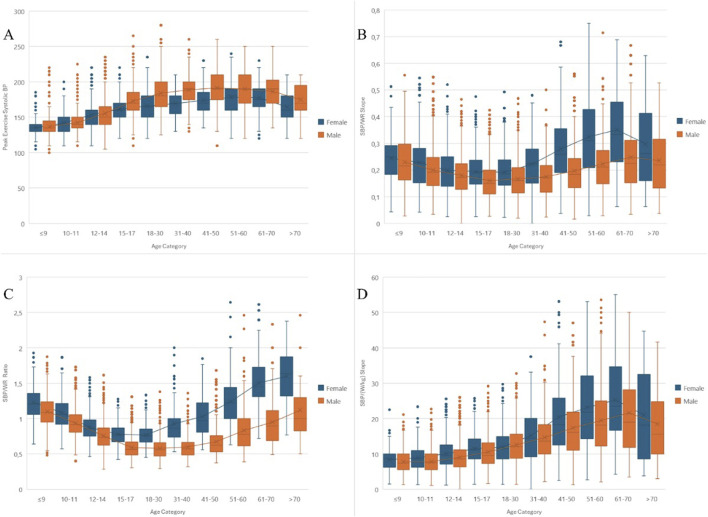
Results: The cohort included 12,083 athletes (median age 15 years, 26.9% female). Median peak exercise SBP was similar between sexes, but WR-indexed measures including SBP/WR ratio and SBP/(WR/kg) slope were higher in females (0.9 vs. 0.7, p < 0.001; 10.94 vs. 9.52, p < 0.001). Univariate analyses revealed significant associations between SBPpeak and several predictors, including sex, age, weight, height, SBPrest, DBPrest, HRrest, HRpeak, and WR (all p < .001). Multivariate analysis showed that SBPrest (beta = 0.353, 95% CI [0.541, 0.609], p < 0.001), height (beta = 0.303, 95% CI [0.360, 0.447], p < 0.001), WR (beta = 0.171, 95% CI [0.029, 0.045], p < 0.001), and age (beta = 0.093, 95% CI [0.162, 0.241], p < 0.001) were the strongest predictors of SBPpeak.
Conclusion: This study provides reference values for the interpretation of SBP responses to exercise in athletes. Multivariate analyses highlight the complex interplay of factors influencing peak SBP, including SBPrest, height, WR, age, DBPrest, sex, endurance sport category, and weight. In future studies, these findings may inform the development of personalised training strategies and risk stratification models in athletic populations.
目的:运动员在运动期间的血压评估是常规的,但正常值仍然是模棱两可的。本研究考察了一大批运动员的收缩压(SBP)对运动的反应,并建立了按性别和年龄划分的规范值。方法:无心血管疾病的竞技运动员在自行车测力仪上进行赛前运动测试。记录静息(SBPrest)和峰值血压(SBPpeak)、心率(HRrest和HRpeak)和功率输出(WR)。计算工作负载索引值。结果:该队列包括12083名运动员(中位年龄15岁,26.9%为女性)。运动中位峰值收缩压在两性之间相似,但女性的收缩压/收缩压比和收缩压/(WR/kg)斜率更高(0.9 vs. 0.7, p < 0.001;10.94 vs. 9.52, p < 0.001)。单变量分析显示,SBPpeak与性别、年龄、体重、身高、SBPrest、DBPrest、HRrest、HRpeak和WR等预测因子之间存在显著相关性(均p < 0.001)。多因素分析显示,SBPrest (beta = 0.353, 95% CI [0.541, 0.609], p < 0.001)、身高(beta = 0.303, 95% CI [0.360, 0.447], p < 0.001)、WR (beta = 0.171, 95% CI [0.029, 0.045], p < 0.001)和年龄(beta = 0.093, 95% CI [0.162, 0.241], p < 0.001)是SBPpeak的最强预测因子。结论:本研究为运动员运动后收缩压反应的解释提供了参考价值。多变量分析强调了影响收缩压峰值的因素的复杂相互作用,包括SBPrest、身高、WR、年龄、DBPrest、性别、耐力运动类别和体重。在未来的研究中,这些发现可能会为运动员群体的个性化训练策略和风险分层模型的发展提供信息。
期刊介绍:
Frontiers in Physiology is a leading journal in its field, publishing rigorously peer-reviewed research on the physiology of living systems, from the subcellular and molecular domains to the intact organism, and its interaction with the environment. Field Chief Editor George E. Billman at the Ohio State University Columbus is supported by an outstanding Editorial Board of international researchers. This multidisciplinary open-access journal is at the forefront of disseminating and communicating scientific knowledge and impactful discoveries to researchers, academics, clinicians and the public worldwide.





 京公网安备 11010802042870号
京ICP备2023020795号-1
京公网安备 11010802042870号
京ICP备2023020795号-1

 分享
分享
 求助内容:
求助内容: 应助结果提醒方式:
 扫码关注我们
