Claire Greenwell, Angela Webster, Ian A Harris, David Beard, Angie Barba, Sarah J Lord
{"title":"Surgical clinical trial activity in Australia, 2010–20, by specialty: analysis of trial registration data","authors":"Claire Greenwell, Angela Webster, Ian A Harris, David Beard, Angie Barba, Sarah J Lord","doi":"10.5694/mja2.52555","DOIUrl":null,"url":null,"abstract":"<p>Randomised controlled trials (RCTs) support clinical practice by generating high quality evidence about the safety and effectiveness of medical interventions. However, RCTs are not required for the regulatory approval of new surgical procedures or devices.<span><sup>1</sup></span> Surgical RCTs are subject to distinct practical challenges,<span><sup>2</sup></span> and the quality of surgical trials has been criticised,<span><sup>3</sup></span> although it appears to be improving.<span><sup>4</sup></span> Few studies have directly compared the design features of surgical and non-surgical trials, or examined differences between surgical clinical trials by specialty. We therefore determined the proportion of surgical clinical trials in Australia relative to all clinical trials and examined their characteristics, and compared surgical trial activity by specialty.</p><p>We reviewed all randomised and non-randomised clinical trials registered with the Australian New Zealand Clinical Trials Registry (ANZCTR; https://anzctr.org.au) or ClinicalTrials.gov (https://clinicaltrials.gov) during 1 January 2010 – 29 February 2020 that included recruitment of adult participants (18 years or older) in Australia. We defined a surgical trial as one in which the intervention was delivered by surgeons with the aim of improving surgical outcomes for patients (further details: Supporting Information, methods). We used information in trial registration records to assess trial activity (number of trials, planned recruitment size), design (randomisation, masking), and industry involvement. For surgical trials, we compared these characteristics by specialty (cardio-thoracic surgery; otolaryngology, head and neck surgery; general [including colorectal] surgery; neurosurgery; orthopaedic surgery; plastic and reconstructive surgery; urological surgery; vascular surgery; ophthalmology surgery; transplantation surgery). We characterised trial activity by specialty as the ratio of its proportion of all surgical trials to the proportion of in-hospital surgical procedures for the specialty during 1 July 2010 – 30 June 2020, as recorded by the Australian Institute of Health and Welfare.<span><sup>5</sup></span> If interventions or procedures could be performed in more than one specialty, we initially classified it under one specialty for the primary analysis, then remapped it to the alternative specialty in a sensitivity analysis (further details: Supporting Information, methods). Statistical analyses were performed in RStudio 2022.7.2.576. We did not seek formal ethics approval for our analysis of publicly available data.</p><p>Of 12 775 clinical trials with planned recruitment of adults in Australia registered during 2010–20, 435 were surgical trials (3.4%); 311 surgical (71%) and 8802 non-surgical trials (72%) were RCTs, and industry involvement was recorded for 128 surgical (29%) and 5531 non-surgical trials (45%) (Box 1). The annual number of surgical trial registrations rose from 24 in 2010 to 50 in 2019; in most years, the largest number of trials registered were for orthopaedic and general surgery (Supporting Information, figure 1). Clinical trials were identified for each of the ten surgical specialties, but the number and their characteristics varied widely (Supporting Information, table 1). The numbers of registrations were largest for orthopaedic surgery (142 trials, 33% of surgical trials; 7 092 232 procedures, 19% of surgical procedures; ratio, 1.71) and general surgery (97 trials, 22%; 9 804 429 procedures, 26%; ratio, 0.85). Trial activity relative to procedure number was highest for transplantation (ratio, 84.8) and cardio-thoracic surgery (ratio, 3.47), and lowest for plastic (ratio, 0.42), urological (ratio, 0.42), and ophthalmology surgery (ratio, 0.49) (Box 2). In the sensitivity analysis, reclassification of trials and procedures that could be associated with two specialties changed the ratio for orthopaedic surgery from 1.71 to 1.42 and that for neurosurgery from 0.88 to 1.00 (Supporting Information, table 4). The relationship of the numbers of RCTs and procedures by specialty were similar to those for all surgical trials (Supporting Information, figure 2). The numbers and total planned recruitment size of surgical trials by specialty (excluding transplantation surgery) each differed from those predicted by the numbers of procedures (χ<sup>2</sup> goodness-of-fit tests, <i>P</i> < 0.001).</p><p>Surgical trials comprised 3.4% of registered Australian clinical trials during 2010–20, while 23% of hospitalisations in Australia in 2022–23 were related to non-obstetric surgery.<span><sup>6</sup></span> The proportions of surgical and non-surgical trials that used randomisation were similar, but the proportion that used masking was slightly smaller for surgical than non-surgical RCTs (59% <i>v</i> 67%). Industry was involved in a smaller proportion of surgical trials than of non-surgical trials, possibly reflecting differences in regulatory requirements for new devices and medicines.</p><p>Differences in the numbers of surgical trials by specialty did not reflect differences in the volume of surgical activity. Alternative explanations include differences in the use of new devices, research training, data collection and audit culture, trial infrastructure, academic appointments, and perceived need. The volume of surgical activity provides a denominator for comparisons of trial activity, but it does not provide information about the optimal number of surgical trials for a specialty.</p><p>As trial registry records rely on investigator input, our comparisons of trial characteristics will be affected if important details were omitted. For multinational trials, the planned recruitment size included overseas participants, but these trials were still relevant to Australian surgical practice. Hospital procedures data used to assess surgical activity did not include invasive procedures that can be performed by physicians or surgeons (eg, colonoscopies), which may have led to underestimation of surgical activity for some specialties. We examined trial registrations as a measure of the number of trials initiated, but not all registered trials are completed.<span><sup>7</sup></span> Investigating how many surgical trials are completed and how they change practice would be valuable.</p><p>We report recent clinical trial activity by surgical specialty in Australia, and our findings could inform discussions of surgical research priorities and governance. The relatively low number of clinical trials in surgery suggests that strategies for supporting surgical trials are needed in Australia, including dedicated funding. The ANZCTR is a valuable public resource for monitoring the impact of such strategies.</p><p>No relevant disclosures.</p><p>The data we analysed are freely available from the cited sources.</p>","PeriodicalId":18214,"journal":{"name":"Medical Journal of Australia","volume":"222 2","pages":"102-103"},"PeriodicalIF":8.5000,"publicationDate":"2024-12-10","publicationTypes":"Journal Article","fieldsOfStudy":null,"isOpenAccess":false,"openAccessPdf":"https://onlinelibrary.wiley.com/doi/epdf/10.5694/mja2.52555","citationCount":"0","resultStr":null,"platform":"Semanticscholar","paperid":null,"PeriodicalName":"Medical Journal of Australia","FirstCategoryId":"3","ListUrlMain":"https://onlinelibrary.wiley.com/doi/10.5694/mja2.52555","RegionNum":2,"RegionCategory":"医学","ArticlePicture":[],"TitleCN":null,"AbstractTextCN":null,"PMCID":null,"EPubDate":"","PubModel":"","JCR":"Q1","JCRName":"MEDICINE, GENERAL & INTERNAL","Score":null,"Total":0}
引用次数: 0
Abstract
Randomised controlled trials (RCTs) support clinical practice by generating high quality evidence about the safety and effectiveness of medical interventions. However, RCTs are not required for the regulatory approval of new surgical procedures or devices.1 Surgical RCTs are subject to distinct practical challenges,2 and the quality of surgical trials has been criticised,3 although it appears to be improving.4 Few studies have directly compared the design features of surgical and non-surgical trials, or examined differences between surgical clinical trials by specialty. We therefore determined the proportion of surgical clinical trials in Australia relative to all clinical trials and examined their characteristics, and compared surgical trial activity by specialty.
We reviewed all randomised and non-randomised clinical trials registered with the Australian New Zealand Clinical Trials Registry (ANZCTR; https://anzctr.org.au) or ClinicalTrials.gov (https://clinicaltrials.gov) during 1 January 2010 – 29 February 2020 that included recruitment of adult participants (18 years or older) in Australia. We defined a surgical trial as one in which the intervention was delivered by surgeons with the aim of improving surgical outcomes for patients (further details: Supporting Information, methods). We used information in trial registration records to assess trial activity (number of trials, planned recruitment size), design (randomisation, masking), and industry involvement. For surgical trials, we compared these characteristics by specialty (cardio-thoracic surgery; otolaryngology, head and neck surgery; general [including colorectal] surgery; neurosurgery; orthopaedic surgery; plastic and reconstructive surgery; urological surgery; vascular surgery; ophthalmology surgery; transplantation surgery). We characterised trial activity by specialty as the ratio of its proportion of all surgical trials to the proportion of in-hospital surgical procedures for the specialty during 1 July 2010 – 30 June 2020, as recorded by the Australian Institute of Health and Welfare.5 If interventions or procedures could be performed in more than one specialty, we initially classified it under one specialty for the primary analysis, then remapped it to the alternative specialty in a sensitivity analysis (further details: Supporting Information, methods). Statistical analyses were performed in RStudio 2022.7.2.576. We did not seek formal ethics approval for our analysis of publicly available data.
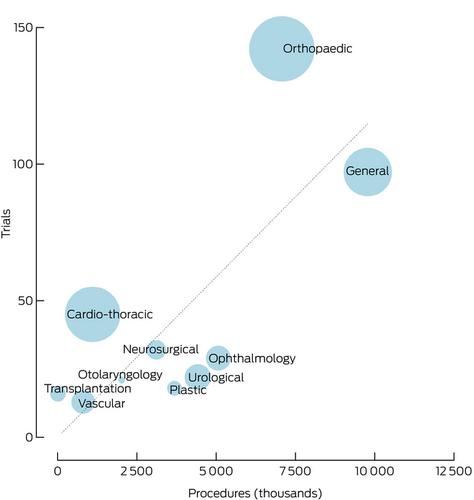
Of 12 775 clinical trials with planned recruitment of adults in Australia registered during 2010–20, 435 were surgical trials (3.4%); 311 surgical (71%) and 8802 non-surgical trials (72%) were RCTs, and industry involvement was recorded for 128 surgical (29%) and 5531 non-surgical trials (45%) (Box 1). The annual number of surgical trial registrations rose from 24 in 2010 to 50 in 2019; in most years, the largest number of trials registered were for orthopaedic and general surgery (Supporting Information, figure 1). Clinical trials were identified for each of the ten surgical specialties, but the number and their characteristics varied widely (Supporting Information, table 1). The numbers of registrations were largest for orthopaedic surgery (142 trials, 33% of surgical trials; 7 092 232 procedures, 19% of surgical procedures; ratio, 1.71) and general surgery (97 trials, 22%; 9 804 429 procedures, 26%; ratio, 0.85). Trial activity relative to procedure number was highest for transplantation (ratio, 84.8) and cardio-thoracic surgery (ratio, 3.47), and lowest for plastic (ratio, 0.42), urological (ratio, 0.42), and ophthalmology surgery (ratio, 0.49) (Box 2). In the sensitivity analysis, reclassification of trials and procedures that could be associated with two specialties changed the ratio for orthopaedic surgery from 1.71 to 1.42 and that for neurosurgery from 0.88 to 1.00 (Supporting Information, table 4). The relationship of the numbers of RCTs and procedures by specialty were similar to those for all surgical trials (Supporting Information, figure 2). The numbers and total planned recruitment size of surgical trials by specialty (excluding transplantation surgery) each differed from those predicted by the numbers of procedures (χ2 goodness-of-fit tests, P < 0.001).
Surgical trials comprised 3.4% of registered Australian clinical trials during 2010–20, while 23% of hospitalisations in Australia in 2022–23 were related to non-obstetric surgery.6 The proportions of surgical and non-surgical trials that used randomisation were similar, but the proportion that used masking was slightly smaller for surgical than non-surgical RCTs (59% v 67%). Industry was involved in a smaller proportion of surgical trials than of non-surgical trials, possibly reflecting differences in regulatory requirements for new devices and medicines.
Differences in the numbers of surgical trials by specialty did not reflect differences in the volume of surgical activity. Alternative explanations include differences in the use of new devices, research training, data collection and audit culture, trial infrastructure, academic appointments, and perceived need. The volume of surgical activity provides a denominator for comparisons of trial activity, but it does not provide information about the optimal number of surgical trials for a specialty.
As trial registry records rely on investigator input, our comparisons of trial characteristics will be affected if important details were omitted. For multinational trials, the planned recruitment size included overseas participants, but these trials were still relevant to Australian surgical practice. Hospital procedures data used to assess surgical activity did not include invasive procedures that can be performed by physicians or surgeons (eg, colonoscopies), which may have led to underestimation of surgical activity for some specialties. We examined trial registrations as a measure of the number of trials initiated, but not all registered trials are completed.7 Investigating how many surgical trials are completed and how they change practice would be valuable.
We report recent clinical trial activity by surgical specialty in Australia, and our findings could inform discussions of surgical research priorities and governance. The relatively low number of clinical trials in surgery suggests that strategies for supporting surgical trials are needed in Australia, including dedicated funding. The ANZCTR is a valuable public resource for monitoring the impact of such strategies.
No relevant disclosures.
The data we analysed are freely available from the cited sources.
随机对照试验(RCTs)通过产生关于医疗干预的安全性和有效性的高质量证据来支持临床实践。然而,新的外科手术或设备的监管批准并不需要随机对照试验外科随机对照试验受到明显的实际挑战2,手术试验的质量受到批评3,尽管它似乎正在改善很少有研究直接比较手术和非手术试验的设计特点,或按专业检查手术临床试验之间的差异。因此,我们确定了澳大利亚外科临床试验相对于所有临床试验的比例,并检查了它们的特征,并按专业比较了外科试验的活动。我们回顾了在澳大利亚新西兰临床试验注册中心(ANZCTR;https://anzctr.org.au)或ClinicalTrials.gov (https://clinicaltrials.gov),于2010年1月1日至2020年2月29日期间在澳大利亚招募成年参与者(18岁或以上)。我们将外科试验定义为外科医生以改善患者手术结果为目的进行干预的试验(进一步细节:支持信息,方法)。我们使用试验注册记录中的信息来评估试验活动(试验数量、计划招募规模)、设计(随机化、掩蔽)和行业参与。在外科试验中,我们通过专科(心胸外科;耳鼻喉科、头颈外科;一般(包括结直肠)手术;神经外科;骨科手术;整形和重建外科;泌尿外科;血管手术;眼科手术;移植手术)。根据澳大利亚健康与福利研究所(Australian Institute of Health and welfare)的记录,我们将试验活动按专业划分为2010年7月1日至2020年6月30日期间所有外科试验的比例与该专业住院外科手术的比例之比。5如果干预措施或手术可以在多个专业进行,我们最初将其分类为一个专业进行初步分析。然后在敏感性分析中将其重新映射到替代专业(进一步的细节:支持信息,方法)。在RStudio 2022.7.2.576中进行统计分析。我们没有为我们对公开数据的分析寻求正式的伦理批准。在2010 - 2020年澳大利亚注册的12775项计划招募成人的临床试验中,435项为手术试验(3.4%);311项手术试验(71%)和8802项非手术试验(72%)为随机对照试验,其中128项手术试验(29%)和5531项非手术试验(45%)被记录为行业参与(框1)。外科试验注册数量从2010年的24项增加到2019年的50项;在大多数年份,注册试验数量最多的是骨科和普外科(辅助信息,图1)。10个外科专科均有临床试验,但临床试验数量及其特征差异很大(辅助信息,表1)。注册试验数量最多的是骨科(142项试验,占外科试验的33%;7 092 232例,占外科手术的19%;比,1.71)和普外科(97项试验,22%;9 804 429例,26%;比,0.85)。与手术次数相关的试验活跃度在移植手术(比率为84.8)和心胸外科手术(比率为3.47)中最高,在整形手术(比率为0.42)、泌尿外科手术(比率为0.42)和眼科手术(比率为0.49)中最低(框2)。在敏感性分析中,对可能与两个专业相关的试验和手术进行重新分类,使骨科手术的比率从1.71变为1.42,神经外科手术的比率从0.88变为1.00(支持信息)。表4)。按专科分类的随机对照试验的数量与手术程序的关系与所有外科试验的数量相似(支持信息,图2)。按专科分类的外科试验(不包括移植手术)的数量和计划招募的总规模均不同于按手术程序数预测的数量(χ2拟合优度检验,P < 0.001)。2010 - 2020年期间,外科试验占澳大利亚注册临床试验的3.4%,而2022-23年期间,澳大利亚23%的住院治疗与非产科手术有关使用随机化的手术和非手术试验的比例相似,但手术随机对照试验使用掩蔽的比例略小于非手术随机对照试验(59% vs 67%)。工业界参与手术试验的比例比参与非手术试验的比例要小,这可能反映了对新装置和药物的监管要求的差异。不同专科的手术试验数量的差异并不能反映手术活动量的差异。
期刊介绍:
The Medical Journal of Australia (MJA) stands as Australia's foremost general medical journal, leading the dissemination of high-quality research and commentary to shape health policy and influence medical practices within the country. Under the leadership of Professor Virginia Barbour, the expert editorial team at MJA is dedicated to providing authors with a constructive and collaborative peer-review and publication process. Established in 1914, the MJA has evolved into a modern journal that upholds its founding values, maintaining a commitment to supporting the medical profession by delivering high-quality and pertinent information essential to medical practice.



 京公网安备 11010802042870号
京ICP备2023020795号-1
京公网安备 11010802042870号
京ICP备2023020795号-1

 分享
分享
 求助内容:
求助内容: 应助结果提醒方式:
 扫码关注我们
