Hossam Elnoamany, Ahmed Mansour, Mazen Lotfy Agour, Mohammed Dorrah, Nour Elnoamany, Anwar Hourieh, Hany Elkholy
{"title":"Surgical outcome after autologous bone chips replacement in depressed skull fractures: a single center experience.","authors":"Hossam Elnoamany, Ahmed Mansour, Mazen Lotfy Agour, Mohammed Dorrah, Nour Elnoamany, Anwar Hourieh, Hany Elkholy","doi":"10.1007/s10143-024-03128-y","DOIUrl":null,"url":null,"abstract":"<p><strong>Background: </strong>Surgery for depressed skull fractures (DSFs) is always faced by multiple challenges including ideal timing, defect reconstruction and complications. Few data are available regarding the aesthetic results and patients' satisfaction following DSFs management.</p><p><strong>Methods: </strong>A prospective non-randomized study included 59 traumatic brain injury (TBI) patients surgically treated for DSFs. Depressed bone fragments were elevated and washed with diluted hydrogen peroxide for 15 min then replaced within a net made of vicryl 0 through edges of the galea. Our objective was to evaluate outcome and patients' satisfaction of using autologous bone fragments for skull defect reconstruction.</p><p><strong>Results: </strong>The mean Glasgow Coma Scale (GCS) score on admission was 14.51 ± 1.237. The mean age was 16.505 ± 12.426 years. DSFs were of compound type in 81.4% with predominance towards the parietal region 54.2%. Associated intracranial pathologies were found in 39.0% of cases. Mean time to surgery was 5.79 ± 9.982 h. Dura was found torn in 19 cases (32.2%). Postoperative complications were encountered in 5 cases (8.5%). The mean hospital stay was 3.61 ± 3.157 days. 96.6% of cases had good discharge outcome. Factors with significant impact on outcome included; admission GCS score (P < 0.001), type of associated pathology (P = 0.006), and venous sinus involvement (P = 0.003). At the end of follow up, 46 patients (82.5%) were satisfied about the aesthetic results, while 10 patients (17.5%) were not satisfied and 9 of them underwent re-surgery for late cranioplasty.</p><p><strong>Conclusions: </strong>Using autologous depressed bone chips for skull defect reconstruction can be a safe and feasible surgical technique for TBI patients suffering DSFs with good aesthetic results, high patient satisfaction, decreased need for later cranioplasty and consequently low overall management cost.</p>","PeriodicalId":19184,"journal":{"name":"Neurosurgical Review","volume":"47 1","pages":"898"},"PeriodicalIF":2.5000,"publicationDate":"2024-12-10","publicationTypes":"Journal Article","fieldsOfStudy":null,"isOpenAccess":false,"openAccessPdf":"https://www.ncbi.nlm.nih.gov/pmc/articles/PMC11632004/pdf/","citationCount":"0","resultStr":null,"platform":"Semanticscholar","paperid":null,"PeriodicalName":"Neurosurgical Review","FirstCategoryId":"3","ListUrlMain":"https://doi.org/10.1007/s10143-024-03128-y","RegionNum":3,"RegionCategory":"医学","ArticlePicture":[],"TitleCN":null,"AbstractTextCN":null,"PMCID":null,"EPubDate":"","PubModel":"","JCR":"Q2","JCRName":"CLINICAL NEUROLOGY","Score":null,"Total":0}
引用次数: 0
Abstract
Background: Surgery for depressed skull fractures (DSFs) is always faced by multiple challenges including ideal timing, defect reconstruction and complications. Few data are available regarding the aesthetic results and patients' satisfaction following DSFs management.
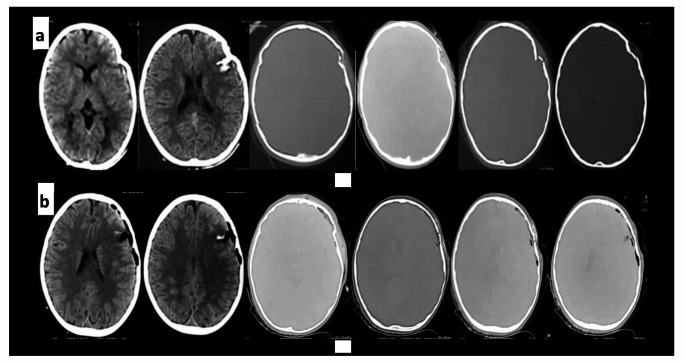
Methods: A prospective non-randomized study included 59 traumatic brain injury (TBI) patients surgically treated for DSFs. Depressed bone fragments were elevated and washed with diluted hydrogen peroxide for 15 min then replaced within a net made of vicryl 0 through edges of the galea. Our objective was to evaluate outcome and patients' satisfaction of using autologous bone fragments for skull defect reconstruction.
Results: The mean Glasgow Coma Scale (GCS) score on admission was 14.51 ± 1.237. The mean age was 16.505 ± 12.426 years. DSFs were of compound type in 81.4% with predominance towards the parietal region 54.2%. Associated intracranial pathologies were found in 39.0% of cases. Mean time to surgery was 5.79 ± 9.982 h. Dura was found torn in 19 cases (32.2%). Postoperative complications were encountered in 5 cases (8.5%). The mean hospital stay was 3.61 ± 3.157 days. 96.6% of cases had good discharge outcome. Factors with significant impact on outcome included; admission GCS score (P < 0.001), type of associated pathology (P = 0.006), and venous sinus involvement (P = 0.003). At the end of follow up, 46 patients (82.5%) were satisfied about the aesthetic results, while 10 patients (17.5%) were not satisfied and 9 of them underwent re-surgery for late cranioplasty.
Conclusions: Using autologous depressed bone chips for skull defect reconstruction can be a safe and feasible surgical technique for TBI patients suffering DSFs with good aesthetic results, high patient satisfaction, decreased need for later cranioplasty and consequently low overall management cost.
期刊介绍:
The goal of Neurosurgical Review is to provide a forum for comprehensive reviews on current issues in neurosurgery. Each issue contains up to three reviews, reflecting all important aspects of one topic (a disease or a surgical approach). Comments by a panel of experts within the same issue complete the topic. By providing comprehensive coverage of one topic per issue, Neurosurgical Review combines the topicality of professional journals with the indepth treatment of a monograph. Original papers of high quality are also welcome.




 京公网安备 11010802042870号
京ICP备2023020795号-1
京公网安备 11010802042870号
京ICP备2023020795号-1

 分享
分享
 求助内容:
求助内容: 应助结果提醒方式:
 扫码关注我们
