{"title":"Determinants of persistent malaria transmission in the Arjo-Didessa farm area in Ethiopia.","authors":"Hiwot S Taffese, Sibusiso M Zuma","doi":"10.4102/sajid.v39i1.623","DOIUrl":null,"url":null,"abstract":"<p><strong>Background: </strong>In tropical and subtropical areas of the world, malaria is still a serious public health concern. Activities related to agricultural development that involve irrigation schemes likely increase the risk of malaria in tropical and sub-Saharan African regions. Ethiopia is a sub-Saharan country where malaria is endemic.</p><p><strong>Objectives: </strong>The aim of the study was to investigate the determinants related to the persistence of malaria transmission in the Arjo-Didessa sugarcane farm area in southwest Ethiopia.</p><p><strong>Method: </strong>The study employed a quantitative survey design. Quantitative data were collected from 397 households using structured questionnaires. SPSS Statistics version 26 was used to analyse the data. Z- and Chi-square tests were applied, and the data were analysed using logistic regression.</p><p><strong>Results: </strong>The determinants that were identified included variation in land use, water management practices, socioeconomic status and knowledge about the use of anti-malaria treatment. These were shown to contribute to increased malaria transmission and the rise in malaria cases in agricultural areas.</p><p><strong>Conclusion: </strong>The effectiveness of malaria control in agricultural settings can be improved through free access to malaria testing and treatment as well as knowledge about anti-malaria treatment among the residents in agricultural areas.</p><p><strong>Contribution: </strong>The study revealed key determinants, including the promotion of free access to anti-malaria treatment, which should be considered for the effective management of malaria in agricultural areas.</p>","PeriodicalId":44007,"journal":{"name":"Southern African Journal of Infectious Diseases","volume":"39 1","pages":"623"},"PeriodicalIF":1.3000,"publicationDate":"2024-11-13","publicationTypes":"Journal Article","fieldsOfStudy":null,"isOpenAccess":false,"openAccessPdf":"https://www.ncbi.nlm.nih.gov/pmc/articles/PMC11622134/pdf/","citationCount":"0","resultStr":null,"platform":"Semanticscholar","paperid":null,"PeriodicalName":"Southern African Journal of Infectious Diseases","FirstCategoryId":"1085","ListUrlMain":"https://doi.org/10.4102/sajid.v39i1.623","RegionNum":0,"RegionCategory":null,"ArticlePicture":[],"TitleCN":null,"AbstractTextCN":null,"PMCID":null,"EPubDate":"2024/1/1 0:00:00","PubModel":"eCollection","JCR":"Q4","JCRName":"INFECTIOUS DISEASES","Score":null,"Total":0}
引用次数: 0
Abstract
Background: In tropical and subtropical areas of the world, malaria is still a serious public health concern. Activities related to agricultural development that involve irrigation schemes likely increase the risk of malaria in tropical and sub-Saharan African regions. Ethiopia is a sub-Saharan country where malaria is endemic.
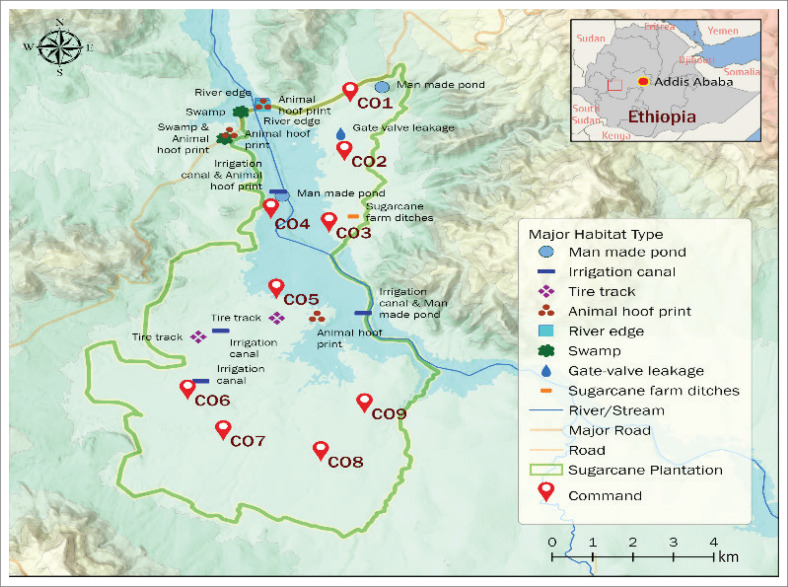
Objectives: The aim of the study was to investigate the determinants related to the persistence of malaria transmission in the Arjo-Didessa sugarcane farm area in southwest Ethiopia.
Method: The study employed a quantitative survey design. Quantitative data were collected from 397 households using structured questionnaires. SPSS Statistics version 26 was used to analyse the data. Z- and Chi-square tests were applied, and the data were analysed using logistic regression.
Results: The determinants that were identified included variation in land use, water management practices, socioeconomic status and knowledge about the use of anti-malaria treatment. These were shown to contribute to increased malaria transmission and the rise in malaria cases in agricultural areas.
Conclusion: The effectiveness of malaria control in agricultural settings can be improved through free access to malaria testing and treatment as well as knowledge about anti-malaria treatment among the residents in agricultural areas.
Contribution: The study revealed key determinants, including the promotion of free access to anti-malaria treatment, which should be considered for the effective management of malaria in agricultural areas.
背景:在世界热带和亚热带地区,疟疾仍然是一个严重的公共卫生问题。涉及灌溉计划的与农业发展有关的活动可能会增加热带和撒哈拉以南非洲地区疟疾的风险。埃塞俄比亚是一个撒哈拉以南的国家,疟疾在那里流行。目的:本研究的目的是调查与埃塞俄比亚西南部Arjo-Didessa甘蔗农场地区疟疾持续传播相关的决定因素。方法:采用定量调查设计。采用结构化问卷对397户家庭进行了定量调查。采用SPSS Statistics version 26对数据进行分析。采用Z-检验和卡方检验,并采用逻辑回归对数据进行分析。结果:确定的决定因素包括土地利用、水管理实践、社会经济地位和使用抗疟疾治疗的知识的差异。事实证明,这些因素导致了疟疾传播的增加和农业地区疟疾病例的增加。结论:通过免费提供疟疾检测和治疗,提高农区居民抗疟治疗知识,可提高农业地区疟疾控制效果。贡献:该研究揭示了关键的决定因素,包括促进免费获得抗疟疾治疗,应考虑在农业地区有效管理疟疾。



 京公网安备 11010802042870号
京ICP备2023020795号-1
京公网安备 11010802042870号
京ICP备2023020795号-1

 分享
分享
 求助内容:
求助内容: 应助结果提醒方式:
 扫码关注我们
