{"title":"Nickel-oxide embedded laser-induced graphene for high-performance supercapacitors†","authors":"Hani Porat, Aneena Lal, Asmita Dutta, Manish Kumar Yadav, Divya Catherin Sesu, Refael Minnes and Arie Borenstein","doi":"10.1039/D4NR03227F","DOIUrl":null,"url":null,"abstract":"<p >This study explores the fabrication of nickel-oxide-embedded laser-induced graphene and its application in high-performance supercapacitors. Supercapacitors are critical for various applications due to their high power density and long cycle life. Nevertheless, they suffer from lower energy density compared to batteries. By embedding redox-active nickel oxide (NiO) nanoparticles into graphene electrodes, we enhance the energy density of these supercapacitors while maintaining high power. The NiO nanoparticles were synthesized at the nanoscale and embedded into graphene oxide (GO) using a one-step laser processing technique, resulting in a composite material with improved electrochemical properties. High specific capacitance for a discharge current density of 0.25 A g<small><sup>−1</sup></small> is 1420 F g<small><sup>−1</sup></small> in 6 M KOH. Moreover, by tracking the crystallographic X-ray diffraction (XRD) pattern of the composite electrodes upon electrochemical cycling, we identified the phase transition from NiO to Ni(OH)<small><sub>2</sub></small>. Our results verify the advantages of laser processing to incorporating highly-dispersed NiO nanoparticles into graphene films, which significantly enhances the electrochemical performance of supercapacitors, offering a promising approach for developing high-energy and high-power energy storage devices.</p>","PeriodicalId":92,"journal":{"name":"Nanoscale","volume":" 4","pages":" 2243-2251"},"PeriodicalIF":5.1000,"publicationDate":"2024-12-11","publicationTypes":"Journal Article","fieldsOfStudy":null,"isOpenAccess":false,"openAccessPdf":"","citationCount":"0","resultStr":null,"platform":"Semanticscholar","paperid":null,"PeriodicalName":"Nanoscale","FirstCategoryId":"88","ListUrlMain":"https://pubs.rsc.org/en/content/articlelanding/2025/nr/d4nr03227f","RegionNum":3,"RegionCategory":"材料科学","ArticlePicture":[],"TitleCN":null,"AbstractTextCN":null,"PMCID":null,"EPubDate":"","PubModel":"","JCR":"Q1","JCRName":"CHEMISTRY, MULTIDISCIPLINARY","Score":null,"Total":0}
引用次数: 0
Abstract
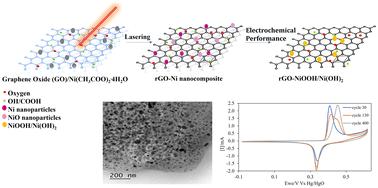
This study explores the fabrication of nickel-oxide-embedded laser-induced graphene and its application in high-performance supercapacitors. Supercapacitors are critical for various applications due to their high power density and long cycle life. Nevertheless, they suffer from lower energy density compared to batteries. By embedding redox-active nickel oxide (NiO) nanoparticles into graphene electrodes, we enhance the energy density of these supercapacitors while maintaining high power. The NiO nanoparticles were synthesized at the nanoscale and embedded into graphene oxide (GO) using a one-step laser processing technique, resulting in a composite material with improved electrochemical properties. High specific capacitance for a discharge current density of 0.25 A g−1 is 1420 F g−1 in 6 M KOH. Moreover, by tracking the crystallographic X-ray diffraction (XRD) pattern of the composite electrodes upon electrochemical cycling, we identified the phase transition from NiO to Ni(OH)2. Our results verify the advantages of laser processing to incorporating highly-dispersed NiO nanoparticles into graphene films, which significantly enhances the electrochemical performance of supercapacitors, offering a promising approach for developing high-energy and high-power energy storage devices.
本研究探讨了氧化镍嵌入激光诱导石墨烯的制备及其在高性能超级电容器中的应用。超级电容器由于其高功率密度和长循环寿命而对各种应用至关重要。然而,与电池相比,它们的能量密度较低。通过将氧化还原活性氧化镍(NiO)纳米颗粒嵌入石墨烯电极,我们在保持高功率的同时提高了这些超级电容器的能量密度。在纳米尺度上合成了NiO纳米颗粒,并使用一步激光加工技术将其嵌入氧化石墨烯(GO)中,从而获得了具有改善电化学性能的复合材料。放电电流密度为0.25 a g−1时,在6m KOH下的高比电容为1420 F g−1。此外,通过跟踪电化学循环时复合电极的晶体x射线衍射(XRD)图,我们确定了从NiO到Ni(OH)2的相变。我们的研究结果验证了激光加工在石墨烯薄膜中加入高度分散的NiO纳米颗粒的优势,这显着提高了超级电容器的电化学性能,为开发高能量和高功率储能器件提供了一条有前途的途径。
期刊介绍:
Nanoscale is a high-impact international journal, publishing high-quality research across nanoscience and nanotechnology. Nanoscale publishes a full mix of research articles on experimental and theoretical work, including reviews, communications, and full papers.Highly interdisciplinary, this journal appeals to scientists, researchers and professionals interested in nanoscience and nanotechnology, quantum materials and quantum technology, including the areas of physics, chemistry, biology, medicine, materials, energy/environment, information technology, detection science, healthcare and drug discovery, and electronics.




 京公网安备 11010802042870号
京ICP备2023020795号-1
京公网安备 11010802042870号
京ICP备2023020795号-1

 分享
分享
 求助内容:
求助内容: 应助结果提醒方式:
 扫码关注我们
