Computational studies on Mn(iii)-catalyzed cyclopropanols: a case of Mn(iii)-based metalloradical catalysis involving an α-Mn(ii)-bound-alkyl radical key intermediate†
Pan Hong , Xiu-Yuan Zou , Peng-Cheng Zhang , Xin Lu , Long-Wu Ye , Yi-Dong Luo , Qing Sun
{"title":"Computational studies on Mn(iii)-catalyzed cyclopropanols: a case of Mn(iii)-based metalloradical catalysis involving an α-Mn(ii)-bound-alkyl radical key intermediate†","authors":"Pan Hong , Xiu-Yuan Zou , Peng-Cheng Zhang , Xin Lu , Long-Wu Ye , Yi-Dong Luo , Qing Sun","doi":"10.1039/d4qo01775g","DOIUrl":null,"url":null,"abstract":"<div><div>Controlling the reactivity of radicals has long posed a significant challenge in the field of radical chemistry. A groundbreaking strategy to address this challenge involves the use of metal-entangled organic radicals <em>via</em> metalloradical catalysis (MRC). Despite achievements in this domain, the substrates capable of generating metal-bound radical species have predominantly been of an oxidative nature, with scarce reports on reductive substrates. Herein, using DFT calculations, we present a novel finding: a reducing substrate, cyclopropanol, capable of generating metal-bound radicals <em>via</em> a Mn(acac)<sub>3</sub> catalyst. Through detailed mechanistic exploration, we have determined that the free radical mechanism proposed in Mn(<span>iii</span>)-catalyzed cyclopropanol reactions is energetically unfavorable, while the metal-bound radical mechanism can proceed smoothly at room temperature. Notably, the Mn(<span>ii</span>)-bound carbene radical intermediate generated from cyclopropanol holds substantial potential for rational control over the diversity of radical reactions. Furthermore, the presence of metal-bound radical intermediates offers significant feasibility for designing stereoselective products by introducing auxiliary ligands in reactions involving cyclopropanols. This discovery highlights the potential of reducing substrates in metal-catalyzed radical reactions and unlocks new prospects for the development of redox-neutral radical catalytic processes. The ability to form well-defined metal-bound radicals from cyclopropanol not only expands the scope of substrates available for such transformations but also paves the way for advanced applications in stereoselective synthesis, leveraging the unique properties of metal coordination environments.</div></div>","PeriodicalId":94379,"journal":{"name":"Organic chemistry frontiers : an international journal of organic chemistry","volume":"12 3","pages":"Pages 918-927"},"PeriodicalIF":0.0000,"publicationDate":"2024-11-05","publicationTypes":"Journal Article","fieldsOfStudy":null,"isOpenAccess":false,"openAccessPdf":"","citationCount":"0","resultStr":null,"platform":"Semanticscholar","paperid":null,"PeriodicalName":"Organic chemistry frontiers : an international journal of organic chemistry","FirstCategoryId":"1085","ListUrlMain":"https://www.sciencedirect.com/org/science/article/pii/S2052412924008489","RegionNum":0,"RegionCategory":null,"ArticlePicture":[],"TitleCN":null,"AbstractTextCN":null,"PMCID":null,"EPubDate":"","PubModel":"","JCR":"","JCRName":"","Score":null,"Total":0}
引用次数: 0
Abstract
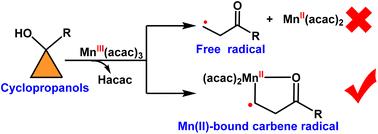
Controlling the reactivity of radicals has long posed a significant challenge in the field of radical chemistry. A groundbreaking strategy to address this challenge involves the use of metal-entangled organic radicals via metalloradical catalysis (MRC). Despite achievements in this domain, the substrates capable of generating metal-bound radical species have predominantly been of an oxidative nature, with scarce reports on reductive substrates. Herein, using DFT calculations, we present a novel finding: a reducing substrate, cyclopropanol, capable of generating metal-bound radicals via a Mn(acac)3 catalyst. Through detailed mechanistic exploration, we have determined that the free radical mechanism proposed in Mn(iii)-catalyzed cyclopropanol reactions is energetically unfavorable, while the metal-bound radical mechanism can proceed smoothly at room temperature. Notably, the Mn(ii)-bound carbene radical intermediate generated from cyclopropanol holds substantial potential for rational control over the diversity of radical reactions. Furthermore, the presence of metal-bound radical intermediates offers significant feasibility for designing stereoselective products by introducing auxiliary ligands in reactions involving cyclopropanols. This discovery highlights the potential of reducing substrates in metal-catalyzed radical reactions and unlocks new prospects for the development of redox-neutral radical catalytic processes. The ability to form well-defined metal-bound radicals from cyclopropanol not only expands the scope of substrates available for such transformations but also paves the way for advanced applications in stereoselective synthesis, leveraging the unique properties of metal coordination environments.



 京公网安备 11010802042870号
京ICP备2023020795号-1
京公网安备 11010802042870号
京ICP备2023020795号-1

 分享
分享

 求助内容:
求助内容: 应助结果提醒方式:
 扫码关注我们
