Dr. Quan Zhang, Dr. Chao Yang, Dr. Yangshen Chen, Yaqin Yan, Dr. Miao Kan, Huining Wang, Dr. Ximeng Lv, Prof. Qing Han, Prof. Gengfeng Zheng
{"title":"Efficient Photocatalytic CH4-to-Ethanol Conversion by Limiting Interfacial Hydroxyl Radicals Using Gold Nanoparticles","authors":"Dr. Quan Zhang, Dr. Chao Yang, Dr. Yangshen Chen, Yaqin Yan, Dr. Miao Kan, Huining Wang, Dr. Ximeng Lv, Prof. Qing Han, Prof. Gengfeng Zheng","doi":"10.1002/anie.202419282","DOIUrl":null,"url":null,"abstract":"<p>Photocatalytic CH<sub>4</sub> oxidation to ethanol with high selectivity is attractive but substantially challenging. The activation of inert C−H bonds at ambient conditions requires highly reactive oxygen species like hydroxyl radicals (⋅OH), while the presence of those oxidative species also facilitates fast formation of C<sub>1</sub> products, instead of the kinetically sluggish C−C coupling to produce ethanol. Herein, we developed a BiVO<sub>4</sub> photocatalyst with surface functionalization of Au nanoparticles (BiVO<sub>4</sub>@Au), which not only enables photogeneration of ⋅OH to activate CH<sub>4</sub> into ⋅CH<sub>3</sub>, but also in situ consumes those ⋅OH species to retard their further attack on ⋅CH<sub>3</sub>, resulting in an enhanced ⋅CH<sub>3</sub>/⋅OH ratio and facilitating C−C coupling toward ethanol. The ⋅CH<sub>3</sub>/⋅OH ratio is further improved by transporting CH<sub>4</sub> via a gas-diffusion layer to the photocatalytic interface, leading to even higher ethanol selectivity and production rates. At ambient conditions and without photosensitizers or sacrificial agents, the BiVO<sub>4</sub>@Au photocatalyst exhibited an outstanding CH<sub>4</sub>-to-ethanol conversion performance, including a peak ethanol yield of 680 μmol ⋅ g<sup>−1</sup> ⋅ h<sup>−1</sup>, a high selectivity of 86 %, and a stable photoconversion of >100 h, substantially exceeding most of the previous reports. Our work suggests an attractive approach of in situ generation and modulation of the ⋅OH levels for photocatalytic CH<sub>4</sub> conversion toward multi-carbon products.</p>","PeriodicalId":125,"journal":{"name":"Angewandte Chemie International Edition","volume":"64 7","pages":""},"PeriodicalIF":16.9000,"publicationDate":"2024-12-11","publicationTypes":"Journal Article","fieldsOfStudy":null,"isOpenAccess":false,"openAccessPdf":"","citationCount":"0","resultStr":null,"platform":"Semanticscholar","paperid":null,"PeriodicalName":"Angewandte Chemie International Edition","FirstCategoryId":"92","ListUrlMain":"https://onlinelibrary.wiley.com/doi/10.1002/anie.202419282","RegionNum":1,"RegionCategory":"化学","ArticlePicture":[],"TitleCN":null,"AbstractTextCN":null,"PMCID":null,"EPubDate":"","PubModel":"","JCR":"Q1","JCRName":"CHEMISTRY, MULTIDISCIPLINARY","Score":null,"Total":0}
引用次数: 0
Abstract
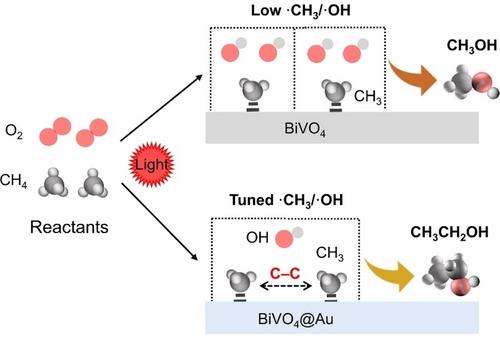
Photocatalytic CH4 oxidation to ethanol with high selectivity is attractive but substantially challenging. The activation of inert C−H bonds at ambient conditions requires highly reactive oxygen species like hydroxyl radicals (⋅OH), while the presence of those oxidative species also facilitates fast formation of C1 products, instead of the kinetically sluggish C−C coupling to produce ethanol. Herein, we developed a BiVO4 photocatalyst with surface functionalization of Au nanoparticles (BiVO4@Au), which not only enables photogeneration of ⋅OH to activate CH4 into ⋅CH3, but also in situ consumes those ⋅OH species to retard their further attack on ⋅CH3, resulting in an enhanced ⋅CH3/⋅OH ratio and facilitating C−C coupling toward ethanol. The ⋅CH3/⋅OH ratio is further improved by transporting CH4 via a gas-diffusion layer to the photocatalytic interface, leading to even higher ethanol selectivity and production rates. At ambient conditions and without photosensitizers or sacrificial agents, the BiVO4@Au photocatalyst exhibited an outstanding CH4-to-ethanol conversion performance, including a peak ethanol yield of 680 μmol ⋅ g−1 ⋅ h−1, a high selectivity of 86 %, and a stable photoconversion of >100 h, substantially exceeding most of the previous reports. Our work suggests an attractive approach of in situ generation and modulation of the ⋅OH levels for photocatalytic CH4 conversion toward multi-carbon products.
期刊介绍:
Angewandte Chemie, a journal of the German Chemical Society (GDCh), maintains a leading position among scholarly journals in general chemistry with an impressive Impact Factor of 16.6 (2022 Journal Citation Reports, Clarivate, 2023). Published weekly in a reader-friendly format, it features new articles almost every day. Established in 1887, Angewandte Chemie is a prominent chemistry journal, offering a dynamic blend of Review-type articles, Highlights, Communications, and Research Articles on a weekly basis, making it unique in the field.



 京公网安备 11010802042870号
京ICP备2023020795号-1
京公网安备 11010802042870号
京ICP备2023020795号-1

 分享
分享
 求助内容:
求助内容: 应助结果提醒方式:
 扫码关注我们
