Kerstin Sell, Eva Rehfuess, Jimmy Osuret, Esther Bayiga-Zziwa, Bezinash Geremew, Lisa Pfadenhauer
{"title":"Outcomes of an integrated knowledge translation approach in five African countries: a mixed-methods comparative case study.","authors":"Kerstin Sell, Eva Rehfuess, Jimmy Osuret, Esther Bayiga-Zziwa, Bezinash Geremew, Lisa Pfadenhauer","doi":"10.1186/s12961-024-01256-x","DOIUrl":null,"url":null,"abstract":"<p><strong>Background: </strong>Integrated knowledge translation (IKT) aims to enhance evidence-informed decision-making in public health and healthcare by establishing continuous relationships between researchers and knowledge users, in particular decision-makers. The Collaboration for Evidence-Based Healthcare and Public Health in Africa (CEBHA+) undertook research on noncommunicable diseases in Ethiopia, Malawi, Rwanda, South Africa and Uganda. Alongside the research activities, we implemented an IKT approach, which entailed training and the development and implementation of site-specific IKT strategies. We evaluated these strategies according to a predefined programme theory.</p><p><strong>Methods: </strong>Drawing on our published protocol ( https://rdcu.be/dyfBP ), we interviewed and surveyed CEBHA+ researchers and their decision-making counterparts during two project stages (3/2020-2/2021; 9/2022-5/2023) and collected IKT-related documents. Transcripts and documents were analysed using qualitative content analysis and surveys were analysed descriptively, with subsequent integration, cross-case analysis and revision of the programme theory.</p><p><strong>Results: </strong>A total of 36 researchers and 19 decision-makers participated in surveys, focus groups and/or interviews, and we collected 92 documents. Relationship building, capacity building and collaborative research were the most proximal intervention outcomes: CEBHA+ researchers and their counterparts built mutual appreciation and partnerships, accessed contacts and networks, and expanded skills in conducting and using research and in IKT. The level of trust between partners varied. Intermediate outcomes were changes in attitudes and knowledge; beyond the conceptualization in our initial programme theory, researchers substantially increased their understanding of the decision-making context and developed a vision for \"research impact\". While it was challenging to evaluate distal outcomes, the IKT approach was linked to the production of research perceived as addressing local priorities and being highly applicable and contextualized, and some consideration of evidence among decision-makers. Unintended effects included high opportunity costs associated with undertaking IKT. An unanticipated outcome was the heightened interest of the research funder in policy engagement. Our updated programme theory constitutes a low-level theory for IKT.</p><p><strong>Conclusions: </strong>Whilst this study faced many challenges common to the evaluation of knowledge translation interventions, it presents rich, theory-informed insights into IKT outcomes. These are based on documented IKT activities and participants' views, particularly in-depth insights of researchers' experiences with implementing the CEBHA+ IKT approach.</p>","PeriodicalId":12870,"journal":{"name":"Health Research Policy and Systems","volume":"22 1","pages":"162"},"PeriodicalIF":3.2000,"publicationDate":"2024-12-10","publicationTypes":"Journal Article","fieldsOfStudy":null,"isOpenAccess":false,"openAccessPdf":"https://www.ncbi.nlm.nih.gov/pmc/articles/PMC11629502/pdf/","citationCount":"0","resultStr":null,"platform":"Semanticscholar","paperid":null,"PeriodicalName":"Health Research Policy and Systems","FirstCategoryId":"3","ListUrlMain":"https://doi.org/10.1186/s12961-024-01256-x","RegionNum":2,"RegionCategory":"医学","ArticlePicture":[],"TitleCN":null,"AbstractTextCN":null,"PMCID":null,"EPubDate":"","PubModel":"","JCR":"Q1","JCRName":"HEALTH POLICY & SERVICES","Score":null,"Total":0}
引用次数: 0
Abstract
Background: Integrated knowledge translation (IKT) aims to enhance evidence-informed decision-making in public health and healthcare by establishing continuous relationships between researchers and knowledge users, in particular decision-makers. The Collaboration for Evidence-Based Healthcare and Public Health in Africa (CEBHA+) undertook research on noncommunicable diseases in Ethiopia, Malawi, Rwanda, South Africa and Uganda. Alongside the research activities, we implemented an IKT approach, which entailed training and the development and implementation of site-specific IKT strategies. We evaluated these strategies according to a predefined programme theory.
Methods: Drawing on our published protocol ( https://rdcu.be/dyfBP ), we interviewed and surveyed CEBHA+ researchers and their decision-making counterparts during two project stages (3/2020-2/2021; 9/2022-5/2023) and collected IKT-related documents. Transcripts and documents were analysed using qualitative content analysis and surveys were analysed descriptively, with subsequent integration, cross-case analysis and revision of the programme theory.
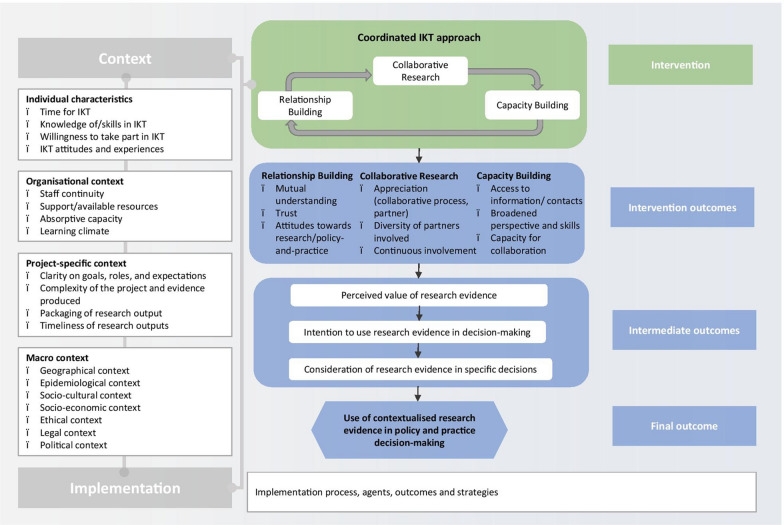
Results: A total of 36 researchers and 19 decision-makers participated in surveys, focus groups and/or interviews, and we collected 92 documents. Relationship building, capacity building and collaborative research were the most proximal intervention outcomes: CEBHA+ researchers and their counterparts built mutual appreciation and partnerships, accessed contacts and networks, and expanded skills in conducting and using research and in IKT. The level of trust between partners varied. Intermediate outcomes were changes in attitudes and knowledge; beyond the conceptualization in our initial programme theory, researchers substantially increased their understanding of the decision-making context and developed a vision for "research impact". While it was challenging to evaluate distal outcomes, the IKT approach was linked to the production of research perceived as addressing local priorities and being highly applicable and contextualized, and some consideration of evidence among decision-makers. Unintended effects included high opportunity costs associated with undertaking IKT. An unanticipated outcome was the heightened interest of the research funder in policy engagement. Our updated programme theory constitutes a low-level theory for IKT.
Conclusions: Whilst this study faced many challenges common to the evaluation of knowledge translation interventions, it presents rich, theory-informed insights into IKT outcomes. These are based on documented IKT activities and participants' views, particularly in-depth insights of researchers' experiences with implementing the CEBHA+ IKT approach.
期刊介绍:
Health Research Policy and Systems is an Open Access, peer-reviewed, online journal that aims to provide a platform for the global research community to share their views, findings, insights and successes. Health Research Policy and Systems considers manuscripts that investigate the role of evidence-based health policy and health research systems in ensuring the efficient utilization and application of knowledge to improve health and health equity, especially in developing countries. Research is the foundation for improvements in public health. The problem is that people involved in different areas of research, together with managers and administrators in charge of research entities, do not communicate sufficiently with each other.



 京公网安备 11010802042870号
京ICP备2023020795号-1
京公网安备 11010802042870号
京ICP备2023020795号-1

 分享
分享
 求助内容:
求助内容: 应助结果提醒方式:
 扫码关注我们
