Xosé López-Goldar, Xuening Zhang, Amy P Hastings, Christophe Duplais, Anurag A Agrawal
{"title":"Plant chemical diversity enhances defense against herbivory.","authors":"Xosé López-Goldar, Xuening Zhang, Amy P Hastings, Christophe Duplais, Anurag A Agrawal","doi":"10.1073/pnas.2417524121","DOIUrl":null,"url":null,"abstract":"<p><p>Multiple hypotheses have been put forth to understand why defense chemistry in individual plants is so diverse. A major challenge has been teasing apart the importance of concentration vs. composition of defense compounds and resolving the mechanisms of diversity effects that determine plant resistance against herbivores. Accordingly, we first outline nonexclusive mechanisms by which phytochemical diversity may increase toxicity of a mixture compared to the average effect of each compound alone. We then leveraged independent in vitro, in vivo transgenic, and organismal experiments to test the effect of equimolar concentrations of purified milkweed toxins in isolation vs. mixtures on the specialist and sequestering monarch butterfly. We show that cardenolide toxin mixtures from milkweed plants enhance resistance against this herbivore compared to equal concentrations of single compounds. In mixtures, highly potent toxins dominated the inhibition of the monarch's target enzyme (Na<sup>+</sup>/K<sup>+</sup>-ATPase) in vitro, revealing toxin-specific affinity for the adapted enzyme in the absence of other physiological adaptations of the monarch. Mixtures also caused increased mortality in CRISPR-edited adult <i>Drosophila melanogaster</i> with the monarch enzyme in vivo, whereas wild-type flies showed lower survival regardless of mixture type. Finally, although experimentally administered mixtures were not more toxic to monarch caterpillars than single compounds overall, increasing caterpillar sequestration from mixtures resulted in an increasing burden for growth compared to single compounds. Phytochemical diversity likely provides an economical plant defense by acting on multiple aspects of herbivore physiology and may be particularly effective against sequestering specialist herbivores.</p>","PeriodicalId":20548,"journal":{"name":"Proceedings of the National Academy of Sciences of the United States of America","volume":"121 51","pages":"e2417524121"},"PeriodicalIF":9.1000,"publicationDate":"2024-12-17","publicationTypes":"Journal Article","fieldsOfStudy":null,"isOpenAccess":false,"openAccessPdf":"https://www.ncbi.nlm.nih.gov/pmc/articles/PMC11665865/pdf/","citationCount":"0","resultStr":null,"platform":"Semanticscholar","paperid":null,"PeriodicalName":"Proceedings of the National Academy of Sciences of the United States of America","FirstCategoryId":"103","ListUrlMain":"https://doi.org/10.1073/pnas.2417524121","RegionNum":1,"RegionCategory":"综合性期刊","ArticlePicture":[],"TitleCN":null,"AbstractTextCN":null,"PMCID":null,"EPubDate":"2024/12/11 0:00:00","PubModel":"Epub","JCR":"Q1","JCRName":"MULTIDISCIPLINARY SCIENCES","Score":null,"Total":0}
引用次数: 0
Abstract
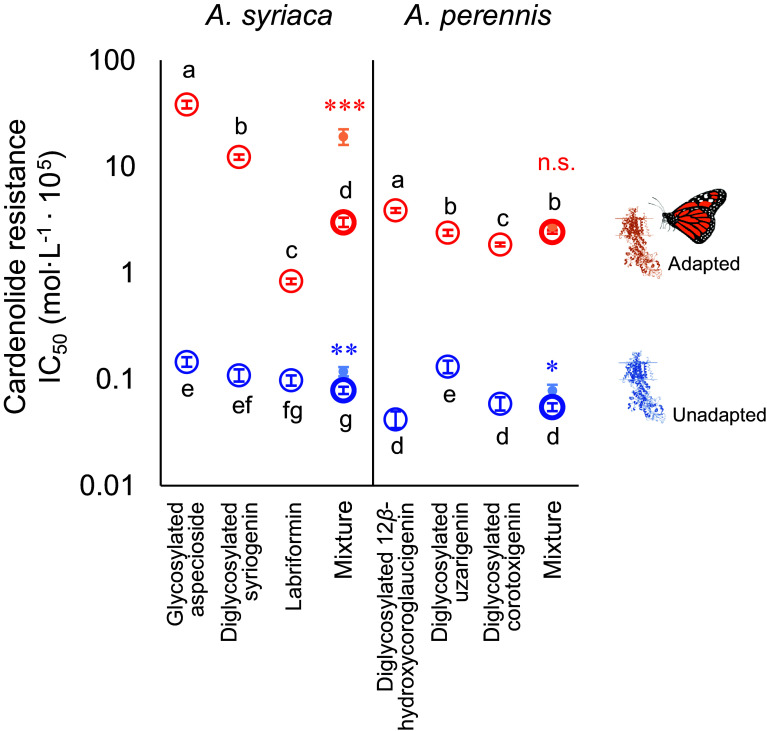
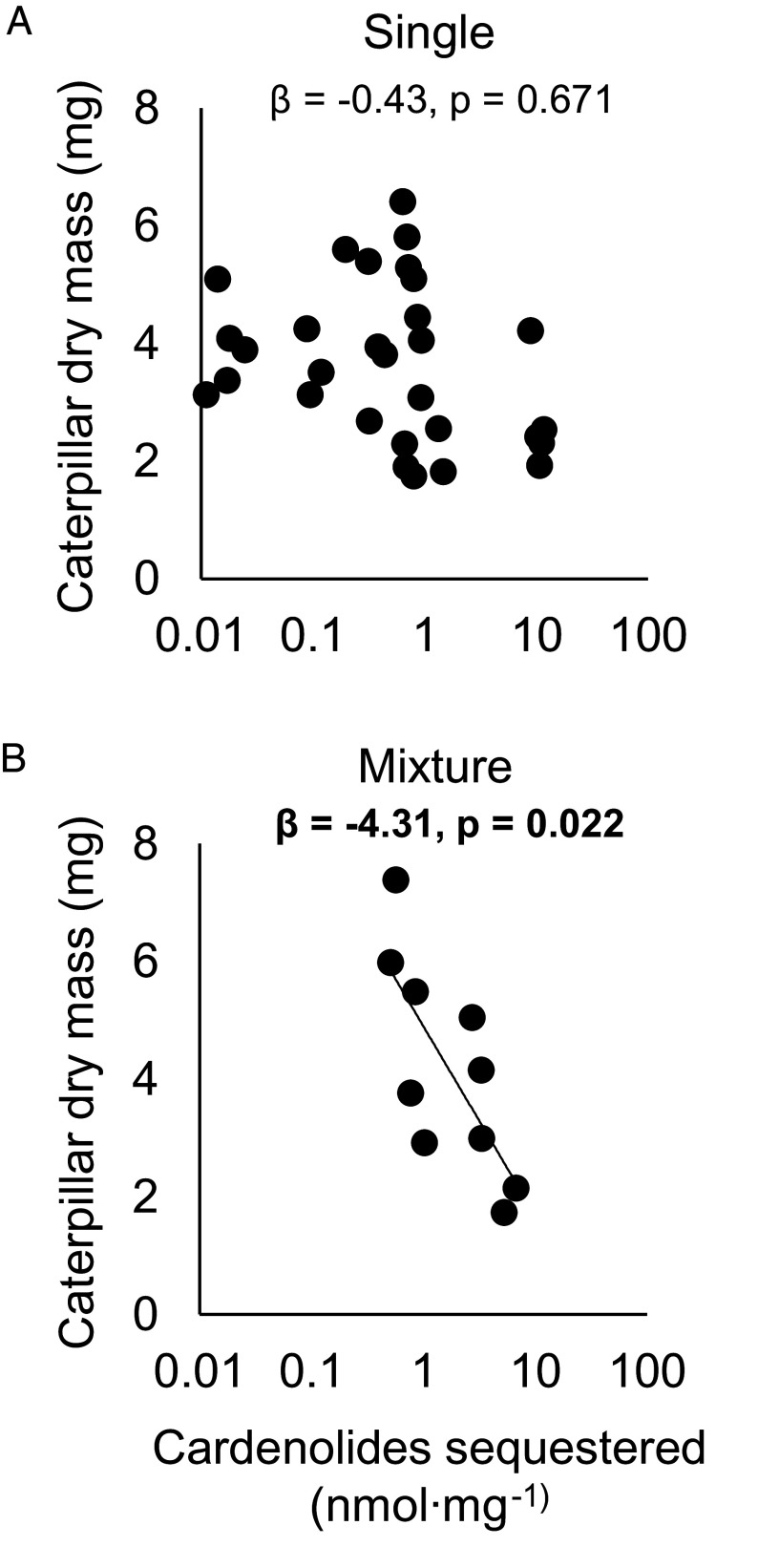
Multiple hypotheses have been put forth to understand why defense chemistry in individual plants is so diverse. A major challenge has been teasing apart the importance of concentration vs. composition of defense compounds and resolving the mechanisms of diversity effects that determine plant resistance against herbivores. Accordingly, we first outline nonexclusive mechanisms by which phytochemical diversity may increase toxicity of a mixture compared to the average effect of each compound alone. We then leveraged independent in vitro, in vivo transgenic, and organismal experiments to test the effect of equimolar concentrations of purified milkweed toxins in isolation vs. mixtures on the specialist and sequestering monarch butterfly. We show that cardenolide toxin mixtures from milkweed plants enhance resistance against this herbivore compared to equal concentrations of single compounds. In mixtures, highly potent toxins dominated the inhibition of the monarch's target enzyme (Na+/K+-ATPase) in vitro, revealing toxin-specific affinity for the adapted enzyme in the absence of other physiological adaptations of the monarch. Mixtures also caused increased mortality in CRISPR-edited adult Drosophila melanogaster with the monarch enzyme in vivo, whereas wild-type flies showed lower survival regardless of mixture type. Finally, although experimentally administered mixtures were not more toxic to monarch caterpillars than single compounds overall, increasing caterpillar sequestration from mixtures resulted in an increasing burden for growth compared to single compounds. Phytochemical diversity likely provides an economical plant defense by acting on multiple aspects of herbivore physiology and may be particularly effective against sequestering specialist herbivores.
期刊介绍:
The Proceedings of the National Academy of Sciences (PNAS), a peer-reviewed journal of the National Academy of Sciences (NAS), serves as an authoritative source for high-impact, original research across the biological, physical, and social sciences. With a global scope, the journal welcomes submissions from researchers worldwide, making it an inclusive platform for advancing scientific knowledge.




 京公网安备 11010802042870号
京ICP备2023020795号-1
京公网安备 11010802042870号
京ICP备2023020795号-1

 分享
分享
 求助内容:
求助内容: 应助结果提醒方式:
 扫码关注我们
