{"title":"Cobalt-Based Ferrite Modified Carbon Nanotubes Fibers for Flexible and Disposable Microelectrode Toward Electrochemical Glucose Sensing","authors":"Abid Ali, Rizwan Shoukat, Ahmad Raza Ashraf, Zarqa Rasheed, Sheza Muqaddas, Munawar Iqbal, Munira Khalid, Wissem Mnif, Ismail ElKamil Suliman Mohamed","doi":"10.1002/ansa.202400032","DOIUrl":null,"url":null,"abstract":"<p>Glucose detection is critical in clinical health and the food industry, particularly in the diagnosis of blood sugar levels. Carbon-based fiber materials have recently featured prominently as non-enzymatic electrochemical glucose detectors. Herein, cobalt-based ferrite (CoFe<sub>2</sub>O<sub>4</sub>) in the form of nanoparticles has been successfully fabricated over the carbon nanotubes (CNTs) fiber via a simple hydrothermal process. Fabricated microelectrode (CoFe<sub>2</sub>O<sub>4</sub>@CNTs) was investigated as an electrocatalyst toward the non-enzymatic electrochemical glucose sensors. The structure and morphology of the modified fiber were studied by scanning electron microscopy including energy-dispersive X-ray spectroscopy. The electrochemical capability of the microelectrode was analyzed by using different electrochemical techniques including cyclic voltammetry, chronoamperometry, and electrochemical impedance spectroscopy (EIS). The proposed sensors exhibited a superb sensitivity of 0.21 µAcm<sup>−2</sup> mM<sup>−1</sup>, a good linear range from 1 to 9 mM, and a lower detection limit of 1.7 mM. Further investigation via EIS indicated the low charge transfer resistance as compared to the bare CNTs-based fiber. Outcomes revealed that the material can potentially prove promising for the disposable microelectrode toward electrochemical glucose sensing.</p>","PeriodicalId":93411,"journal":{"name":"Analytical science advances","volume":"5 11-12","pages":""},"PeriodicalIF":4.1000,"publicationDate":"2024-10-13","publicationTypes":"Journal Article","fieldsOfStudy":null,"isOpenAccess":false,"openAccessPdf":"https://www.ncbi.nlm.nih.gov/pmc/articles/PMC11627181/pdf/","citationCount":"0","resultStr":null,"platform":"Semanticscholar","paperid":null,"PeriodicalName":"Analytical science advances","FirstCategoryId":"1085","ListUrlMain":"https://chemistry-europe.onlinelibrary.wiley.com/doi/10.1002/ansa.202400032","RegionNum":0,"RegionCategory":null,"ArticlePicture":[],"TitleCN":null,"AbstractTextCN":null,"PMCID":null,"EPubDate":"","PubModel":"","JCR":"Q2","JCRName":"CHEMISTRY, ANALYTICAL","Score":null,"Total":0}
引用次数: 0
Abstract
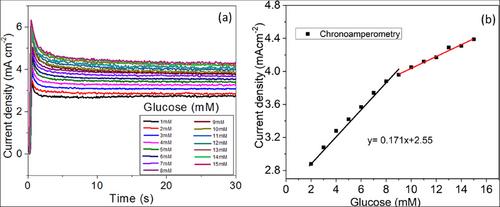
Glucose detection is critical in clinical health and the food industry, particularly in the diagnosis of blood sugar levels. Carbon-based fiber materials have recently featured prominently as non-enzymatic electrochemical glucose detectors. Herein, cobalt-based ferrite (CoFe2O4) in the form of nanoparticles has been successfully fabricated over the carbon nanotubes (CNTs) fiber via a simple hydrothermal process. Fabricated microelectrode (CoFe2O4@CNTs) was investigated as an electrocatalyst toward the non-enzymatic electrochemical glucose sensors. The structure and morphology of the modified fiber were studied by scanning electron microscopy including energy-dispersive X-ray spectroscopy. The electrochemical capability of the microelectrode was analyzed by using different electrochemical techniques including cyclic voltammetry, chronoamperometry, and electrochemical impedance spectroscopy (EIS). The proposed sensors exhibited a superb sensitivity of 0.21 µAcm−2 mM−1, a good linear range from 1 to 9 mM, and a lower detection limit of 1.7 mM. Further investigation via EIS indicated the low charge transfer resistance as compared to the bare CNTs-based fiber. Outcomes revealed that the material can potentially prove promising for the disposable microelectrode toward electrochemical glucose sensing.




 京公网安备 11010802042870号
京ICP备2023020795号-1
京公网安备 11010802042870号
京ICP备2023020795号-1

 分享
分享

 求助内容:
求助内容: 应助结果提醒方式:
 扫码关注我们
