Yao Lyu;Xiangteng Zhang;Shengbo Eben Li;Jingliang Duan;Letian Tao;Qing Xu;Lei He;Keqiang Li
{"title":"Conformal Symplectic Optimization for Stable Reinforcement Learning","authors":"Yao Lyu;Xiangteng Zhang;Shengbo Eben Li;Jingliang Duan;Letian Tao;Qing Xu;Lei He;Keqiang Li","doi":"10.1109/TNNLS.2024.3511670","DOIUrl":null,"url":null,"abstract":"Training deep reinforcement learning (RL) agents necessitates overcoming the highly unstable nonconvex stochastic optimization inherent in the trial-and-error mechanism. To tackle this challenge, we propose a physics-inspired optimization algorithm called relativistic adaptive gradient descent (RAD), which enhances long-term training stability. By conceptualizing neural network (NN) training as the evolution of a conformal Hamiltonian system, we present a universal framework for transferring long-term stability from conformal symplectic integrators to iterative NN updating rules, where the choice of kinetic energy governs the dynamical properties of resulting optimization algorithms. By utilizing relativistic kinetic energy, RAD incorporates principles from special relativity and limits parameter updates below a finite speed, effectively mitigating abnormal gradient influences. In addition, RAD models NN optimization as the evolution of a multiparticle system where each trainable parameter acts as an independent particle with an individual adaptive learning rate. We prove RAD’s sublinear convergence under general nonconvex settings, where smaller gradient variance and larger batch sizes contribute to tighter convergence. Notably, RAD degrades to the well-known adaptive moment estimation (ADAM) algorithm when its speed coefficient is chosen as one and symplectic factor as a small positive value. Experimental results show RAD outperforming nine baseline optimizers with five RL algorithms across twelve environments, including standard benchmarks and challenging scenarios. Notably, RAD achieves up to a 155.1% performance improvement over ADAM in Atari games, showcasing its efficacy in stabilizing and accelerating RL training.","PeriodicalId":13303,"journal":{"name":"IEEE transactions on neural networks and learning systems","volume":"36 6","pages":"11049-11063"},"PeriodicalIF":8.9000,"publicationDate":"2024-12-11","publicationTypes":"Journal Article","fieldsOfStudy":null,"isOpenAccess":false,"openAccessPdf":"","citationCount":"0","resultStr":null,"platform":"Semanticscholar","paperid":null,"PeriodicalName":"IEEE transactions on neural networks and learning systems","FirstCategoryId":"94","ListUrlMain":"https://ieeexplore.ieee.org/document/10792938/","RegionNum":1,"RegionCategory":"计算机科学","ArticlePicture":[],"TitleCN":null,"AbstractTextCN":null,"PMCID":null,"EPubDate":"","PubModel":"","JCR":"Q1","JCRName":"COMPUTER SCIENCE, ARTIFICIAL INTELLIGENCE","Score":null,"Total":0}
引用次数: 0
Abstract
Training deep reinforcement learning (RL) agents necessitates overcoming the highly unstable nonconvex stochastic optimization inherent in the trial-and-error mechanism. To tackle this challenge, we propose a physics-inspired optimization algorithm called relativistic adaptive gradient descent (RAD), which enhances long-term training stability. By conceptualizing neural network (NN) training as the evolution of a conformal Hamiltonian system, we present a universal framework for transferring long-term stability from conformal symplectic integrators to iterative NN updating rules, where the choice of kinetic energy governs the dynamical properties of resulting optimization algorithms. By utilizing relativistic kinetic energy, RAD incorporates principles from special relativity and limits parameter updates below a finite speed, effectively mitigating abnormal gradient influences. In addition, RAD models NN optimization as the evolution of a multiparticle system where each trainable parameter acts as an independent particle with an individual adaptive learning rate. We prove RAD’s sublinear convergence under general nonconvex settings, where smaller gradient variance and larger batch sizes contribute to tighter convergence. Notably, RAD degrades to the well-known adaptive moment estimation (ADAM) algorithm when its speed coefficient is chosen as one and symplectic factor as a small positive value. Experimental results show RAD outperforming nine baseline optimizers with five RL algorithms across twelve environments, including standard benchmarks and challenging scenarios. Notably, RAD achieves up to a 155.1% performance improvement over ADAM in Atari games, showcasing its efficacy in stabilizing and accelerating RL training.
期刊介绍:
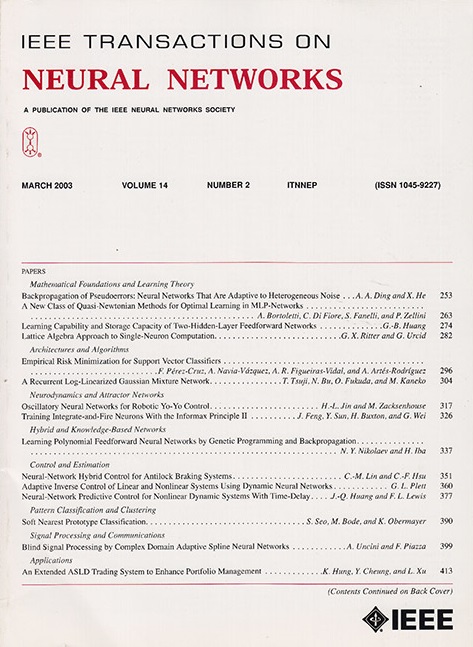
The focus of IEEE Transactions on Neural Networks and Learning Systems is to present scholarly articles discussing the theory, design, and applications of neural networks as well as other learning systems. The journal primarily highlights technical and scientific research in this domain.



 京公网安备 11010802042870号
京ICP备2023020795号-1
京公网安备 11010802042870号
京ICP备2023020795号-1

 分享
分享
 求助内容:
求助内容: 应助结果提醒方式:
 扫码关注我们
