{"title":"A Survey of Security in UAVs and FANETs: Issues, Threats, Analysis of Attacks, and Solutions","authors":"Ozlem Ceviz;Sevil Sen;Pinar Sadioglu","doi":"10.1109/COMST.2024.3515051","DOIUrl":null,"url":null,"abstract":"Thanks to the rapidly developing technology, unmanned aerial vehicles (UAVs) are able to complete a number of tasks in cooperation with each other without need for human intervention. In recent years, UAVs, which are widely utilized in military missions, have begun to be deployed in civilian applications and mostly for commercial purposes. With their growing numbers and range of applications, UAVs are becoming more and more popular; on the other hand, they are also the target of various threats which can exploit various vulnerabilities of UAV systems in order to cause destructive effects. It is therefore critical that security is ensured for UAVs and the networks that provide communication between UAVs. This survey seeks to provide a comprehensive perspective on security within the domain of UAVs and Flying Ad Hoc Networks (FANETs). Our approach incorporates attack surface analysis and aligns it with the identification of potential threats. Additionally, we discuss countermeasures proposed in the existing literature in two categories: preventive and detection strategies. Our primary focus centers on the security challenges inherent to FANETs, acknowledging their susceptibility to insider threats due to their decentralized and dynamic nature. To provide a deeper understanding of these challenges, we simulate and analyze four distinct routing attacks on FANETs, using realistic parameters to evaluate their impact. Hence, this study transcends a standard review by integrating an attack analysis based on extensive simulations. Finally, we rigorously examine open issues, and propose research directions to guide future endeavors in this field.","PeriodicalId":55029,"journal":{"name":"IEEE Communications Surveys and Tutorials","volume":"27 5","pages":"3227-3265"},"PeriodicalIF":34.4000,"publicationDate":"2024-12-11","publicationTypes":"Journal Article","fieldsOfStudy":null,"isOpenAccess":false,"openAccessPdf":"","citationCount":"0","resultStr":null,"platform":"Semanticscholar","paperid":null,"PeriodicalName":"IEEE Communications Surveys and Tutorials","FirstCategoryId":"94","ListUrlMain":"https://ieeexplore.ieee.org/document/10793113/","RegionNum":1,"RegionCategory":"计算机科学","ArticlePicture":[],"TitleCN":null,"AbstractTextCN":null,"PMCID":null,"EPubDate":"","PubModel":"","JCR":"Q1","JCRName":"COMPUTER SCIENCE, INFORMATION SYSTEMS","Score":null,"Total":0}
引用次数: 0
Abstract
Thanks to the rapidly developing technology, unmanned aerial vehicles (UAVs) are able to complete a number of tasks in cooperation with each other without need for human intervention. In recent years, UAVs, which are widely utilized in military missions, have begun to be deployed in civilian applications and mostly for commercial purposes. With their growing numbers and range of applications, UAVs are becoming more and more popular; on the other hand, they are also the target of various threats which can exploit various vulnerabilities of UAV systems in order to cause destructive effects. It is therefore critical that security is ensured for UAVs and the networks that provide communication between UAVs. This survey seeks to provide a comprehensive perspective on security within the domain of UAVs and Flying Ad Hoc Networks (FANETs). Our approach incorporates attack surface analysis and aligns it with the identification of potential threats. Additionally, we discuss countermeasures proposed in the existing literature in two categories: preventive and detection strategies. Our primary focus centers on the security challenges inherent to FANETs, acknowledging their susceptibility to insider threats due to their decentralized and dynamic nature. To provide a deeper understanding of these challenges, we simulate and analyze four distinct routing attacks on FANETs, using realistic parameters to evaluate their impact. Hence, this study transcends a standard review by integrating an attack analysis based on extensive simulations. Finally, we rigorously examine open issues, and propose research directions to guide future endeavors in this field.
期刊介绍:
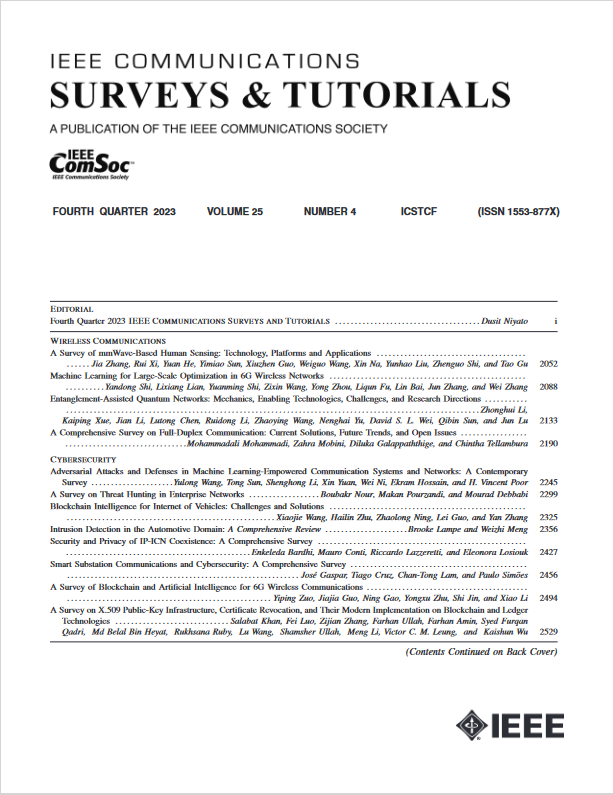
IEEE Communications Surveys & Tutorials is an online journal published by the IEEE Communications Society for tutorials and surveys covering all aspects of the communications field. Telecommunications technology is progressing at a rapid pace, and the IEEE Communications Society is committed to providing researchers and other professionals the information and tools to stay abreast. IEEE Communications Surveys and Tutorials focuses on integrating and adding understanding to the existing literature on communications, putting results in context. Whether searching for in-depth information about a familiar area or an introduction into a new area, IEEE Communications Surveys & Tutorials aims to be the premier source of peer-reviewed, comprehensive tutorials and surveys, and pointers to further sources. IEEE Communications Surveys & Tutorials publishes only articles exclusively written for IEEE Communications Surveys & Tutorials and go through a rigorous review process before their publication in the quarterly issues.
A tutorial article in the IEEE Communications Surveys & Tutorials should be designed to help the reader to become familiar with and learn something specific about a chosen topic. In contrast, the term survey, as applied here, is defined to mean a survey of the literature. A survey article in IEEE Communications Surveys & Tutorials should provide a comprehensive review of developments in a selected area, covering its development from its inception to its current state and beyond, and illustrating its development through liberal citations from the literature. Both tutorials and surveys should be tutorial in nature and should be written in a style comprehensible to readers outside the specialty of the article.



 京公网安备 11010802042870号
京ICP备2023020795号-1
京公网安备 11010802042870号
京ICP备2023020795号-1

 分享
分享
 求助内容:
求助内容: 应助结果提醒方式:
 扫码关注我们
