Biing-Chiau Tzeng, Yu-Ting Chen, Jia-Hen Chang, Bing-Jian Sun, Agnes H. H. Chang, Su-Ying Chien
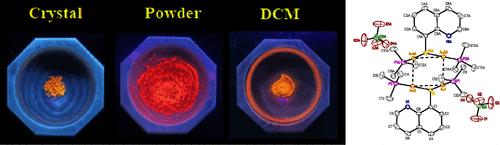
{"title":"Supramolecular Assembly, Solvent-Induced, and Mechanochromic Luminescence of Au(I) Quinoline-8-thiolates","authors":"Biing-Chiau Tzeng, Yu-Ting Chen, Jia-Hen Chang, Bing-Jian Sun, Agnes H. H. Chang, Su-Ying Chien","doi":"10.1021/acs.inorgchem.4c03328","DOIUrl":null,"url":null,"abstract":"AuCl(PMe<sub>3</sub>) and AuCl(PEt<sub>3</sub>) were used to react with quinoline-8-thiolate (8-QNS) to give three Au(I) complexes, i.e., [8-QNS(AuPMe<sub>3</sub>)<sub>2</sub>]ClO<sub>4</sub> (<b>1</b>), [(8-QNS)<sub>2</sub>Ag(AuPMe<sub>3</sub>)<sub>2</sub>]ClO<sub>4</sub> (<b>2</b>), and [8-QNS(AuPEt<sub>3</sub>)<sub>2</sub>]ClO<sub>4</sub> (<b>3</b>), which have been structurally determined by X-ray diffraction to show various intra- and intermolecular metal···metal contacts (i.e., metal = Au(I) or Ag(I)). All complexes displayed solid-state luminescence at 535–568 nm, which is most likely attributed to an intraligand transition of 8-QNS and/or a S → Au(I) charge-transfer transition, possibly modified by Au(I)···Au(I) interactions. Notably, complex <b>1</b>·CH<sub>2</sub>Cl<sub>2</sub> exhibited remarkable mechanochromic luminescence from 535 to 601 nm upon grinding. While immersed in various solvents for the ground powder samples of complex <b>1</b>·CH<sub>2</sub>Cl<sub>2</sub>, the luminescence at 601 nm mostly reverted to the original luminescence. Powder X-ray diffraction measurements indicated that complex <b>1</b>·CH<sub>2</sub>Cl<sub>2</sub> underwent structural transformation from a crystalline to an amorphous phase upon grinding, and it can be restored to the original crystalline phase upon immersion in various solvents. Additionally, the reversible experiments of complex <b>1</b>·CH<sub>2</sub>Cl<sub>2</sub> for the grinding and immersion actions were performed for up to five cycles. Moreover, the time-dependent luminescence spectra for the crystalline samples of complex <b>1</b>·CH<sub>2</sub>Cl<sub>2</sub> were measured, and they showed a significant luminescence change from 535 to 590 nm within 2 days.","PeriodicalId":40,"journal":{"name":"Inorganic Chemistry","volume":"30 1","pages":""},"PeriodicalIF":4.7000,"publicationDate":"2024-12-12","publicationTypes":"Journal Article","fieldsOfStudy":null,"isOpenAccess":false,"openAccessPdf":"","citationCount":"0","resultStr":null,"platform":"Semanticscholar","paperid":null,"PeriodicalName":"Inorganic Chemistry","FirstCategoryId":"92","ListUrlMain":"https://doi.org/10.1021/acs.inorgchem.4c03328","RegionNum":2,"RegionCategory":"化学","ArticlePicture":[],"TitleCN":null,"AbstractTextCN":null,"PMCID":null,"EPubDate":"","PubModel":"","JCR":"Q1","JCRName":"CHEMISTRY, INORGANIC & NUCLEAR","Score":null,"Total":0}
引用次数: 0
Abstract
AuCl(PMe3) and AuCl(PEt3) were used to react with quinoline-8-thiolate (8-QNS) to give three Au(I) complexes, i.e., [8-QNS(AuPMe3)2]ClO4 (1), [(8-QNS)2Ag(AuPMe3)2]ClO4 (2), and [8-QNS(AuPEt3)2]ClO4 (3), which have been structurally determined by X-ray diffraction to show various intra- and intermolecular metal···metal contacts (i.e., metal = Au(I) or Ag(I)). All complexes displayed solid-state luminescence at 535–568 nm, which is most likely attributed to an intraligand transition of 8-QNS and/or a S → Au(I) charge-transfer transition, possibly modified by Au(I)···Au(I) interactions. Notably, complex 1·CH2Cl2 exhibited remarkable mechanochromic luminescence from 535 to 601 nm upon grinding. While immersed in various solvents for the ground powder samples of complex 1·CH2Cl2, the luminescence at 601 nm mostly reverted to the original luminescence. Powder X-ray diffraction measurements indicated that complex 1·CH2Cl2 underwent structural transformation from a crystalline to an amorphous phase upon grinding, and it can be restored to the original crystalline phase upon immersion in various solvents. Additionally, the reversible experiments of complex 1·CH2Cl2 for the grinding and immersion actions were performed for up to five cycles. Moreover, the time-dependent luminescence spectra for the crystalline samples of complex 1·CH2Cl2 were measured, and they showed a significant luminescence change from 535 to 590 nm within 2 days.
期刊介绍:
Inorganic Chemistry publishes fundamental studies in all phases of inorganic chemistry. Coverage includes experimental and theoretical reports on quantitative studies of structure and thermodynamics, kinetics, mechanisms of inorganic reactions, bioinorganic chemistry, and relevant aspects of organometallic chemistry, solid-state phenomena, and chemical bonding theory. Emphasis is placed on the synthesis, structure, thermodynamics, reactivity, spectroscopy, and bonding properties of significant new and known compounds.



 京公网安备 11010802042870号
京ICP备2023020795号-1
京公网安备 11010802042870号
京ICP备2023020795号-1

 分享
分享
 求助内容:
求助内容: 应助结果提醒方式:
 扫码关注我们
