{"title":"A novel annexin dimer targets microglial phagocytosis of astrocytes to protect the brain-blood barrier after cerebral ischemia.","authors":"Wei Tang, Rong Cheng, Meng-Yue Gao, Min-Jin Hu, Lu Zhang, Qiang Wang, Xin-Yu Li, Wei Yan, Xiao-Ying Wang, Hai-Mei Yang, Jian Cheng, Zi-Chun Hua","doi":"10.1038/s41401-024-01432-3","DOIUrl":null,"url":null,"abstract":"<p><p>Despite the vital role of astrocytes in preserving blood-brain barrier (BBB) integrity, their therapeutic potential as targets in ischemic stroke-induced barrier disruption remains underexplored. We previously reported externalization of phosphatidylserine (PS) on astrocytic membranes concurrent with the emergence of PS externalization in neurons. PS externalization of astrocytes induced microglial phagocytosis of astrocytes, resulting in reduced astrocyte-vascular coupling and subsequent BBB breakdown. Annexin A5 (ANXA5) belongs to the superfamily of calcium (Ca<sup>2+</sup>)- and phospholipid-binding proteins. Here, we report two X-ray structures of human ANXA5, including monomeric ANXA5 (1.42 Å) and dimeric ANXA5 (1.80 Å). Through the combination of molecular docking and functional analysis, we explored the mechanism of action of ANXA5 in stroke treatment. In addition, we observed a clear increase in therapeutic efficacy corresponding to the increased affinity of ANXA5 for PS. In summary, the phagocytosis of PS-externalized astrocytes by microglia has emerged as a critical mechanism driving BBB breakdown after ischemia. Our findings offer valuable structural insight into ANXA5 as an innovative pharmacological target for safeguarding blood-brain barrier integrity after cerebral ischemia. These insights may facilitate the development of novel PS-targeting medications aimed at achieving enhanced efficacy with minimal side effects.</p>","PeriodicalId":6942,"journal":{"name":"Acta Pharmacologica Sinica","volume":" ","pages":"852-866"},"PeriodicalIF":8.4000,"publicationDate":"2025-04-01","publicationTypes":"Journal Article","fieldsOfStudy":null,"isOpenAccess":false,"openAccessPdf":"https://www.ncbi.nlm.nih.gov/pmc/articles/PMC11950206/pdf/","citationCount":"0","resultStr":null,"platform":"Semanticscholar","paperid":null,"PeriodicalName":"Acta Pharmacologica Sinica","FirstCategoryId":"3","ListUrlMain":"https://doi.org/10.1038/s41401-024-01432-3","RegionNum":1,"RegionCategory":"医学","ArticlePicture":[],"TitleCN":null,"AbstractTextCN":null,"PMCID":null,"EPubDate":"2024/12/11 0:00:00","PubModel":"Epub","JCR":"Q1","JCRName":"CHEMISTRY, MULTIDISCIPLINARY","Score":null,"Total":0}
引用次数: 0
Abstract
Despite the vital role of astrocytes in preserving blood-brain barrier (BBB) integrity, their therapeutic potential as targets in ischemic stroke-induced barrier disruption remains underexplored. We previously reported externalization of phosphatidylserine (PS) on astrocytic membranes concurrent with the emergence of PS externalization in neurons. PS externalization of astrocytes induced microglial phagocytosis of astrocytes, resulting in reduced astrocyte-vascular coupling and subsequent BBB breakdown. Annexin A5 (ANXA5) belongs to the superfamily of calcium (Ca2+)- and phospholipid-binding proteins. Here, we report two X-ray structures of human ANXA5, including monomeric ANXA5 (1.42 Å) and dimeric ANXA5 (1.80 Å). Through the combination of molecular docking and functional analysis, we explored the mechanism of action of ANXA5 in stroke treatment. In addition, we observed a clear increase in therapeutic efficacy corresponding to the increased affinity of ANXA5 for PS. In summary, the phagocytosis of PS-externalized astrocytes by microglia has emerged as a critical mechanism driving BBB breakdown after ischemia. Our findings offer valuable structural insight into ANXA5 as an innovative pharmacological target for safeguarding blood-brain barrier integrity after cerebral ischemia. These insights may facilitate the development of novel PS-targeting medications aimed at achieving enhanced efficacy with minimal side effects.
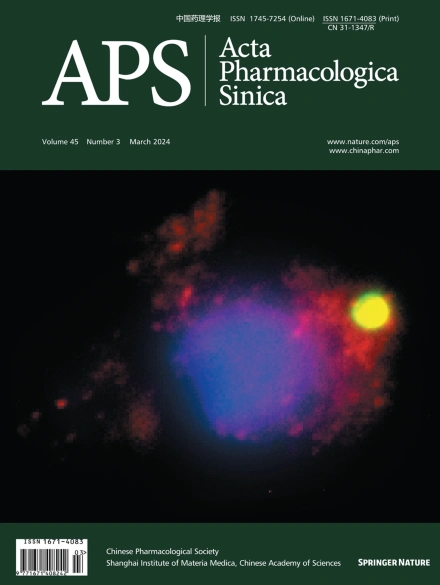
期刊介绍:
APS (Acta Pharmacologica Sinica) welcomes submissions from diverse areas of pharmacology and the life sciences. While we encourage contributions across a broad spectrum, topics of particular interest include, but are not limited to: anticancer pharmacology, cardiovascular and pulmonary pharmacology, clinical pharmacology, drug discovery, gastrointestinal and hepatic pharmacology, genitourinary, renal, and endocrine pharmacology, immunopharmacology and inflammation, molecular and cellular pharmacology, neuropharmacology, pharmaceutics, and pharmacokinetics. Join us in sharing your research and insights in pharmacology and the life sciences.



 京公网安备 11010802042870号
京ICP备2023020795号-1
京公网安备 11010802042870号
京ICP备2023020795号-1

 分享
分享
 求助内容:
求助内容: 应助结果提醒方式:
 扫码关注我们
