{"title":"A CLINICAL PREDICTION MODEL FOR SHORT-TERM PROGNOSIS IN PATIENTS WITH NON-ACUTE MYOCARDIAL INFARCTION-RELATED CARDIOGENIC SHOCK.","authors":"Xiaoke Wang, Xiaojuan Fan, Taibo Wu, Shaopeng Che, Xue Shi, Peining Liu, Junhui Liu, Yongbai Luo, Beidi Lan, Yue Wu","doi":"10.1097/SHK.0000000000002535","DOIUrl":null,"url":null,"abstract":"<p><strong>Abstract: </strong>Background : While acute myocardial infarction (AMI) is widely recognized as the primary cause of cardiogenic shock (CS), non-AMI-related CS has been excluded from the majority of CS studies. Information on its prognostic factors remains largely understudied, and it is necessary to focus on these patients to identify the specific risk factors. In this study, we aimed to build and validate a predictive nomogram and risk classification system. Methods: 1298 patients and 548 patients with CS from the Medical Information Mart for Intensive Care IV and III databases were included in the study after excluding patients with AMI. Lasso and logistic regression analysis were used to identify statistically significant predictors, which were finally involved in the nomogram. The predictive performance of the nomogram was validated by calibration plots and was compared with other scoring systems by area under curve and decision curve analysis curves. Results: Age, heart rate, white blood cell count, albumin level, lactic acid level, GCS score, 24-h urine output, and vasopressor use were identified as the most critical factors for in-hospital death. Based on these results, a nomogram was established for predicting in-hospital mortality. The area under curve value of the nomogram was 0.806 in the training group and 0.814 and 0.730 in the internal and external validation sets, respectively, which were significantly higher than those of other commonly used intensive care unit scoring systems (Simplified Acute Physiology Score II, Acute Physiology Score III, and Sequential Organ Failure Assessment). In addition, the survival curve showed significant differences in the 30-day survival of the three risk subgroups divided by the nomogram. Conclusion: For non-AMI-associated CS, a predictive nomogram and risk classification system were developed and validated, and the nomogram demonstrated good performance in prognostic prediction and risk stratification.</p>","PeriodicalId":21667,"journal":{"name":"SHOCK","volume":" ","pages":"706-713"},"PeriodicalIF":2.7000,"publicationDate":"2025-05-01","publicationTypes":"Journal Article","fieldsOfStudy":null,"isOpenAccess":false,"openAccessPdf":"https://www.ncbi.nlm.nih.gov/pmc/articles/PMC12039905/pdf/","citationCount":"0","resultStr":null,"platform":"Semanticscholar","paperid":null,"PeriodicalName":"SHOCK","FirstCategoryId":"3","ListUrlMain":"https://doi.org/10.1097/SHK.0000000000002535","RegionNum":3,"RegionCategory":"医学","ArticlePicture":[],"TitleCN":null,"AbstractTextCN":null,"PMCID":null,"EPubDate":"2024/12/10 0:00:00","PubModel":"Epub","JCR":"Q2","JCRName":"CRITICAL CARE MEDICINE","Score":null,"Total":0}
引用次数: 0
Abstract
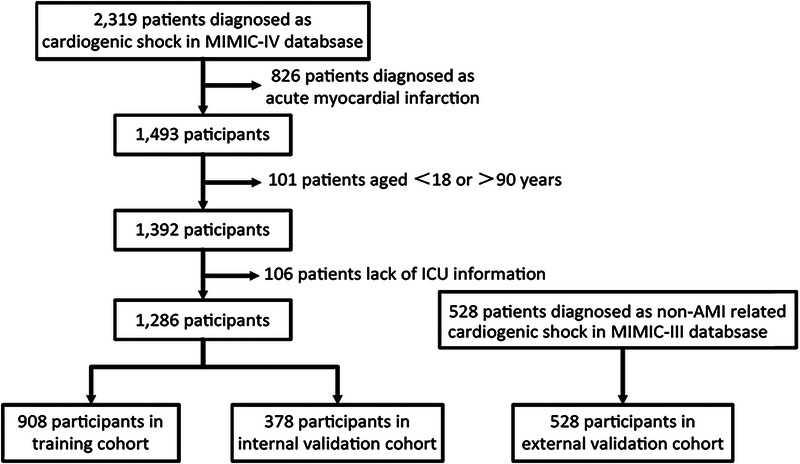
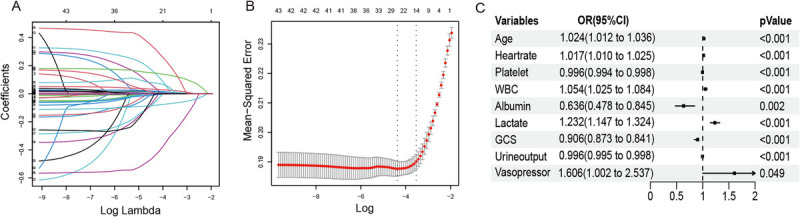
Abstract: Background : While acute myocardial infarction (AMI) is widely recognized as the primary cause of cardiogenic shock (CS), non-AMI-related CS has been excluded from the majority of CS studies. Information on its prognostic factors remains largely understudied, and it is necessary to focus on these patients to identify the specific risk factors. In this study, we aimed to build and validate a predictive nomogram and risk classification system. Methods: 1298 patients and 548 patients with CS from the Medical Information Mart for Intensive Care IV and III databases were included in the study after excluding patients with AMI. Lasso and logistic regression analysis were used to identify statistically significant predictors, which were finally involved in the nomogram. The predictive performance of the nomogram was validated by calibration plots and was compared with other scoring systems by area under curve and decision curve analysis curves. Results: Age, heart rate, white blood cell count, albumin level, lactic acid level, GCS score, 24-h urine output, and vasopressor use were identified as the most critical factors for in-hospital death. Based on these results, a nomogram was established for predicting in-hospital mortality. The area under curve value of the nomogram was 0.806 in the training group and 0.814 and 0.730 in the internal and external validation sets, respectively, which were significantly higher than those of other commonly used intensive care unit scoring systems (Simplified Acute Physiology Score II, Acute Physiology Score III, and Sequential Organ Failure Assessment). In addition, the survival curve showed significant differences in the 30-day survival of the three risk subgroups divided by the nomogram. Conclusion: For non-AMI-associated CS, a predictive nomogram and risk classification system were developed and validated, and the nomogram demonstrated good performance in prognostic prediction and risk stratification.
期刊介绍:
SHOCK®: Injury, Inflammation, and Sepsis: Laboratory and Clinical Approaches includes studies of novel therapeutic approaches, such as immunomodulation, gene therapy, nutrition, and others. The mission of the Journal is to foster and promote multidisciplinary studies, both experimental and clinical in nature, that critically examine the etiology, mechanisms and novel therapeutics of shock-related pathophysiological conditions. Its purpose is to excel as a vehicle for timely publication in the areas of basic and clinical studies of shock, trauma, sepsis, inflammation, ischemia, and related pathobiological states, with particular emphasis on the biologic mechanisms that determine the response to such injury. Making such information available will ultimately facilitate improved care of the traumatized or septic individual.





 京公网安备 11010802042870号
京ICP备2023020795号-1
京公网安备 11010802042870号
京ICP备2023020795号-1

 分享
分享
 求助内容:
求助内容: 应助结果提醒方式:
 扫码关注我们
