Mechanisms underlying neurocognitive dysfunction following critical illness: a systematic review

IF 6.9 1区 医学 Q1 ANESTHESIOLOGY Anaesthesia Pub Date : 2024-12-12 DOI:10.1111/anae.16494
Mark Andonovic, Holly Morrison, William Allingham, Robert Adam, Martin Shaw, Tara Quasim, Joanne McPeake, Terence Quinn
{"title":"Mechanisms underlying neurocognitive dysfunction following critical illness: a systematic review","authors":"Mark Andonovic,&nbsp;Holly Morrison,&nbsp;William Allingham,&nbsp;Robert Adam,&nbsp;Martin Shaw,&nbsp;Tara Quasim,&nbsp;Joanne McPeake,&nbsp;Terence Quinn","doi":"10.1111/anae.16494","DOIUrl":null,"url":null,"abstract":"<div>\n \n \n <section>\n \n <h3> Introduction</h3>\n \n <p>Cognitive impairment is a significant healthcare problem globally and its prevalence is projected to affect over 150 million people worldwide. Survivors of critical illness are impacted frequently by long-term neurocognitive dysfunction regardless of presenting illness, but the mechanisms are poorly understood. The goal of this review was to synthesise the existing evidence regarding potential mechanisms underlying neurocognitive dysfunction following critical illness in order to guide potential avenues for future research.</p>\n </section>\n \n <section>\n \n <h3> Methods</h3>\n \n <p>We performed a systematic search of the literature for studies published between 1 January 1974 and 15 July 2023. We included publications involving adult patients with critical illness due to any aetiology that assessed for cognitive impairment following recovery from illness, and explored or investigated potential underlying causative mechanisms. The quality and risk of bias of the individual studies was assessed using the Newcastle-Ottawa scale.</p>\n </section>\n \n <section>\n \n <h3> Results</h3>\n \n <p>Of the 7658 reviewed references, 37 studies comprising 4344 patients were selected for inclusion. Most studies were single centre with sample sizes of &lt; 100 patients. The proportion of patients with long-term cognitive impairment ranged from 13% to 100%. A wide variety of theoretical mechanisms were explored, with biomarkers and neuroimaging utilised most frequently. Many studies reported associations between investigated mechanisms and reduced cognition; several of these mechanisms have been implicated in other forms of long-term neurodegenerative conditions. Increased levels of inflammatory cytokines during acute illness and white matter hyperintensities on neuroimaging following recovery were the associations reported most commonly.</p>\n </section>\n \n <section>\n \n <h3> Discussion</h3>\n \n <p>The underlying pathophysiology of neurocognitive decline after critical illness is not yet understood fully. The mechanisms implicated in other neurodegenerative conditions suggest that this may represent an accelerated version of the same processes. Large scale studies are required to further elucidate the cause of this significant problem for survivors of critical illness.</p>\n </section>\n </div>","PeriodicalId":7742,"journal":{"name":"Anaesthesia","volume":"80 2","pages":"188-196"},"PeriodicalIF":6.9000,"publicationDate":"2024-12-12","publicationTypes":"Journal Article","fieldsOfStudy":null,"isOpenAccess":false,"openAccessPdf":"https://onlinelibrary.wiley.com/doi/epdf/10.1111/anae.16494","citationCount":"0","resultStr":null,"platform":"Semanticscholar","paperid":null,"PeriodicalName":"Anaesthesia","FirstCategoryId":"3","ListUrlMain":"https://associationofanaesthetists-publications.onlinelibrary.wiley.com/doi/10.1111/anae.16494","RegionNum":1,"RegionCategory":"医学","ArticlePicture":[],"TitleCN":null,"AbstractTextCN":null,"PMCID":null,"EPubDate":"","PubModel":"","JCR":"Q1","JCRName":"ANESTHESIOLOGY","Score":null,"Total":0}
引用次数: 0

Abstract

Introduction

Cognitive impairment is a significant healthcare problem globally and its prevalence is projected to affect over 150 million people worldwide. Survivors of critical illness are impacted frequently by long-term neurocognitive dysfunction regardless of presenting illness, but the mechanisms are poorly understood. The goal of this review was to synthesise the existing evidence regarding potential mechanisms underlying neurocognitive dysfunction following critical illness in order to guide potential avenues for future research.

Methods

We performed a systematic search of the literature for studies published between 1 January 1974 and 15 July 2023. We included publications involving adult patients with critical illness due to any aetiology that assessed for cognitive impairment following recovery from illness, and explored or investigated potential underlying causative mechanisms. The quality and risk of bias of the individual studies was assessed using the Newcastle-Ottawa scale.

Results

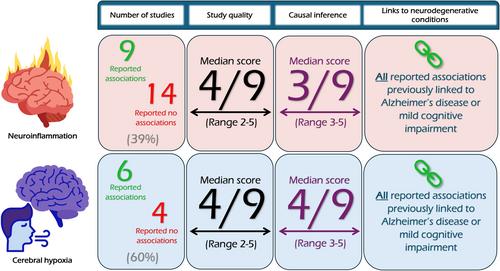
Of the 7658 reviewed references, 37 studies comprising 4344 patients were selected for inclusion. Most studies were single centre with sample sizes of < 100 patients. The proportion of patients with long-term cognitive impairment ranged from 13% to 100%. A wide variety of theoretical mechanisms were explored, with biomarkers and neuroimaging utilised most frequently. Many studies reported associations between investigated mechanisms and reduced cognition; several of these mechanisms have been implicated in other forms of long-term neurodegenerative conditions. Increased levels of inflammatory cytokines during acute illness and white matter hyperintensities on neuroimaging following recovery were the associations reported most commonly.

Discussion

The underlying pathophysiology of neurocognitive decline after critical illness is not yet understood fully. The mechanisms implicated in other neurodegenerative conditions suggest that this may represent an accelerated version of the same processes. Large scale studies are required to further elucidate the cause of this significant problem for survivors of critical illness.

Abstract Image

Abstract Image

Abstract Image

Abstract Image

Abstract Image

查看原文
分享 分享
微信好友 朋友圈 QQ好友 复制链接
本刊更多论文
危重疾病后神经认知功能障碍的机制:系统综述
认知障碍是全球范围内的一个重大医疗问题,预计其发病率将影响全球超过 1.5 亿人。危重症患者无论是否出现疾病,都会经常受到长期神经认知功能障碍的影响,但人们对其机制却知之甚少。本综述的目的是综合现有证据,探讨危重病后神经认知功能障碍的潜在机制,为今后的研究提供指导。
本文章由计算机程序翻译,如有差异,请以英文原文为准。
求助全文
约1分钟内获得全文 去求助
来源期刊
Anaesthesia
Anaesthesia 医学-麻醉学
CiteScore
21.20
自引率
9.30%
发文量
300
审稿时长
6 months
期刊介绍: The official journal of the Association of Anaesthetists is Anaesthesia. It is a comprehensive international publication that covers a wide range of topics. The journal focuses on general and regional anaesthesia, as well as intensive care and pain therapy. It includes original articles that have undergone peer review, covering all aspects of these fields, including research on equipment.
期刊最新文献
Conscious sedation vs. general anaesthesia for the peri-operative management of patients undergoing transcatheter aortic valve implantation: a reply. Interpreting the afternoon disadvantage: accounting for mediation, weighting and secular trends: a reply. Chronic pain after day-case surgery: the next challenge in the prevention of chronic post-surgical pain. Patient-reported outcomes, postoperative pain and pain relief after day-case surgery (POPPY): baseline data from day surgery practice in the UK. Patient-reported outcomes, postoperative pain and pain relief after day-case surgery (POPPY): chronic post-surgical pain prevalence and associations.
×
引用
GB/T 7714-2015
复制
MLA
复制
APA
复制
导出至
BibTeX EndNote RefMan NoteFirst NoteExpress
×
×
提示
您的信息不完整,为了账户安全,请先补充。
现在去补充
×
提示
您因"违规操作"
具体请查看互助需知
我知道了
×
提示
现在去查看 取消
×
提示
确定
0
微信
客服QQ
Book学术公众号 扫码关注我们
反馈
×
意见反馈
请填写您的意见或建议
请填写您的手机或邮箱
已复制链接
已复制链接
快去分享给好友吧!
我知道了
×
扫码分享
扫码分享
Book学术官方微信
Book学术文献互助
Book学术文献互助群
群 号:604180095
Book学术
文献互助 智能选刊 最新文献 互助须知 联系我们:info@booksci.cn
Book学术提供免费学术资源搜索服务,方便国内外学者检索中英文文献。致力于提供最便捷和优质的服务体验。
Copyright © 2023 Book学术 All rights reserved.
ghs 京公网安备 11010802042870号 京ICP备2023020795号-1