Shiyi Qin, Surajudeen Omolabake, Aminata Diaby, Jianping Li, Leonardo D. González, Christopher M. Holland, Victor M. Zavala, Shannon S. Stahl, Reid C. Van Lehn
{"title":"Identifying Green Solvent Mixtures for Bioproduct Separation Using Bayesian Experimental Design","authors":"Shiyi Qin, Surajudeen Omolabake, Aminata Diaby, Jianping Li, Leonardo D. González, Christopher M. Holland, Victor M. Zavala, Shannon S. Stahl, Reid C. Van Lehn","doi":"10.1021/acssuschemeng.4c07423","DOIUrl":null,"url":null,"abstract":"Liquid–liquid extraction (LLE) is a widely used technique for the separation and purification of liquid-phase products with applications in various industries, including pharmaceuticals, petrochemicals, and renewable chemistry. A critical step in the design of an LLE process is the selection of appropriate solvents. This study presents a new methodology for identifying solvent mixtures for bioproduct separation using Bayesian experimental design (BED). Motivated by the need for environmentally friendly and effective separation methods, we address the challenge of selecting solvent systems that balance separation efficiency, selectivity, and environmental impact while also tackling the difficulty of separating multiple bioproducts using complex solvent systems. Our approach specifically seeks to predict product partition coefficients (log<sub>10</sub> <i>K</i><sub>p</sub> values) as thermodynamic parameters underlying solvent selection. The iterative approach integrates Bayesian optimization with experimental measurements to guide solvent selection and leverages COSMO-RS simulations to enhance high-throughput experimentation. Using the design of solvent systems for the separation of lignin-derived aromatic products via centrifugal partition chromatography (CPC) as a case study, we show that within seven iterations/cycles of the methodology, we can identify new mixtures of green solvents that align with CPC design principles. These results demonstrate the efficacy of the BED framework in optimizing green solvent systems for complex separations, highlighting the potential of this method to advance the field of green chemistry and contribute to the development of sustainable industrial processes.","PeriodicalId":25,"journal":{"name":"ACS Sustainable Chemistry & Engineering","volume":"142 1","pages":""},"PeriodicalIF":7.3000,"publicationDate":"2024-12-13","publicationTypes":"Journal Article","fieldsOfStudy":null,"isOpenAccess":false,"openAccessPdf":"","citationCount":"0","resultStr":null,"platform":"Semanticscholar","paperid":null,"PeriodicalName":"ACS Sustainable Chemistry & Engineering","FirstCategoryId":"92","ListUrlMain":"https://doi.org/10.1021/acssuschemeng.4c07423","RegionNum":1,"RegionCategory":"化学","ArticlePicture":[],"TitleCN":null,"AbstractTextCN":null,"PMCID":null,"EPubDate":"","PubModel":"","JCR":"Q1","JCRName":"CHEMISTRY, MULTIDISCIPLINARY","Score":null,"Total":0}
引用次数: 0
Abstract
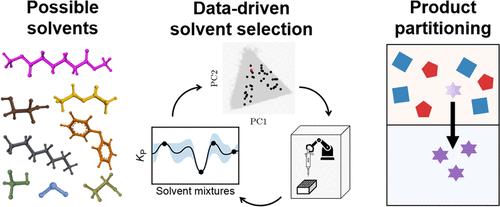
Liquid–liquid extraction (LLE) is a widely used technique for the separation and purification of liquid-phase products with applications in various industries, including pharmaceuticals, petrochemicals, and renewable chemistry. A critical step in the design of an LLE process is the selection of appropriate solvents. This study presents a new methodology for identifying solvent mixtures for bioproduct separation using Bayesian experimental design (BED). Motivated by the need for environmentally friendly and effective separation methods, we address the challenge of selecting solvent systems that balance separation efficiency, selectivity, and environmental impact while also tackling the difficulty of separating multiple bioproducts using complex solvent systems. Our approach specifically seeks to predict product partition coefficients (log10Kp values) as thermodynamic parameters underlying solvent selection. The iterative approach integrates Bayesian optimization with experimental measurements to guide solvent selection and leverages COSMO-RS simulations to enhance high-throughput experimentation. Using the design of solvent systems for the separation of lignin-derived aromatic products via centrifugal partition chromatography (CPC) as a case study, we show that within seven iterations/cycles of the methodology, we can identify new mixtures of green solvents that align with CPC design principles. These results demonstrate the efficacy of the BED framework in optimizing green solvent systems for complex separations, highlighting the potential of this method to advance the field of green chemistry and contribute to the development of sustainable industrial processes.
期刊介绍:
ACS Sustainable Chemistry & Engineering is a prestigious weekly peer-reviewed scientific journal published by the American Chemical Society. Dedicated to advancing the principles of green chemistry and green engineering, it covers a wide array of research topics including green chemistry, green engineering, biomass, alternative energy, and life cycle assessment.
The journal welcomes submissions in various formats, including Letters, Articles, Features, and Perspectives (Reviews), that address the challenges of sustainability in the chemical enterprise and contribute to the advancement of sustainable practices. Join us in shaping the future of sustainable chemistry and engineering.



 京公网安备 11010802042870号
京ICP备2023020795号-1
京公网安备 11010802042870号
京ICP备2023020795号-1

 分享
分享
 求助内容:
求助内容: 应助结果提醒方式:
 扫码关注我们
