{"title":"Space Exploration of Metal-Organic Frameworks in the Mesopore Regime.","authors":"Gaoli Hu, Qi Liu, Hexiang Deng","doi":"10.1021/acs.accounts.4c00633","DOIUrl":null,"url":null,"abstract":"<p><p>ConspectusThe past decades have witnessed the proliferation of porous materials offering high surface areas and the revolution in gas storage and separation, where metal-organic frameworks (MOFs) stand out as an important family. Alongside the pursuit of higher surface area, the increase in the size of guests, such as nanoparticles and biomolecules, has also led to the demand for larger space defined by the pores and cages within the MOF structure, from the conventional micropore regime (<2 nm) toward the mesopore regime (2-50 nm). Among the essential elements in the design of MOFs, molecular building blocks, their coordination and spatial arrangement, the chemistry for molecular design, and coordination bonds have become relatively mature, offering precise control of the shape and environment of the molecularly defined 3D cages; however, the correlation between the geometrical parameters and the size of polyhedrons describing the cages, concerning the spatial arrangement of building blocks, is much less explored.In this Account, we made efforts to associate actual cage size with the critical geometrical components, vertices, edges, connectivity, rings, and underlying polyhedrons, as well as the combination of components of various types in the design of MOFs. Several trends were found, such as influence from connectivity and expansion efficiency, offering insights into the construction of 3D cages in MOFs. This enables the creation of extremely large mesoporous cages in MOFs with an internal diameter up to 11.4 nm from relatively small building blocks. Furthermore, we discuss a strategy of partial removal or replacement of organic linkers to construct mesoporous cages from readily known topologies.All of the above efforts urged us to ask the following questions: Is there any limit in the sculpting of the 3D space from molecules? How large an area can one chemical bond support? The answer to these questions will deepen the knowledge of efficient utilization of chemical bonds in the sculpting of 3D spaces and guide the design of larger mesopores. Several general geometrical principals emerged: (1) Expansion efficiency and radius are positively correlated with the number of vertices. (2) Increase in the number of vertices and decrease of their connectivity favor the construction and expansion of large cages. (3) The boundary of the 3D space constructed by the chemical bonds is related to the polyhedron type and determined by the energy involved in crystallinity. Such principals are likely to be applicable also in the design of isolated cages in supramolecular chemistry. In addition to the structural design and synthesis, the applications of these mesoporous cages in MOFs are also summarized.</p>","PeriodicalId":1,"journal":{"name":"Accounts of Chemical Research","volume":" ","pages":""},"PeriodicalIF":17.7000,"publicationDate":"2024-12-13","publicationTypes":"Journal Article","fieldsOfStudy":null,"isOpenAccess":false,"openAccessPdf":"","citationCount":"0","resultStr":null,"platform":"Semanticscholar","paperid":null,"PeriodicalName":"Accounts of Chemical Research","FirstCategoryId":"92","ListUrlMain":"https://doi.org/10.1021/acs.accounts.4c00633","RegionNum":1,"RegionCategory":"化学","ArticlePicture":[],"TitleCN":null,"AbstractTextCN":null,"PMCID":null,"EPubDate":"","PubModel":"","JCR":"Q1","JCRName":"CHEMISTRY, MULTIDISCIPLINARY","Score":null,"Total":0}
引用次数: 0
Abstract
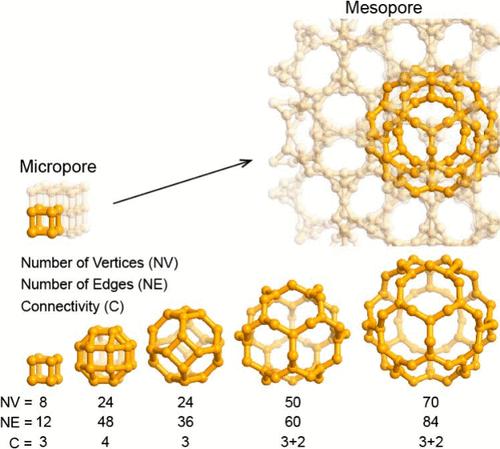
ConspectusThe past decades have witnessed the proliferation of porous materials offering high surface areas and the revolution in gas storage and separation, where metal-organic frameworks (MOFs) stand out as an important family. Alongside the pursuit of higher surface area, the increase in the size of guests, such as nanoparticles and biomolecules, has also led to the demand for larger space defined by the pores and cages within the MOF structure, from the conventional micropore regime (<2 nm) toward the mesopore regime (2-50 nm). Among the essential elements in the design of MOFs, molecular building blocks, their coordination and spatial arrangement, the chemistry for molecular design, and coordination bonds have become relatively mature, offering precise control of the shape and environment of the molecularly defined 3D cages; however, the correlation between the geometrical parameters and the size of polyhedrons describing the cages, concerning the spatial arrangement of building blocks, is much less explored.In this Account, we made efforts to associate actual cage size with the critical geometrical components, vertices, edges, connectivity, rings, and underlying polyhedrons, as well as the combination of components of various types in the design of MOFs. Several trends were found, such as influence from connectivity and expansion efficiency, offering insights into the construction of 3D cages in MOFs. This enables the creation of extremely large mesoporous cages in MOFs with an internal diameter up to 11.4 nm from relatively small building blocks. Furthermore, we discuss a strategy of partial removal or replacement of organic linkers to construct mesoporous cages from readily known topologies.All of the above efforts urged us to ask the following questions: Is there any limit in the sculpting of the 3D space from molecules? How large an area can one chemical bond support? The answer to these questions will deepen the knowledge of efficient utilization of chemical bonds in the sculpting of 3D spaces and guide the design of larger mesopores. Several general geometrical principals emerged: (1) Expansion efficiency and radius are positively correlated with the number of vertices. (2) Increase in the number of vertices and decrease of their connectivity favor the construction and expansion of large cages. (3) The boundary of the 3D space constructed by the chemical bonds is related to the polyhedron type and determined by the energy involved in crystallinity. Such principals are likely to be applicable also in the design of isolated cages in supramolecular chemistry. In addition to the structural design and synthesis, the applications of these mesoporous cages in MOFs are also summarized.
期刊介绍:
Accounts of Chemical Research presents short, concise and critical articles offering easy-to-read overviews of basic research and applications in all areas of chemistry and biochemistry. These short reviews focus on research from the author’s own laboratory and are designed to teach the reader about a research project. In addition, Accounts of Chemical Research publishes commentaries that give an informed opinion on a current research problem. Special Issues online are devoted to a single topic of unusual activity and significance.
Accounts of Chemical Research replaces the traditional article abstract with an article "Conspectus." These entries synopsize the research affording the reader a closer look at the content and significance of an article. Through this provision of a more detailed description of the article contents, the Conspectus enhances the article's discoverability by search engines and the exposure for the research.




 京公网安备 11010802042870号
京ICP备2023020795号-1
京公网安备 11010802042870号
京ICP备2023020795号-1

 分享
分享
 求助内容:
求助内容: 应助结果提醒方式:
 扫码关注我们
