Biswadev Mitra MBBS, MHSM, PhD, FACEM, Kate Settle CCRN, MHA, Christine Koolstra CCRN, Carly Talarico BA, BHSc, MPH, MHA, De Villiers Smit MBChB, FACEM, Peter A Cameron MBBS, MD, FACEM
{"title":"Introduction of the Broset Violence Checklist in the emergency department: A retrospective cohort study","authors":"Biswadev Mitra MBBS, MHSM, PhD, FACEM, Kate Settle CCRN, MHA, Christine Koolstra CCRN, Carly Talarico BA, BHSc, MPH, MHA, De Villiers Smit MBChB, FACEM, Peter A Cameron MBBS, MD, FACEM","doi":"10.1111/1742-6723.14546","DOIUrl":null,"url":null,"abstract":"<div>\n \n \n <section>\n \n <h3> Objective</h3>\n \n <p>The Broset Violence Checklist (BVC) can stratify the risk of violence and aggression in EDs. The aim of the present study was to report the initial uptake of introducing this checklist and associations with unplanned alerts to potential or actual violence in two EDs.</p>\n </section>\n \n <section>\n \n <h3> Methods</h3>\n \n <p>The BVC was recommended in all patient care episodes. This retrospective review included routinely collected data from an adult tertiary referral hospital and a suburban mixed paediatric and adult ED over a 12-month period. The primary outcome variable was completion of at least one BVC score and the secondary outcome was unplanned alerts to potential or actual violence episodes within the EDs.</p>\n </section>\n \n <section>\n \n <h3> Results</h3>\n \n <p>There were 121 330 presentations, of which 108 274 were included in the present study. The BVC was completed for 42 675 (39.4%) presentations. Using a cut-off score of 3, BVC had a specificity of 99.2% (95% confidence interval [CI] 99.1–99.2) and a sensitivity of 15.6% (95% CI 12.5–19.3) for unplanned alerts to potential or actual violence events. Completion of a BVC was independently associated with more unplanned alerts to potential or actual violence events (adjusted odds ratio 1.37; 95% CI 1.12–1.66).</p>\n </section>\n \n <section>\n \n <h3> Conclusions</h3>\n \n <p>The BVC was highly specific for violence and aggression but had low sensitivity. Completion of the BVC was associated with more frequent unplanned alerts to potential or actual violence events, suggesting that high-risk patients might be identified intuitively, without formal scoring. Further exploration of the utility of the BVC in the ED is indicated with a focus on strategies to prevent violence and aggression.</p>\n </section>\n </div>","PeriodicalId":11604,"journal":{"name":"Emergency Medicine Australasia","volume":"37 1","pages":""},"PeriodicalIF":1.4000,"publicationDate":"2024-12-12","publicationTypes":"Journal Article","fieldsOfStudy":null,"isOpenAccess":false,"openAccessPdf":"","citationCount":"0","resultStr":null,"platform":"Semanticscholar","paperid":null,"PeriodicalName":"Emergency Medicine Australasia","FirstCategoryId":"3","ListUrlMain":"https://onlinelibrary.wiley.com/doi/10.1111/1742-6723.14546","RegionNum":4,"RegionCategory":"医学","ArticlePicture":[],"TitleCN":null,"AbstractTextCN":null,"PMCID":null,"EPubDate":"","PubModel":"","JCR":"Q2","JCRName":"EMERGENCY MEDICINE","Score":null,"Total":0}
引用次数: 0
Abstract
Objective
The Broset Violence Checklist (BVC) can stratify the risk of violence and aggression in EDs. The aim of the present study was to report the initial uptake of introducing this checklist and associations with unplanned alerts to potential or actual violence in two EDs.
Methods
The BVC was recommended in all patient care episodes. This retrospective review included routinely collected data from an adult tertiary referral hospital and a suburban mixed paediatric and adult ED over a 12-month period. The primary outcome variable was completion of at least one BVC score and the secondary outcome was unplanned alerts to potential or actual violence episodes within the EDs.
Results
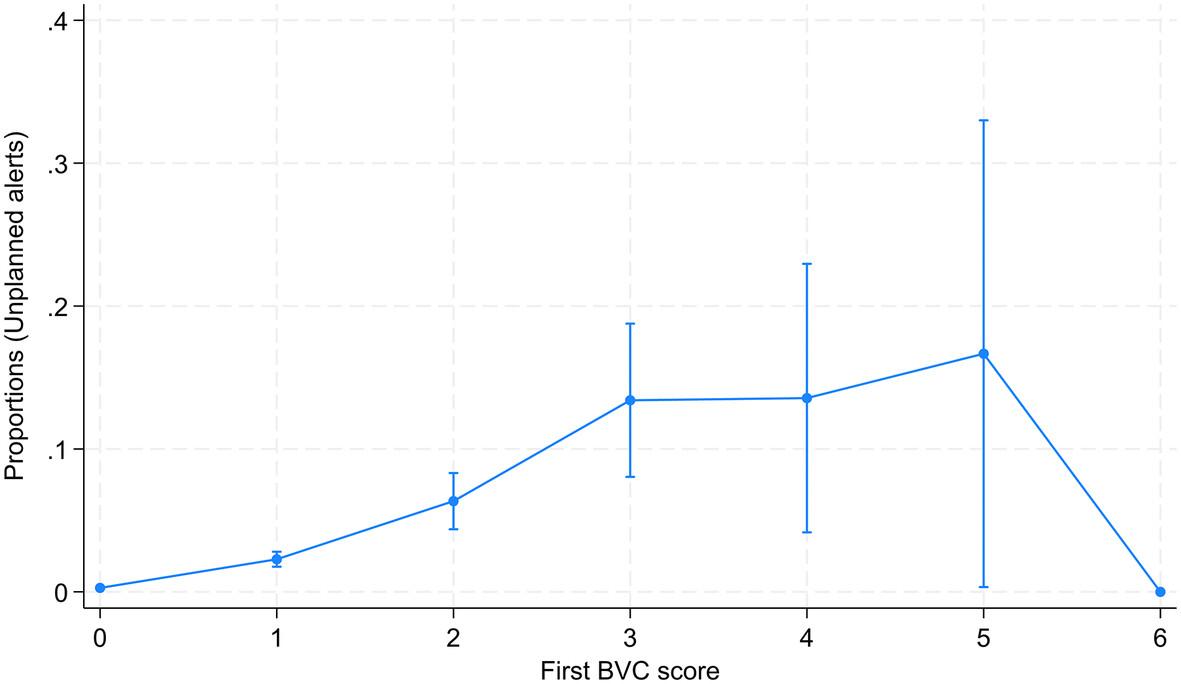
There were 121 330 presentations, of which 108 274 were included in the present study. The BVC was completed for 42 675 (39.4%) presentations. Using a cut-off score of 3, BVC had a specificity of 99.2% (95% confidence interval [CI] 99.1–99.2) and a sensitivity of 15.6% (95% CI 12.5–19.3) for unplanned alerts to potential or actual violence events. Completion of a BVC was independently associated with more unplanned alerts to potential or actual violence events (adjusted odds ratio 1.37; 95% CI 1.12–1.66).
Conclusions
The BVC was highly specific for violence and aggression but had low sensitivity. Completion of the BVC was associated with more frequent unplanned alerts to potential or actual violence events, suggesting that high-risk patients might be identified intuitively, without formal scoring. Further exploration of the utility of the BVC in the ED is indicated with a focus on strategies to prevent violence and aggression.
目的:用Broset暴力行为检查表(BVC)对急诊科患者的暴力和攻击行为风险进行分类。本研究的目的是报告在两种急诊科中引入该清单的初步情况以及与潜在或实际暴力的意外警报的联系。方法:推荐BVC在所有患者护理期使用。本回顾性研究包括12个月期间从一家成人三级转诊医院和一家郊区儿科和成人混合急诊科例行收集的数据。主要结局变量是完成至少一个BVC评分,次要结局是对急症室中潜在或实际暴力事件的意外警报。结果:121 330例报告,其中108 274例纳入本研究。BVC完成了42 675份(39.4%)报告。使用截断分数为3分,BVC对潜在或实际暴力事件的意外警报的特异性为99.2%(95%置信区间[CI] 99.1-99.2),敏感性为15.6% (95% CI 12.5-19.3)。BVC的完成与更多潜在或实际暴力事件的意外警报独立相关(调整优势比1.37;95% ci 1.12-1.66)。结论:BVC对暴力和攻击行为具有高度特异性,但敏感性较低。BVC的完成与更频繁的潜在或实际暴力事件的意外警报有关,这表明高风险患者可能是直观地识别的,而不需要正式的评分。本文将进一步探讨BVC在英语教学中的应用,重点是预防暴力和侵略的策略。
期刊介绍:
Emergency Medicine Australasia is the official journal of the Australasian College for Emergency Medicine (ACEM) and the Australasian Society for Emergency Medicine (ASEM), and publishes original articles dealing with all aspects of clinical practice, research, education and experiences in emergency medicine.
Original articles are published under the following sections: Original Research, Paediatric Emergency Medicine, Disaster Medicine, Education and Training, Ethics, International Emergency Medicine, Management and Quality, Medicolegal Matters, Prehospital Care, Public Health, Rural and Remote Care, Technology, Toxicology and Trauma. Accepted papers become the copyright of the journal.



 京公网安备 11010802042870号
京ICP备2023020795号-1
京公网安备 11010802042870号
京ICP备2023020795号-1

 分享
分享
 求助内容:
求助内容: 应助结果提醒方式:
 扫码关注我们
