Jessica L Fairley, Dylan Hansen, Susanna Proudman, Joanne Sahhar, Gene-Siew Ngian, Diane Apostolopoulos, Jennifer Walker, Lauren V Host, Wendy Stevens, Nava Ferdowsi, Maryam Tabesh, Mandana Nikpour, Laura Ross
{"title":"The frequency and clinical associations of opioid use in systemic sclerosis.","authors":"Jessica L Fairley, Dylan Hansen, Susanna Proudman, Joanne Sahhar, Gene-Siew Ngian, Diane Apostolopoulos, Jennifer Walker, Lauren V Host, Wendy Stevens, Nava Ferdowsi, Maryam Tabesh, Mandana Nikpour, Laura Ross","doi":"10.1093/rap/rkae144","DOIUrl":null,"url":null,"abstract":"<p><strong>Objective: </strong>To define the frequency and associations of opioid use in SSc.</p><p><strong>Methods: </strong>Australian Scleroderma Cohort Study participants meeting ACR/EULAR criteria for SSc were included. Current or previous opioid use was recorded at each visit, with long-term use defined as use on two or more consecutive visits. Groups were compared using two-sample <i>t</i>-test, Wilcoxon rank sum test or chi-squared test. Generalised estimating equations were used to model longitudinal data.</p><p><strong>Results: </strong>Of 1951 participants with a mean age of 46.7 years (s.d. 14.4), 88% were female and 12% had ever received any opioids since SSc onset. Of these, 46% recorded opioid use across multiple consecutive study visits. Digital ulcers (63% <i>vs</i> 52%), synovitis (57% <i>vs</i> 38%), interstitial lung disease (37% <i>vs</i> 27%), gastrointestinal (GI) symptoms (upper 97% <i>vs</i> 88%, lower 90% <i>vs</i> 80%) and immunosuppression (59% <i>vs</i> 46%) were all more frequent in opioid-exposed groups (<i>P</i> < 0.05). In multivariable modelling, current opioid use at each study visit was associated with digital ulcers [odds ratio (OR) 1.5 (95% CI 1.1, 2.0), <i>P</i> = 0.01], synovitis [OR 1.5 (95% CI 1.1, 2.1), <i>P</i> = 0.02], lower GI symptoms [OR 1.8 (95% CI 1.3, 2.6), <i>P</i> < 0.01] and poorer physical [OR 1.8 (95% CI 1.3, 2.4), <i>P</i> < 0.01] and mental [OR 1.8 (95% CI 1.1, 3.0), <i>P</i> = 0.02] quality of life (QoL). Current opioid use was associated with worse fatigue [regression coefficient (RC) 3.0 units (95% CI 1.2, 4.8), <i>P</i> < 0.01], functional disability [RC 0.2 (95% CI 0.2, 0.3), <i>P</i> < 0.01], dyspnoea [RC 2.0 (95% CI 0.8, 3.1), <i>P</i> < 0.01], depression [RC 2.5 (95% CI 0.9, 4.0), <i>P</i> < 0.01] and anxiety [RC 2.5 (95% CI 0.9, 4.0), <i>P</i> < 0.01].</p><p><strong>Conclusions: </strong>Opioid use in SSc was associated with musculoskeletal, GI and lung involvement. Opioid prescription was associated with poorer QoL and physical function.</p>","PeriodicalId":21350,"journal":{"name":"Rheumatology Advances in Practice","volume":"8 4","pages":"rkae144"},"PeriodicalIF":2.1000,"publicationDate":"2024-11-15","publicationTypes":"Journal Article","fieldsOfStudy":null,"isOpenAccess":false,"openAccessPdf":"https://www.ncbi.nlm.nih.gov/pmc/articles/PMC11634672/pdf/","citationCount":"0","resultStr":null,"platform":"Semanticscholar","paperid":null,"PeriodicalName":"Rheumatology Advances in Practice","FirstCategoryId":"1085","ListUrlMain":"https://doi.org/10.1093/rap/rkae144","RegionNum":0,"RegionCategory":null,"ArticlePicture":[],"TitleCN":null,"AbstractTextCN":null,"PMCID":null,"EPubDate":"2024/1/1 0:00:00","PubModel":"eCollection","JCR":"Q3","JCRName":"RHEUMATOLOGY","Score":null,"Total":0}
引用次数: 0
Abstract
Objective: To define the frequency and associations of opioid use in SSc.
Methods: Australian Scleroderma Cohort Study participants meeting ACR/EULAR criteria for SSc were included. Current or previous opioid use was recorded at each visit, with long-term use defined as use on two or more consecutive visits. Groups were compared using two-sample t-test, Wilcoxon rank sum test or chi-squared test. Generalised estimating equations were used to model longitudinal data.
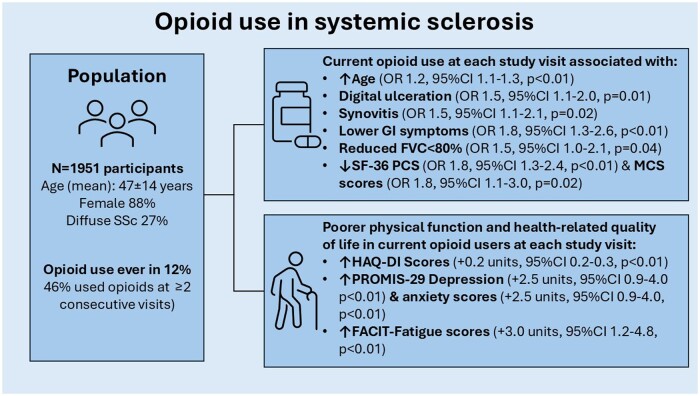
Results: Of 1951 participants with a mean age of 46.7 years (s.d. 14.4), 88% were female and 12% had ever received any opioids since SSc onset. Of these, 46% recorded opioid use across multiple consecutive study visits. Digital ulcers (63% vs 52%), synovitis (57% vs 38%), interstitial lung disease (37% vs 27%), gastrointestinal (GI) symptoms (upper 97% vs 88%, lower 90% vs 80%) and immunosuppression (59% vs 46%) were all more frequent in opioid-exposed groups (P < 0.05). In multivariable modelling, current opioid use at each study visit was associated with digital ulcers [odds ratio (OR) 1.5 (95% CI 1.1, 2.0), P = 0.01], synovitis [OR 1.5 (95% CI 1.1, 2.1), P = 0.02], lower GI symptoms [OR 1.8 (95% CI 1.3, 2.6), P < 0.01] and poorer physical [OR 1.8 (95% CI 1.3, 2.4), P < 0.01] and mental [OR 1.8 (95% CI 1.1, 3.0), P = 0.02] quality of life (QoL). Current opioid use was associated with worse fatigue [regression coefficient (RC) 3.0 units (95% CI 1.2, 4.8), P < 0.01], functional disability [RC 0.2 (95% CI 0.2, 0.3), P < 0.01], dyspnoea [RC 2.0 (95% CI 0.8, 3.1), P < 0.01], depression [RC 2.5 (95% CI 0.9, 4.0), P < 0.01] and anxiety [RC 2.5 (95% CI 0.9, 4.0), P < 0.01].
Conclusions: Opioid use in SSc was associated with musculoskeletal, GI and lung involvement. Opioid prescription was associated with poorer QoL and physical function.
目的:明确SSc中阿片类药物使用的频率及其相关性。方法:澳大利亚硬皮病队列研究的参与者符合ACR/EULAR标准的SSc。在每次就诊时记录当前或以前的阿片类药物使用情况,长期使用定义为连续两次或两次以上的使用。各组间比较采用双样本t检验、Wilcoxon秩和检验或卡方检验。采用广义估计方程对纵向数据进行建模。结果:1951名平均年龄46.7岁(sd 14.4)的参与者中,88%为女性,12%自SSc发病以来曾服用过阿片类药物。其中,46%的人在多次连续的研究访问中记录了阿片类药物的使用。指部溃疡(63% vs 52%)、滑膜炎(57% vs 38%)、肺间质性疾病(37% vs 27%)、胃肠道(GI)症状(97% vs 88%, 90% vs 80%)和免疫抑制(59% vs 46%)在阿片类药物暴露组更常见(P P = 0.01)、滑膜炎[OR 1.5 (95% CI 1.1, 2.1), P = 0.02]、下消化道症状[OR 1.8 (95% CI 1.3, 2.6), P P P = 0.02]生活质量(QoL)。目前阿片类药物的使用与更严重的疲劳有关[回归系数(RC) 3.0单位(95% CI 1.2, 4.8), P P P P P P结论:阿片类药物在SSc中的使用与肌肉骨骼、GI和肺部受累有关。阿片类药物处方与较差的生活质量和身体功能相关。




 京公网安备 11010802042870号
京ICP备2023020795号-1
京公网安备 11010802042870号
京ICP备2023020795号-1

 分享
分享
 求助内容:
求助内容: 应助结果提醒方式:
 扫码关注我们
