{"title":"Longitudinal relationship between hip displacement and hip function in children and adolescents with cerebral palsy: A scoping review","authors":"","doi":"10.1111/dmcn.16208","DOIUrl":null,"url":null,"abstract":"<p>Children with cerebral palsy (CP) are born with typical hips; however, the muscle imbalance caused by CP eventually leads to hip displacement in one of every three children. This can negatively affect how a child functions; however, we do not know how hip structure and function change together over time.</p><p>The aim of this scoping review was to bring together available evidence on the relationship over time between hip structure (measured by X-ray) and hip function (measured in clinical assessment). To do this, we searched five healthcare databases for published studies involving children with CP, which had measured both hip structure and function at least twice over time.</p><p>We identified 29 eligible studies. Four were from large national registry studies, one was a clinical trial, 12 were prospective studies involving measures taken at planned time points, and 12 were retrospective studies whereby relevant information was extracted from healthcare records, after it had been collected in clinical practice.</p><p>Most studies (27 of 29, or 93%) reported hip structure and function before and after an intervention, such as surgery (16 studies), rehabilitation (two studies), nerve block or botulinum toxin (four studies), or a combination of interventions. The other two studies gave information about natural history, without intervention. In measuring function, most studies (26 of 29, or 90%) focused on the hip itself (pain, joint movement, spasticity). Fewer studies (17, or 59%) measured everyday activity and mobility, and fewer still (3, or 10%) measured the impact on social participation.</p>","PeriodicalId":50587,"journal":{"name":"Developmental Medicine and Child Neurology","volume":"67 2","pages":"e52"},"PeriodicalIF":4.3000,"publicationDate":"2024-12-12","publicationTypes":"Journal Article","fieldsOfStudy":null,"isOpenAccess":false,"openAccessPdf":"https://onlinelibrary.wiley.com/doi/epdf/10.1111/dmcn.16208","citationCount":"0","resultStr":null,"platform":"Semanticscholar","paperid":null,"PeriodicalName":"Developmental Medicine and Child Neurology","FirstCategoryId":"3","ListUrlMain":"https://onlinelibrary.wiley.com/doi/10.1111/dmcn.16208","RegionNum":2,"RegionCategory":"医学","ArticlePicture":[],"TitleCN":null,"AbstractTextCN":null,"PMCID":null,"EPubDate":"","PubModel":"","JCR":"Q1","JCRName":"CLINICAL NEUROLOGY","Score":null,"Total":0}
引用次数: 0
Abstract
Children with cerebral palsy (CP) are born with typical hips; however, the muscle imbalance caused by CP eventually leads to hip displacement in one of every three children. This can negatively affect how a child functions; however, we do not know how hip structure and function change together over time.
The aim of this scoping review was to bring together available evidence on the relationship over time between hip structure (measured by X-ray) and hip function (measured in clinical assessment). To do this, we searched five healthcare databases for published studies involving children with CP, which had measured both hip structure and function at least twice over time.
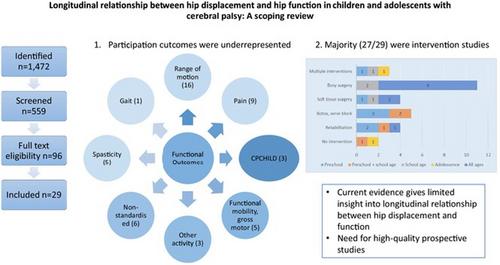
We identified 29 eligible studies. Four were from large national registry studies, one was a clinical trial, 12 were prospective studies involving measures taken at planned time points, and 12 were retrospective studies whereby relevant information was extracted from healthcare records, after it had been collected in clinical practice.
Most studies (27 of 29, or 93%) reported hip structure and function before and after an intervention, such as surgery (16 studies), rehabilitation (two studies), nerve block or botulinum toxin (four studies), or a combination of interventions. The other two studies gave information about natural history, without intervention. In measuring function, most studies (26 of 29, or 90%) focused on the hip itself (pain, joint movement, spasticity). Fewer studies (17, or 59%) measured everyday activity and mobility, and fewer still (3, or 10%) measured the impact on social participation.
期刊介绍:
Wiley-Blackwell is pleased to publish Developmental Medicine & Child Neurology (DMCN), a Mac Keith Press publication and official journal of the American Academy for Cerebral Palsy and Developmental Medicine (AACPDM) and the British Paediatric Neurology Association (BPNA).
For over 50 years, DMCN has defined the field of paediatric neurology and neurodisability and is one of the world’s leading journals in the whole field of paediatrics. DMCN disseminates a range of information worldwide to improve the lives of disabled children and their families. The high quality of published articles is maintained by expert review, including independent statistical assessment, before acceptance.



 京公网安备 11010802042870号
京ICP备2023020795号-1
京公网安备 11010802042870号
京ICP备2023020795号-1

 分享
分享
 求助内容:
求助内容: 应助结果提醒方式:
 扫码关注我们
