{"title":"Sexual and reproductive health education for patients with myelomeningocele","authors":"","doi":"10.1111/dmcn.16207","DOIUrl":null,"url":null,"abstract":"<p>This article focuses on the importance of providing sexual and reproductive health education to individuals with myelomeningocele, the most severe form of spina bifida. Myelomeningocele is caused by a defect to the developing brain and spine that results in damage to the spinal cord and nerves. This lifelong condition is associated with a wide range of disease severity, it is not always clear to patients how their disabilities may affect their reproductive and sexual health.</p><p>A survey was designed to assess the rate of sexual and reproductive health discussions occurring in a multidisciplinary myelomeningocele clinic at a freestanding pediatric hospital.</p><p>The authors highlight that individuals with this condition often face unique challenges related to their sexual and reproductive health due to physical and neurological issues. These challenges can include mobility limitations, bowel and bladder control problems, and potential fertility concerns. Despite these issues, there is a lack of comprehensive sexual health education tailored for these patients.</p><p>The article emphasizes the need for healthcare providers to address these topics openly and sensitively. It suggests that educating patients about their sexual health is crucial for improving their quality of life and fostering healthy relationships. The authors recommend developing specific educational programs that cover a range of topics, including anatomy, contraception, sexually transmitted infections, and healthy relationships.</p><p>Additionally, the article calls for healthcare professionals to create a safe and supportive environment for patients to ask questions and express their concerns. It stresses that sexual health education should not only be about physical health but also include emotional and social aspects, empowering individuals to make informed decisions about their bodies and relationships.</p>","PeriodicalId":50587,"journal":{"name":"Developmental Medicine and Child Neurology","volume":"67 2","pages":"e51"},"PeriodicalIF":4.3000,"publicationDate":"2024-12-12","publicationTypes":"Journal Article","fieldsOfStudy":null,"isOpenAccess":false,"openAccessPdf":"https://onlinelibrary.wiley.com/doi/epdf/10.1111/dmcn.16207","citationCount":"0","resultStr":null,"platform":"Semanticscholar","paperid":null,"PeriodicalName":"Developmental Medicine and Child Neurology","FirstCategoryId":"3","ListUrlMain":"https://onlinelibrary.wiley.com/doi/10.1111/dmcn.16207","RegionNum":2,"RegionCategory":"医学","ArticlePicture":[],"TitleCN":null,"AbstractTextCN":null,"PMCID":null,"EPubDate":"","PubModel":"","JCR":"Q1","JCRName":"CLINICAL NEUROLOGY","Score":null,"Total":0}
引用次数: 0
Abstract
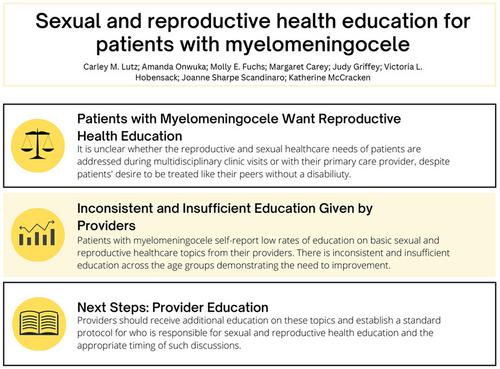
This article focuses on the importance of providing sexual and reproductive health education to individuals with myelomeningocele, the most severe form of spina bifida. Myelomeningocele is caused by a defect to the developing brain and spine that results in damage to the spinal cord and nerves. This lifelong condition is associated with a wide range of disease severity, it is not always clear to patients how their disabilities may affect their reproductive and sexual health.
A survey was designed to assess the rate of sexual and reproductive health discussions occurring in a multidisciplinary myelomeningocele clinic at a freestanding pediatric hospital.
The authors highlight that individuals with this condition often face unique challenges related to their sexual and reproductive health due to physical and neurological issues. These challenges can include mobility limitations, bowel and bladder control problems, and potential fertility concerns. Despite these issues, there is a lack of comprehensive sexual health education tailored for these patients.
The article emphasizes the need for healthcare providers to address these topics openly and sensitively. It suggests that educating patients about their sexual health is crucial for improving their quality of life and fostering healthy relationships. The authors recommend developing specific educational programs that cover a range of topics, including anatomy, contraception, sexually transmitted infections, and healthy relationships.
Additionally, the article calls for healthcare professionals to create a safe and supportive environment for patients to ask questions and express their concerns. It stresses that sexual health education should not only be about physical health but also include emotional and social aspects, empowering individuals to make informed decisions about their bodies and relationships.
期刊介绍:
Wiley-Blackwell is pleased to publish Developmental Medicine & Child Neurology (DMCN), a Mac Keith Press publication and official journal of the American Academy for Cerebral Palsy and Developmental Medicine (AACPDM) and the British Paediatric Neurology Association (BPNA).
For over 50 years, DMCN has defined the field of paediatric neurology and neurodisability and is one of the world’s leading journals in the whole field of paediatrics. DMCN disseminates a range of information worldwide to improve the lives of disabled children and their families. The high quality of published articles is maintained by expert review, including independent statistical assessment, before acceptance.



 京公网安备 11010802042870号
京ICP备2023020795号-1
京公网安备 11010802042870号
京ICP备2023020795号-1

 分享
分享
 求助内容:
求助内容: 应助结果提醒方式:
 扫码关注我们
