{"title":"Programmable Modular Assembly of Homochiral Ir(III)-Metallohelices to Reverse Metallodrug Resistance by Inhibiting CDK1","authors":"Xuezhao Li, Xing Zhao, Xingyun Wang, Anxian Xiong, Zhicheng Wang, Zhuolin Shi, Jingyi Zhang, Hanlin Wang, Wei Wei, Cheng He, Jiajia Ma, Zijian Guo, Chunying Duan, Prof. Dr. Jing Zhao, Xiuxiu Wang","doi":"10.1002/anie.202419292","DOIUrl":null,"url":null,"abstract":"<p>Drug resistance is a major cause of cancer recurrence and poor prognosis. The innovative design and synthesis of inhibitors to target drug-resistance-specific proteins is highly desirable. However, challenges remain in precisely adjusting their conformation and stereochemistry to adapt the chiral regions of target proteins. Herein, using a stepwise programmable modular assembly approach, we precisely engineered two pairs of homochiral dinuclear Ir(III) metallohelices (<b><i>Λ</i><sub>2</sub></b><i><b>S</b></i><sub><b>4</b></sub><b>-H<sub>bpy</sub></b> and <b><i>Δ</i><sub>2</sub></b><i><b>R</b></i><sub><b>4</b></sub><b>-H<sub>bpy</sub></b>, <b><i>Δ</i><sub>2</sub></b><i><b>S</b></i><sub><b>4</b></sub><b>-H<sub>bpy</sub></b> and <b><i>Λ</i><sub>2</sub></b><i><b>R</b></i><sub><b>4</b></sub><b>-H<sub>bpy</sub></b>) functionalized with flexible dithiourea linkages. The resulting homochiral metallohelices exhibited significant chirality-dependent photocytotoxicities, and the enhanced structural compatibility of <b><i>Δ</i><sub>2</sub></b><i><b>S</b></i><sub><b>4</b></sub><b>-H<sub>bpy</sub></b> with the target cyclin-dependent kinase 1 (CDK1) contributed to its superior photodynamic therapy efficacy, achieving an outstanding photocytotoxicity index (PI) value of 2.3×10<sup>4</sup>. Interestingly, emerging as a critical mediator in the development of oxaliplatin resistance, CDK1 targeting by <b><i>Δ</i><sub>2</sub></b><i><b>S</b></i><sub><b>4</b></sub><b>-H<sub>bpy</sub></b> achieved enhanced cellular uptake, anticancer activity, and oncosis-mediated cell death in oxaliplatin-resistant HCT-8/L cells. Mechanistic investigations, including proteomic profiling and CDK1 gene silencing, confirmed the pivotal role of chirality-selective CDK1 targeting in reversing metallodrug resistance. This study introduces a promising platform for constructing and customizing flexible metallohelices with precise conformation and stereochemistry to target drug-resistance-specific proteins, offering innovative insights into the designability of metallodrugs to overcome drug resistance.</p>","PeriodicalId":125,"journal":{"name":"Angewandte Chemie International Edition","volume":"64 7","pages":""},"PeriodicalIF":16.9000,"publicationDate":"2024-12-14","publicationTypes":"Journal Article","fieldsOfStudy":null,"isOpenAccess":false,"openAccessPdf":"","citationCount":"0","resultStr":null,"platform":"Semanticscholar","paperid":null,"PeriodicalName":"Angewandte Chemie International Edition","FirstCategoryId":"92","ListUrlMain":"https://onlinelibrary.wiley.com/doi/10.1002/anie.202419292","RegionNum":1,"RegionCategory":"化学","ArticlePicture":[],"TitleCN":null,"AbstractTextCN":null,"PMCID":null,"EPubDate":"","PubModel":"","JCR":"Q1","JCRName":"CHEMISTRY, MULTIDISCIPLINARY","Score":null,"Total":0}
引用次数: 0
Abstract
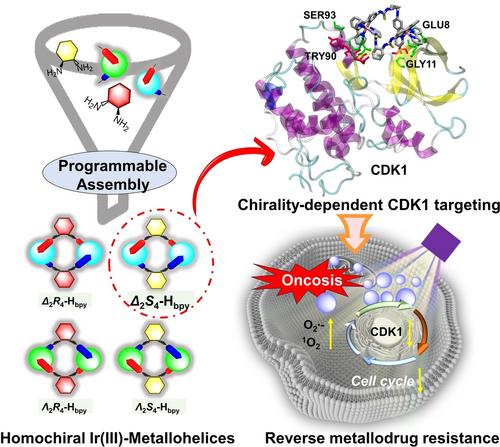
Drug resistance is a major cause of cancer recurrence and poor prognosis. The innovative design and synthesis of inhibitors to target drug-resistance-specific proteins is highly desirable. However, challenges remain in precisely adjusting their conformation and stereochemistry to adapt the chiral regions of target proteins. Herein, using a stepwise programmable modular assembly approach, we precisely engineered two pairs of homochiral dinuclear Ir(III) metallohelices (Λ2S4-Hbpy and Δ2R4-Hbpy, Δ2S4-Hbpy and Λ2R4-Hbpy) functionalized with flexible dithiourea linkages. The resulting homochiral metallohelices exhibited significant chirality-dependent photocytotoxicities, and the enhanced structural compatibility of Δ2S4-Hbpy with the target cyclin-dependent kinase 1 (CDK1) contributed to its superior photodynamic therapy efficacy, achieving an outstanding photocytotoxicity index (PI) value of 2.3×10⁴. Interestingly, emerging as a critical mediator in the development of oxaliplatin resistance, CDK1 targeting by Δ2S4-Hbpy achieved enhanced cellular uptake, anticancer activity, and oncosis-mediated cell death in oxaliplatin-resistant HCT-8/L cells. Mechanistic investigations, including proteomic profiling and CDK1 gene silencing, confirmed the pivotal role of chirality-selective CDK1 targeting in reversing metallodrug resistance. This study introduces a promising platform for constructing and customizing flexible metallohelices with precise conformation and stereochemistry to target drug-resistance-specific proteins, offering innovative insights into the designability of metallodrugs to overcome drug resistance.
期刊介绍:
Angewandte Chemie, a journal of the German Chemical Society (GDCh), maintains a leading position among scholarly journals in general chemistry with an impressive Impact Factor of 16.6 (2022 Journal Citation Reports, Clarivate, 2023). Published weekly in a reader-friendly format, it features new articles almost every day. Established in 1887, Angewandte Chemie is a prominent chemistry journal, offering a dynamic blend of Review-type articles, Highlights, Communications, and Research Articles on a weekly basis, making it unique in the field.



 京公网安备 11010802042870号
京ICP备2023020795号-1
京公网安备 11010802042870号
京ICP备2023020795号-1

 分享
分享
 求助内容:
求助内容: 应助结果提醒方式:
 扫码关注我们
