{"title":"Towards robust causal inference in epidemiologic research: employing double cross-fit TMLE in right heart catheterization data.","authors":"Momenul Haque Mondol, Mohammad Ehsanul Karim","doi":"10.1093/aje/kwae447","DOIUrl":null,"url":null,"abstract":"<p><p>Within epidemiologic research, estimating treatment effects from observational data presents notable challenges. Targeted maximum likelihood estimation (TMLE) emerges as a robust method, addressing these challenges by accurately modeling treatment effects. This approach uniquely combines the precision of correctly specified models with the versatility of data-adaptive, flexible machine learning algorithms. Despite its effectiveness, TMLE's integration of complex algorithms can introduce bias and undercoverage. This issue is addressed through the double cross-fit TMLE (DC-TMLE) approach, enhancing accuracy and reducing biases inherent in observational studies. However, DC-TMLE's potential remains underexplored in epidemiologic research, primarily due to the lack of comprehensive methodologic guidance and the complexity of its computational implementation. Recognizing this gap, our article contributes a detailed, reproducible guide for implementing DC-TMLE in R, aimed specifically at epidemiologic applications. We demonstrate the utility of this method using an openly available clinical data set, underscoring its relevance and adaptability for robust epidemiologic analysis. This guide aims to facilitate broader adoption of DC-TMLE in epidemiologic studies, promoting more accurate and reliable treatment effect estimations in observational research.</p>","PeriodicalId":7472,"journal":{"name":"American journal of epidemiology","volume":" ","pages":"2813-2819"},"PeriodicalIF":4.8000,"publicationDate":"2025-10-07","publicationTypes":"Journal Article","fieldsOfStudy":null,"isOpenAccess":false,"openAccessPdf":"https://www.ncbi.nlm.nih.gov/pmc/articles/PMC12527275/pdf/","citationCount":"0","resultStr":null,"platform":"Semanticscholar","paperid":null,"PeriodicalName":"American journal of epidemiology","FirstCategoryId":"3","ListUrlMain":"https://doi.org/10.1093/aje/kwae447","RegionNum":2,"RegionCategory":"医学","ArticlePicture":[],"TitleCN":null,"AbstractTextCN":null,"PMCID":null,"EPubDate":"","PubModel":"","JCR":"Q1","JCRName":"PUBLIC, ENVIRONMENTAL & OCCUPATIONAL HEALTH","Score":null,"Total":0}
引用次数: 0
Abstract
Within epidemiologic research, estimating treatment effects from observational data presents notable challenges. Targeted maximum likelihood estimation (TMLE) emerges as a robust method, addressing these challenges by accurately modeling treatment effects. This approach uniquely combines the precision of correctly specified models with the versatility of data-adaptive, flexible machine learning algorithms. Despite its effectiveness, TMLE's integration of complex algorithms can introduce bias and undercoverage. This issue is addressed through the double cross-fit TMLE (DC-TMLE) approach, enhancing accuracy and reducing biases inherent in observational studies. However, DC-TMLE's potential remains underexplored in epidemiologic research, primarily due to the lack of comprehensive methodologic guidance and the complexity of its computational implementation. Recognizing this gap, our article contributes a detailed, reproducible guide for implementing DC-TMLE in R, aimed specifically at epidemiologic applications. We demonstrate the utility of this method using an openly available clinical data set, underscoring its relevance and adaptability for robust epidemiologic analysis. This guide aims to facilitate broader adoption of DC-TMLE in epidemiologic studies, promoting more accurate and reliable treatment effect estimations in observational research.
期刊介绍:
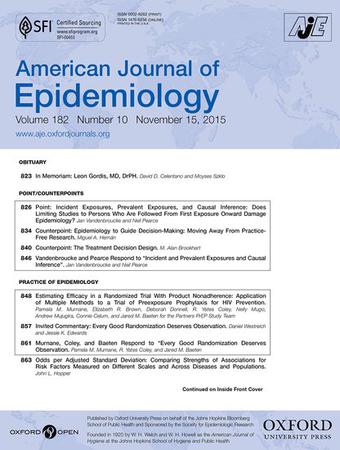
The American Journal of Epidemiology is the oldest and one of the premier epidemiologic journals devoted to the publication of empirical research findings, opinion pieces, and methodological developments in the field of epidemiologic research.
It is a peer-reviewed journal aimed at both fellow epidemiologists and those who use epidemiologic data, including public health workers and clinicians.



 京公网安备 11010802042870号
京ICP备2023020795号-1
京公网安备 11010802042870号
京ICP备2023020795号-1

 分享
分享
 求助内容:
求助内容: 应助结果提醒方式:
 扫码关注我们
