Pseudogerm of the parasitoid Macrocentrus cingulum suppresses host pupation by degenerating prothoracic gland and inhibiting the expression of Br-C in the host Ostrinia furnacalis

IF 3.8 1区 农林科学 Q1 AGRONOMY Pest Management Science Pub Date : 2024-12-16 DOI:10.1002/ps.8605
Yurong Zhang, Yan Du, Qian Wang, Jian Hu
{"title":"Pseudogerm of the parasitoid Macrocentrus cingulum suppresses host pupation by degenerating prothoracic gland and inhibiting the expression of Br-C in the host Ostrinia furnacalis","authors":"Yurong Zhang,&nbsp;Yan Du,&nbsp;Qian Wang,&nbsp;Jian Hu","doi":"10.1002/ps.8605","DOIUrl":null,"url":null,"abstract":"<div>\n \n \n <section>\n \n <h3> BACKGROUND</h3>\n \n <p>Parasitic wasps manipulate host development for successful parasitization. When the host <i>Ostrinia furnacalis</i> is parasitized by the parasitoid <i>Macrocentrus cingulum</i>, its larvae fail to pupate and are consumed as nutrition by the wasp larvae. However, the mechanism by which <i>M. cingulum</i> modulates host pupation remains unclear. This study reports on pseudogerm, a newly discovered parasitic factor derived from <i>M. cingulum</i>, which plays a regulatory role in the pupation process of the host.</p>\n </section>\n \n <section>\n \n <h3> RESULTS</h3>\n \n <p><i>Ostrinia furnacalis</i> larvae transplanted with pseudogerms failed to pupate, and their prothoracic gland (PG) cells did not enlarge significantly at the prepupal stage compared to the control. Additionally, the nuclei of PG cells fragmented, the number of secretory vesicles in the cytoplasm decreased markedly, and the intracellular channel system on the cell membrane atrophied. Furthermore, the elevation of the 20-hydroxyecdysone (20E) titer at the prepupal stage was also suppressed, indicating that pseudogerm disrupts the ecdysteroid level by causing PG cell degeneration. Additionally, there was a suppression of <i>Broad Complex</i> (<i>Br-C</i>) expression in <i>O. furnacalis</i> larvae before the prepupal stage due to pseudogerms transplantation. When <i>OfBr-C</i> was knocked down by RNA-interference or knocked out by CRISPR/Cas9, approximately 24% and 48.3% of <i>O. furnacalis</i> larvae failed to pupate, respectively.</p>\n </section>\n \n <section>\n \n <h3> CONCLUSION</h3>\n \n <p>Pseudogerm potentially disrupts the 20E titer by destroying the host's PG and further inhibits the expression of <i>OfBr-C</i>, ultimately preventing host pupation. This study provides new insights into the strategies employed by parasitoids in controlling host development. © 2024 Society of Chemical Industry.</p>\n </section>\n </div>","PeriodicalId":218,"journal":{"name":"Pest Management Science","volume":"81 4","pages":"2061-2072"},"PeriodicalIF":3.8000,"publicationDate":"2024-12-16","publicationTypes":"Journal Article","fieldsOfStudy":null,"isOpenAccess":false,"openAccessPdf":"","citationCount":"0","resultStr":null,"platform":"Semanticscholar","paperid":null,"PeriodicalName":"Pest Management Science","FirstCategoryId":"97","ListUrlMain":"https://scijournals.onlinelibrary.wiley.com/doi/10.1002/ps.8605","RegionNum":1,"RegionCategory":"农林科学","ArticlePicture":[],"TitleCN":null,"AbstractTextCN":null,"PMCID":null,"EPubDate":"","PubModel":"","JCR":"Q1","JCRName":"AGRONOMY","Score":null,"Total":0}
引用次数: 0

Abstract

BACKGROUND

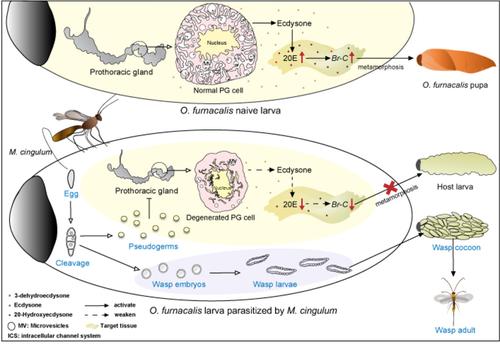
Parasitic wasps manipulate host development for successful parasitization. When the host Ostrinia furnacalis is parasitized by the parasitoid Macrocentrus cingulum, its larvae fail to pupate and are consumed as nutrition by the wasp larvae. However, the mechanism by which M. cingulum modulates host pupation remains unclear. This study reports on pseudogerm, a newly discovered parasitic factor derived from M. cingulum, which plays a regulatory role in the pupation process of the host.

RESULTS

Ostrinia furnacalis larvae transplanted with pseudogerms failed to pupate, and their prothoracic gland (PG) cells did not enlarge significantly at the prepupal stage compared to the control. Additionally, the nuclei of PG cells fragmented, the number of secretory vesicles in the cytoplasm decreased markedly, and the intracellular channel system on the cell membrane atrophied. Furthermore, the elevation of the 20-hydroxyecdysone (20E) titer at the prepupal stage was also suppressed, indicating that pseudogerm disrupts the ecdysteroid level by causing PG cell degeneration. Additionally, there was a suppression of Broad Complex (Br-C) expression in O. furnacalis larvae before the prepupal stage due to pseudogerms transplantation. When OfBr-C was knocked down by RNA-interference or knocked out by CRISPR/Cas9, approximately 24% and 48.3% of O. furnacalis larvae failed to pupate, respectively.

CONCLUSION

Pseudogerm potentially disrupts the 20E titer by destroying the host's PG and further inhibits the expression of OfBr-C, ultimately preventing host pupation. This study provides new insights into the strategies employed by parasitoids in controlling host development. © 2024 Society of Chemical Industry.

Abstract Image

Abstract Image

Abstract Image

Abstract Image

Abstract Image

查看原文
分享 分享
微信好友 朋友圈 QQ好友 复制链接
本刊更多论文
寄生物环带巨心蝇(Macrocentrus cingulum)的假芽通过退化前胸腺和抑制寄主玉米螟(Ostrinia furnacalis) Br-C的表达来抑制寄主化蛹
寄生蜂操纵寄主的发育以成功寄生。当寄主Ostrinia furnacalis被寄生蜂Macrocentrus cingulum寄生时,其幼虫无法化蛹,而被寄生蜂幼虫作为营养消耗掉。然而,M. cingulum调节寄主化蛹的机制仍不清楚。本研究报告了一种新发现的寄生因子--假胚,该因子来源于M. cingulum,在宿主的化蛹过程中起着调节作用。
本文章由计算机程序翻译,如有差异,请以英文原文为准。
求助全文
约1分钟内获得全文 去求助
文献相关原料
公司名称
产品信息
索莱宝
phenol red solution
索莱宝
phenol red solution
麦克林
methanol
来源期刊
Pest Management Science
Pest Management Science 农林科学-昆虫学
CiteScore
7.90
自引率
9.80%
发文量
553
审稿时长
4.8 months
期刊介绍: Pest Management Science is the international journal of research and development in crop protection and pest control. Since its launch in 1970, the journal has become the premier forum for papers on the discovery, application, and impact on the environment of products and strategies designed for pest management. Published for SCI by John Wiley & Sons Ltd.
期刊最新文献
Potential of endophytic Beauveria bassiana against Coraebus (Coleoptera: Buprestidae) oak borers. Artificial shelters as dual-purpose tools for monitoring natural enemies and providing microhabitats in orchards. Residue dynamics and metabolic pathways of sulfoxaflor in Cirsium japonicum var. maackii and Olea europaea L. Molecular co-assembly engineering towards natural tea saponin-based nanopesticides for synergistic enhanced foliar affinity. Cytochrome P450 and glutathione S-transferase may confer bensulfuron-methyl resistance in Cyperus iria.
×
引用
GB/T 7714-2015
复制
MLA
复制
APA
复制
导出至
BibTeX EndNote RefMan NoteFirst NoteExpress
×
×
提示
您的信息不完整,为了账户安全,请先补充。
现在去补充
×
提示
您因"违规操作"
具体请查看互助需知
我知道了
×
提示
现在去查看 取消
×
提示
确定
0
微信
客服QQ
Book学术公众号 扫码关注我们
反馈
×
意见反馈
请填写您的意见或建议
请填写您的手机或邮箱
已复制链接
已复制链接
快去分享给好友吧!
我知道了
×
扫码分享
扫码分享
Book学术官方微信
Book学术文献互助
Book学术文献互助群
群 号:604180095
Book学术
文献互助 智能选刊 最新文献 互助须知 联系我们:info@booksci.cn
Book学术提供免费学术资源搜索服务,方便国内外学者检索中英文文献。致力于提供最便捷和优质的服务体验。
Copyright © 2023 Book学术 All rights reserved.
ghs 京公网安备 11010802042870号 京ICP备2023020795号-1