Risk of Sarcopenia Following Long-Term Statin Use in Community-Dwelling Middle-Aged and Older Adults in Japan

IF 9.1 1区 医学 Q1 GERIATRICS & GERONTOLOGY Journal of Cachexia Sarcopenia and Muscle Pub Date : 2024-12-16 DOI:10.1002/jcsm.13660
Shih-Tsung Huang, Rei Otsuka, Yukiko Nishita, Lin-Chieh Meng, Fei-Yuan Hsiao, Hiroshi Shimokata, Liang-Kung Chen, Hidenori Arai
{"title":"Risk of Sarcopenia Following Long-Term Statin Use in Community-Dwelling Middle-Aged and Older Adults in Japan","authors":"Shih-Tsung Huang,&nbsp;Rei Otsuka,&nbsp;Yukiko Nishita,&nbsp;Lin-Chieh Meng,&nbsp;Fei-Yuan Hsiao,&nbsp;Hiroshi Shimokata,&nbsp;Liang-Kung Chen,&nbsp;Hidenori Arai","doi":"10.1002/jcsm.13660","DOIUrl":null,"url":null,"abstract":"<div>\n \n \n <section>\n \n <h3> Background</h3>\n \n <p>Inconsistent results have been reported concerning the association between statin administration and muscle health, specifically its potential to increase the risk of sarcopenia. Given the widespread long-term use of statins among the elderly population, the exploration of this association remains a crucial yet insufficiently examined matter. This study aimed to assess the association between the prolonged administration of statins and the risk of sarcopenia, diminished muscle strength, reduced skeletal muscle mass and impaired physical performance.</p>\n </section>\n \n <section>\n \n <h3> Methods</h3>\n \n <p>This population-based cohort study was conducted in Japan utilizing data derived from the National Institute for Longevity Sciences-Longitudinal Study of Aging (NILS-LSA). The study participants, enlisted from the 2nd to the 6th waves (spanning from April 2000 to July 2010) of NILS-LSA, were those who aged 40 years or older and had initiated statin therapy (<i>n</i> = 348, age: 64.1 years, female: 63.5%). Individuals who were not administered statins (<i>n</i> = 2559, age: 55.5 years, female: 48.4%) were arbitrarily chosen using a combined approach of propensity score (PS) matching and risk set sampling to form the control group (with a 1:4 matching ratio). The primary outcome of this study was the occurrence of sarcopenia, as defined by the 2019 consensus of the Asian Working Group for Sarcopenia (AWGS). The secondary outcomes included low muscle mass (&lt; 7.0 kg/m<sup>2</sup> for men and below 5.4 kg/m<sup>2</sup> for women by DXA), reduced skeletal muscle strength (handgrip strength &lt; 28 kg in men and &lt; 18 kg in women) and subpar physical performance (6-min walking speed &lt; 1.0 m/s). The relationship between the use of statins and the outcomes was estimated using a Cox proportional hazard model with time-varying covariates, which included the status of statin use and other variables (two-tailed <i>p</i> &lt; 0.05 was considered statistically significant). Stratification based on age and sex, along with five sensitivity analyses—including propensity score overlap weighting and a negative control—was conducted.</p>\n </section>\n \n <section>\n \n <h3> Results</h3>\n \n <p>After applying PS matching, we identified 342 statin initiators and 1294 non-statin users, with well-balanced baseline characteristics between the groups. The use of statins was not associated with an increased risk of incident sarcopenia (adjusted hazard ratio [aHR], 1.43 [95% CI, 0.86, 2.36]), diminished muscle strength (aHR, 1.11 [95% CI, 0.80, 1.54]), reduced muscle mass (aHR, 1.09 [95% CI, 0.66, 1.82]) or impaired physical performance (aHR, 0.73 [95% CI, 0.46, 1.17]). These findings were consistent across age and sex stratifications, as well as all sensitivity analyses.</p>\n </section>\n \n <section>\n \n <h3> Conclusions</h3>\n \n <p>Statin use was not associated with an elevated risk of sarcopenia or impaired muscle health among community-dwelling middle-aged and older adults in Japan.</p>\n </section>\n </div>","PeriodicalId":48911,"journal":{"name":"Journal of Cachexia Sarcopenia and Muscle","volume":"16 1","pages":""},"PeriodicalIF":9.1000,"publicationDate":"2024-12-16","publicationTypes":"Journal Article","fieldsOfStudy":null,"isOpenAccess":false,"openAccessPdf":"https://onlinelibrary.wiley.com/doi/epdf/10.1002/jcsm.13660","citationCount":"0","resultStr":null,"platform":"Semanticscholar","paperid":null,"PeriodicalName":"Journal of Cachexia Sarcopenia and Muscle","FirstCategoryId":"3","ListUrlMain":"https://onlinelibrary.wiley.com/doi/10.1002/jcsm.13660","RegionNum":1,"RegionCategory":"医学","ArticlePicture":[],"TitleCN":null,"AbstractTextCN":null,"PMCID":null,"EPubDate":"","PubModel":"","JCR":"Q1","JCRName":"GERIATRICS & GERONTOLOGY","Score":null,"Total":0}
引用次数: 0

Abstract

Background

Inconsistent results have been reported concerning the association between statin administration and muscle health, specifically its potential to increase the risk of sarcopenia. Given the widespread long-term use of statins among the elderly population, the exploration of this association remains a crucial yet insufficiently examined matter. This study aimed to assess the association between the prolonged administration of statins and the risk of sarcopenia, diminished muscle strength, reduced skeletal muscle mass and impaired physical performance.

Methods

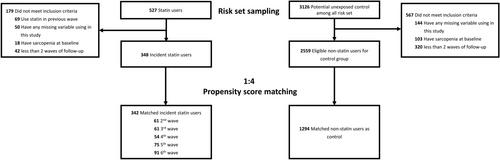
This population-based cohort study was conducted in Japan utilizing data derived from the National Institute for Longevity Sciences-Longitudinal Study of Aging (NILS-LSA). The study participants, enlisted from the 2nd to the 6th waves (spanning from April 2000 to July 2010) of NILS-LSA, were those who aged 40 years or older and had initiated statin therapy (n = 348, age: 64.1 years, female: 63.5%). Individuals who were not administered statins (n = 2559, age: 55.5 years, female: 48.4%) were arbitrarily chosen using a combined approach of propensity score (PS) matching and risk set sampling to form the control group (with a 1:4 matching ratio). The primary outcome of this study was the occurrence of sarcopenia, as defined by the 2019 consensus of the Asian Working Group for Sarcopenia (AWGS). The secondary outcomes included low muscle mass (< 7.0 kg/m2 for men and below 5.4 kg/m2 for women by DXA), reduced skeletal muscle strength (handgrip strength < 28 kg in men and < 18 kg in women) and subpar physical performance (6-min walking speed < 1.0 m/s). The relationship between the use of statins and the outcomes was estimated using a Cox proportional hazard model with time-varying covariates, which included the status of statin use and other variables (two-tailed p < 0.05 was considered statistically significant). Stratification based on age and sex, along with five sensitivity analyses—including propensity score overlap weighting and a negative control—was conducted.

Results

After applying PS matching, we identified 342 statin initiators and 1294 non-statin users, with well-balanced baseline characteristics between the groups. The use of statins was not associated with an increased risk of incident sarcopenia (adjusted hazard ratio [aHR], 1.43 [95% CI, 0.86, 2.36]), diminished muscle strength (aHR, 1.11 [95% CI, 0.80, 1.54]), reduced muscle mass (aHR, 1.09 [95% CI, 0.66, 1.82]) or impaired physical performance (aHR, 0.73 [95% CI, 0.46, 1.17]). These findings were consistent across age and sex stratifications, as well as all sensitivity analyses.

Conclusions

Statin use was not associated with an elevated risk of sarcopenia or impaired muscle health among community-dwelling middle-aged and older adults in Japan.
Abstract Image

查看原文
分享 分享
微信好友 朋友圈 QQ好友 复制链接
本刊更多论文
日本社区中老年人长期服用他汀类药物后患肌少症的风险
关于他汀类药物与肌肉健康之间的关系,特别是其可能增加肌肉减少症的风险,已有不一致的结果报告。鉴于他汀类药物在老年人群中的长期广泛使用,探索这种关联仍然是一个至关重要但尚未充分研究的问题。本研究旨在评估长期服用他汀类药物与肌肉减少、肌肉力量减弱、骨骼肌质量减少和身体机能受损风险之间的关系。
本文章由计算机程序翻译,如有差异,请以英文原文为准。
求助全文
约1分钟内获得全文 去求助
来源期刊
Journal of Cachexia Sarcopenia and Muscle
Journal of Cachexia Sarcopenia and Muscle MEDICINE, GENERAL & INTERNAL-
CiteScore
13.30
自引率
12.40%
发文量
234
审稿时长
16 weeks
期刊介绍: The Journal of Cachexia, Sarcopenia and Muscle is a peer-reviewed international journal dedicated to publishing materials related to cachexia and sarcopenia, as well as body composition and its physiological and pathophysiological changes across the lifespan and in response to various illnesses from all fields of life sciences. The journal aims to provide a reliable resource for professionals interested in related research or involved in the clinical care of affected patients, such as those suffering from AIDS, cancer, chronic heart failure, chronic lung disease, liver cirrhosis, chronic kidney failure, rheumatoid arthritis, or sepsis.
期刊最新文献
Loss of Myonuclei and Transcriptional Activity During Diaphragm Atrophy in Critically Ill Patients The Reliability of Measuring Muscle Cross-Sectional Area in Children Undergoing Treatment for Musculoskeletal Sarcoma Single-Nucleus Transcriptome Reveals Cellular Heterogeneity and Transcriptional Response to Heat Stress in Skeletal Muscle Body Composition in Resectable Non-Small Cell Lung Cancer Patients With Preoperative Sarcopenia: A Propensity-Matched Analysis iCARDIO Alliance Global Implementation Guidelines for the Management of Obesity 2025
×
引用
GB/T 7714-2015
复制
MLA
复制
APA
复制
导出至
BibTeX EndNote RefMan NoteFirst NoteExpress
×
×
提示
您的信息不完整,为了账户安全,请先补充。
现在去补充
×
提示
您因"违规操作"
具体请查看互助需知
我知道了
×
提示
现在去查看 取消
×
提示
确定
0
微信
客服QQ
Book学术公众号 扫码关注我们
反馈
×
意见反馈
请填写您的意见或建议
请填写您的手机或邮箱
已复制链接
已复制链接
快去分享给好友吧!
我知道了
×
扫码分享
扫码分享
Book学术官方微信
Book学术文献互助
Book学术文献互助群
群 号:604180095
Book学术
文献互助 智能选刊 最新文献 互助须知 联系我们:info@booksci.cn
Book学术提供免费学术资源搜索服务,方便国内外学者检索中英文文献。致力于提供最便捷和优质的服务体验。
Copyright © 2023 Book学术 All rights reserved.
ghs 京公网安备 11010802042870号 京ICP备2023020795号-1





