Edelbert A Almeida, Mohit Mehndiratta, Sri V Madhu, Rajarshi Kar
{"title":"Higher Body Mass Index is Associated with Increased Oxidative Stress in Patients of Type 2 Diabetes Mellitus.","authors":"Edelbert A Almeida, Mohit Mehndiratta, Sri V Madhu, Rajarshi Kar","doi":"10.4103/ijem.ijem_474_23","DOIUrl":null,"url":null,"abstract":"<p><strong>Introduction: </strong>Type 2 diabetes mellitus (T2DM) is closely associated with the obesity; however, certain proportion of T2DM patients is non-obese or lean (BMI < 18.5 kg/m<sup>2</sup>). Obesity has long been associated with oxidative stress; however, there are no studies available documenting levels of oxidative stress in the lean patients of T2DM. Therefore, this study was done to compare the levels of makers of oxidative stress (TL, mtDNA, TAS) and their regulators (mRNA expression of <i>TERT, Nrf2</i> and <i>Nqo1</i>) in lean and obese patients of T2DM.</p><p><strong>Methods: </strong>60 newly diagnosed patients (treatment naïve) of T2DM were recruited and divided into lean (BMI < 18.5 kg/m<sup>2</sup>) and obese (BMI > 25 kg/m<sup>2</sup>) groups. Relative telomere length (T/S) and mtDNA content were estimated via real-time PCR. Serum total antioxidant status (TAS) was measured using a commercially available kit. mRNA expression of <i>TERT, Nrf2</i> and <i>Nqo1</i> was measured by real-time PCR.</p><p><strong>Results: </strong>Mean T/S and mtDNA content were lower in the obese group compared to the lean group (<i>P</i> = 0.16 and <i>P</i> = 0.06, respectively). Mean serum TAS levels were higher in obese group compared to the lean group (<i>P</i> = 0.001). mRNA expression of <i>TERT</i> and <i>Nrf2</i> was increased in obese group compared to the lean group. mRNA expression of <i>Nqo1</i> was similar in both the groups.</p><p><strong>Conclusion: </strong>Obese patients of T2DM are exposed to a greater degree of OS compared to the lean patients of T2DM.</p>","PeriodicalId":13353,"journal":{"name":"Indian Journal of Endocrinology and Metabolism","volume":"28 5","pages":"517-521"},"PeriodicalIF":0.0000,"publicationDate":"2024-09-01","publicationTypes":"Journal Article","fieldsOfStudy":null,"isOpenAccess":false,"openAccessPdf":"https://www.ncbi.nlm.nih.gov/pmc/articles/PMC11642501/pdf/","citationCount":"0","resultStr":null,"platform":"Semanticscholar","paperid":null,"PeriodicalName":"Indian Journal of Endocrinology and Metabolism","FirstCategoryId":"1085","ListUrlMain":"https://doi.org/10.4103/ijem.ijem_474_23","RegionNum":0,"RegionCategory":null,"ArticlePicture":[],"TitleCN":null,"AbstractTextCN":null,"PMCID":null,"EPubDate":"2024/9/4 0:00:00","PubModel":"Epub","JCR":"","JCRName":"","Score":null,"Total":0}
引用次数: 0
Abstract
Introduction: Type 2 diabetes mellitus (T2DM) is closely associated with the obesity; however, certain proportion of T2DM patients is non-obese or lean (BMI < 18.5 kg/m2). Obesity has long been associated with oxidative stress; however, there are no studies available documenting levels of oxidative stress in the lean patients of T2DM. Therefore, this study was done to compare the levels of makers of oxidative stress (TL, mtDNA, TAS) and their regulators (mRNA expression of TERT, Nrf2 and Nqo1) in lean and obese patients of T2DM.
Methods: 60 newly diagnosed patients (treatment naïve) of T2DM were recruited and divided into lean (BMI < 18.5 kg/m2) and obese (BMI > 25 kg/m2) groups. Relative telomere length (T/S) and mtDNA content were estimated via real-time PCR. Serum total antioxidant status (TAS) was measured using a commercially available kit. mRNA expression of TERT, Nrf2 and Nqo1 was measured by real-time PCR.
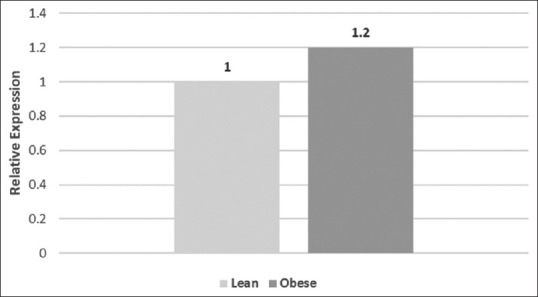
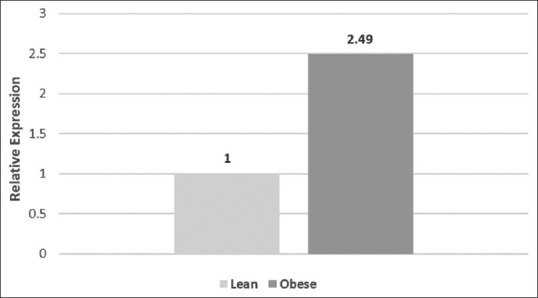
Results: Mean T/S and mtDNA content were lower in the obese group compared to the lean group (P = 0.16 and P = 0.06, respectively). Mean serum TAS levels were higher in obese group compared to the lean group (P = 0.001). mRNA expression of TERT and Nrf2 was increased in obese group compared to the lean group. mRNA expression of Nqo1 was similar in both the groups.
Conclusion: Obese patients of T2DM are exposed to a greater degree of OS compared to the lean patients of T2DM.
期刊介绍:
The Indian Journal of Endocrinology and Metabolism (IJEM) aims to function as the global face of Indian endocrinology research. It aims to act as a bridge between global and national advances in this field. The journal publishes thought-provoking editorials, comprehensive reviews, cutting-edge original research, focused brief communications and insightful letters to editor. The journal encourages authors to submit articles addressing aspects of science related to Endocrinology and Metabolism in particular Diabetology. Articles related to Clinical and Tropical endocrinology are especially encouraged. Sub-topic based Supplements are published regularly. This allows the journal to highlight issues relevant to Endocrine practitioners working in India as well as other countries. IJEM is free access in the true sense of the word, (it charges neither authors nor readers) and this enhances its global appeal.




 京公网安备 11010802042870号
京ICP备2023020795号-1
京公网安备 11010802042870号
京ICP备2023020795号-1

 分享
分享
 求助内容:
求助内容: 应助结果提醒方式:
 扫码关注我们
