My-Diem Nguyen Pham, Chinh Tran-To Su, Thanh-Nhan Nguyen, Hoai-Nghia Nguyen, Dinh Duy An Nguyen, Hoa Giang, Dinh-Thuc Nguyen, Minh-Duy Phan, Vy Nguyen
{"title":"epiTCR-KDA: knowledge distillation model on dihedral angles for TCR-peptide prediction.","authors":"My-Diem Nguyen Pham, Chinh Tran-To Su, Thanh-Nhan Nguyen, Hoai-Nghia Nguyen, Dinh Duy An Nguyen, Hoa Giang, Dinh-Thuc Nguyen, Minh-Duy Phan, Vy Nguyen","doi":"10.1093/bioadv/vbae190","DOIUrl":null,"url":null,"abstract":"<p><strong>Motivation: </strong>The prediction of the T-cell receptor (TCR) and antigen bindings is crucial for advancements in immunotherapy. However, most current TCR-peptide interaction predictors struggle to perform well on unseen data. This limitation may stem from the conventional use of TCR and/or peptide sequences as input, which may not adequately capture their structural characteristics. Therefore, incorporating the structural information of TCRs and peptides into the prediction model is necessary to improve its generalizability.</p><p><strong>Results: </strong>We developed epiTCR-KDA (KDA stands for Knowledge Distillation model on Dihedral Angles), a new predictor of TCR-peptide binding that utilizes the dihedral angles between the residues of the peptide and the TCR as a structural descriptor. This structural information was integrated into a knowledge distillation model to enhance its generalizability. epiTCR-KDA demonstrated competitive prediction performance, with an area under the curve (AUC) of 1.00 for seen data and AUC of 0.91 for unseen data. On public datasets, epiTCR-KDA consistently outperformed other predictors, maintaining a median AUC of 0.93. Further analysis of epiTCR-KDA revealed that the cosine similarity of the dihedral angle vectors between the unseen testing data and training data is crucial for its stable performance. In conclusion, our epiTCR-KDA model represents a significant step forward in developing a highly effective pipeline for antigen-based immunotherapy.</p><p><strong>Availability and implementation: </strong>epiTCR-KDA is available on GitHub (https://github.com/ddiem-ri-4D/epiTCR-KDA).</p>","PeriodicalId":72368,"journal":{"name":"Bioinformatics advances","volume":"4 1","pages":"vbae190"},"PeriodicalIF":2.8000,"publicationDate":"2024-11-29","publicationTypes":"Journal Article","fieldsOfStudy":null,"isOpenAccess":false,"openAccessPdf":"https://www.ncbi.nlm.nih.gov/pmc/articles/PMC11646569/pdf/","citationCount":"0","resultStr":null,"platform":"Semanticscholar","paperid":null,"PeriodicalName":"Bioinformatics advances","FirstCategoryId":"1085","ListUrlMain":"https://doi.org/10.1093/bioadv/vbae190","RegionNum":0,"RegionCategory":null,"ArticlePicture":[],"TitleCN":null,"AbstractTextCN":null,"PMCID":null,"EPubDate":"2024/1/1 0:00:00","PubModel":"eCollection","JCR":"Q2","JCRName":"MATHEMATICAL & COMPUTATIONAL BIOLOGY","Score":null,"Total":0}
引用次数: 0
Abstract
Motivation: The prediction of the T-cell receptor (TCR) and antigen bindings is crucial for advancements in immunotherapy. However, most current TCR-peptide interaction predictors struggle to perform well on unseen data. This limitation may stem from the conventional use of TCR and/or peptide sequences as input, which may not adequately capture their structural characteristics. Therefore, incorporating the structural information of TCRs and peptides into the prediction model is necessary to improve its generalizability.
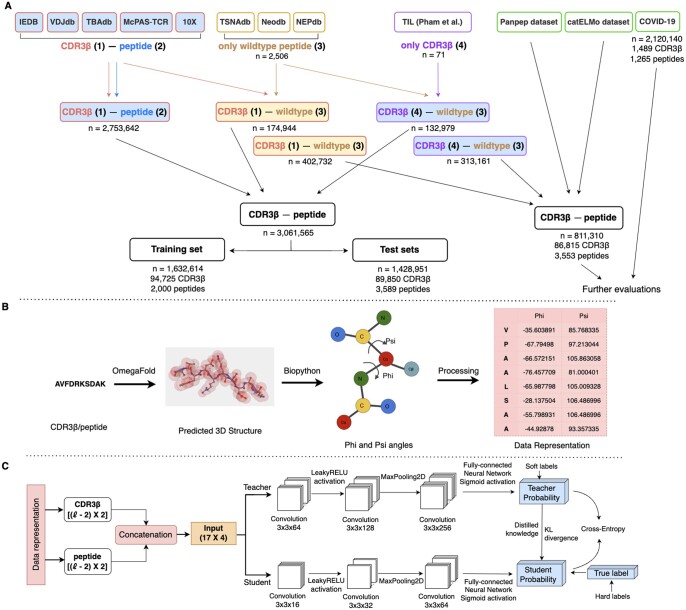
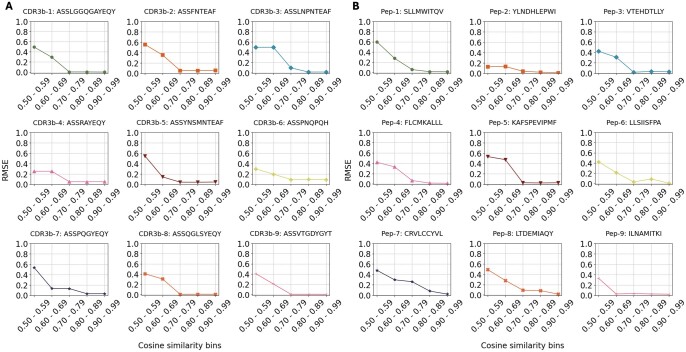
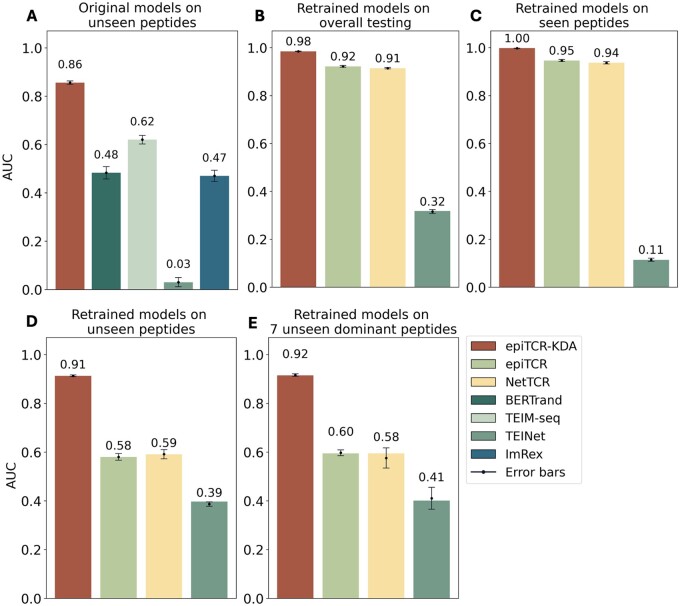
Results: We developed epiTCR-KDA (KDA stands for Knowledge Distillation model on Dihedral Angles), a new predictor of TCR-peptide binding that utilizes the dihedral angles between the residues of the peptide and the TCR as a structural descriptor. This structural information was integrated into a knowledge distillation model to enhance its generalizability. epiTCR-KDA demonstrated competitive prediction performance, with an area under the curve (AUC) of 1.00 for seen data and AUC of 0.91 for unseen data. On public datasets, epiTCR-KDA consistently outperformed other predictors, maintaining a median AUC of 0.93. Further analysis of epiTCR-KDA revealed that the cosine similarity of the dihedral angle vectors between the unseen testing data and training data is crucial for its stable performance. In conclusion, our epiTCR-KDA model represents a significant step forward in developing a highly effective pipeline for antigen-based immunotherapy.
Availability and implementation: epiTCR-KDA is available on GitHub (https://github.com/ddiem-ri-4D/epiTCR-KDA).



 京公网安备 11010802042870号
京ICP备2023020795号-1
京公网安备 11010802042870号
京ICP备2023020795号-1

 分享
分享

 求助内容:
求助内容: 应助结果提醒方式:
 扫码关注我们
