Navid Mohammad Mirzaei, Chin Hur, Mary Beth Terry, Piero Dalerba, Wan Yang
{"title":"Modeling early-onset cancer kinetics to study changes in underlying risk, detection, and impact of population screening.","authors":"Navid Mohammad Mirzaei, Chin Hur, Mary Beth Terry, Piero Dalerba, Wan Yang","doi":"10.1101/2024.12.05.24318584","DOIUrl":null,"url":null,"abstract":"<p><p>Recent studies have reported increases in early-onset cancer cases (diagnosed under age 50) and raised questions about whether the increase is related to earlier diagnosis from non-specific medical tests as reflected by decreasing tumor-size-at-diagnosis (apparent effects) or actual increases in underlying cancer risk (true effects), or both. The classic Multi-Stage Clonal Expansion (MSCE) model assumes cancer detection at the first malignant cell's emergence, although later modifications have included lag-times or stochasticity in detection to represent the delay in tumor detection. Here, we introduce an approach to explicitly incorporate tumor-size-at-diagnosis in the MSCE framework accounting for improvements in cancer detection over time to distinguish between apparent and true increases in early-onset cancer incidence. We demonstrate that our model is structurally identifiable and provides better parameter estimation than the classic model. Applying this model to colorectal, breast, and thyroid cancers, we examine changes in cancer risk while accounting for detection improvements over time in three representative birth cohorts (1950-1954, 1965-1969, and 1980-1984). Our analyses suggest accelerated carcinogenic events and shorter mean sojourn times (the average time from the first malignant cell emergence to cancer detection) in more recent cohorts. We further use this model to examine the screening impact on the incidence of breast and colorectal cancers, both having established screening protocols. Our results align with well-documented differences in screening effects between these cancers. These findings underscore the importance of incorporating tumor-size-at-diagnosis in cancer modeling and support true increases in early-onset cancer risk in recent years for breast, colorectal, and thyroid cancer.</p>","PeriodicalId":94281,"journal":{"name":"medRxiv : the preprint server for health sciences","volume":" ","pages":""},"PeriodicalIF":0.0000,"publicationDate":"2025-05-08","publicationTypes":"Journal Article","fieldsOfStudy":null,"isOpenAccess":false,"openAccessPdf":"https://www.ncbi.nlm.nih.gov/pmc/articles/PMC11643252/pdf/","citationCount":"0","resultStr":null,"platform":"Semanticscholar","paperid":null,"PeriodicalName":"medRxiv : the preprint server for health sciences","FirstCategoryId":"1085","ListUrlMain":"https://doi.org/10.1101/2024.12.05.24318584","RegionNum":0,"RegionCategory":null,"ArticlePicture":[],"TitleCN":null,"AbstractTextCN":null,"PMCID":null,"EPubDate":"","PubModel":"","JCR":"","JCRName":"","Score":null,"Total":0}
引用次数: 0
Abstract
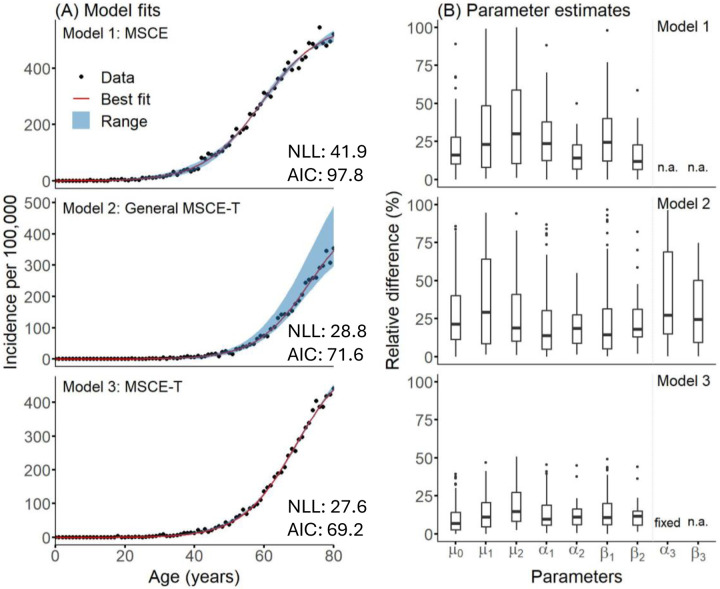
Recent studies have reported increases in early-onset cancer cases (diagnosed under age 50) and raised questions about whether the increase is related to earlier diagnosis from non-specific medical tests as reflected by decreasing tumor-size-at-diagnosis (apparent effects) or actual increases in underlying cancer risk (true effects), or both. The classic Multi-Stage Clonal Expansion (MSCE) model assumes cancer detection at the first malignant cell's emergence, although later modifications have included lag-times or stochasticity in detection to represent the delay in tumor detection. Here, we introduce an approach to explicitly incorporate tumor-size-at-diagnosis in the MSCE framework accounting for improvements in cancer detection over time to distinguish between apparent and true increases in early-onset cancer incidence. We demonstrate that our model is structurally identifiable and provides better parameter estimation than the classic model. Applying this model to colorectal, breast, and thyroid cancers, we examine changes in cancer risk while accounting for detection improvements over time in three representative birth cohorts (1950-1954, 1965-1969, and 1980-1984). Our analyses suggest accelerated carcinogenic events and shorter mean sojourn times (the average time from the first malignant cell emergence to cancer detection) in more recent cohorts. We further use this model to examine the screening impact on the incidence of breast and colorectal cancers, both having established screening protocols. Our results align with well-documented differences in screening effects between these cancers. These findings underscore the importance of incorporating tumor-size-at-diagnosis in cancer modeling and support true increases in early-onset cancer risk in recent years for breast, colorectal, and thyroid cancer.





 京公网安备 11010802042870号
京ICP备2023020795号-1
京公网安备 11010802042870号
京ICP备2023020795号-1

 分享
分享

 求助内容:
求助内容: 应助结果提醒方式:
 扫码关注我们
