{"title":"Antigen-specific immunotherapies for autoimmune disease","authors":"Jane H. Buckner","doi":"10.1038/s41584-024-01201-w","DOIUrl":null,"url":null,"abstract":"Antigen-specific therapies have a long history in the treatment of allergy but have not been successful in autoimmunity. However, in the past 20 years, advances in the definition of the self-antigens that promote autoimmunity and the growing understanding of the mechanisms that maintain tolerance in health but fail in autoimmunity have led to antigen-specific approaches being considered for the treatment of autoimmune diseases. The core goal of each antigen-specific treatment approach is to remove the immune response that promotes autoimmunity whilst sparing protective responses. Approaches to antigen-specific therapy range from targeted deletion of autoreactive lymphocytes to tolerization of autoreactive T cells and active inhibition of autoimmune responses. Technologies such as vaccines, nanoparticles, cell-based therapies and gene editing are being harnessed to achieve these goals. Remaining challenges include the selection of the best antigen to target, modality and timing of administration of these therapies and the disease in which the therapies are used; overcoming these challenges will be vital to move antigen-specific therapies forward. Once established, antigen-specific therapy has the potential to be applied broadly in the area of autoimmunity. In this Review the author summarizes the current approaches for antigen-specific therapies in the treatment of autoimmune disease and highlights the challenges that need to be addressed for successful use of this therapeutic strategy.","PeriodicalId":18810,"journal":{"name":"Nature Reviews Rheumatology","volume":"21 2","pages":"88-97"},"PeriodicalIF":32.7000,"publicationDate":"2024-12-16","publicationTypes":"Journal Article","fieldsOfStudy":null,"isOpenAccess":false,"openAccessPdf":"","citationCount":"0","resultStr":null,"platform":"Semanticscholar","paperid":null,"PeriodicalName":"Nature Reviews Rheumatology","FirstCategoryId":"3","ListUrlMain":"https://www.nature.com/articles/s41584-024-01201-w","RegionNum":1,"RegionCategory":"医学","ArticlePicture":[],"TitleCN":null,"AbstractTextCN":null,"PMCID":null,"EPubDate":"","PubModel":"","JCR":"Q1","JCRName":"RHEUMATOLOGY","Score":null,"Total":0}
引用次数: 0
Abstract
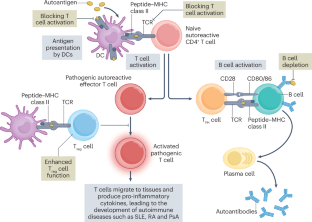
Antigen-specific therapies have a long history in the treatment of allergy but have not been successful in autoimmunity. However, in the past 20 years, advances in the definition of the self-antigens that promote autoimmunity and the growing understanding of the mechanisms that maintain tolerance in health but fail in autoimmunity have led to antigen-specific approaches being considered for the treatment of autoimmune diseases. The core goal of each antigen-specific treatment approach is to remove the immune response that promotes autoimmunity whilst sparing protective responses. Approaches to antigen-specific therapy range from targeted deletion of autoreactive lymphocytes to tolerization of autoreactive T cells and active inhibition of autoimmune responses. Technologies such as vaccines, nanoparticles, cell-based therapies and gene editing are being harnessed to achieve these goals. Remaining challenges include the selection of the best antigen to target, modality and timing of administration of these therapies and the disease in which the therapies are used; overcoming these challenges will be vital to move antigen-specific therapies forward. Once established, antigen-specific therapy has the potential to be applied broadly in the area of autoimmunity. In this Review the author summarizes the current approaches for antigen-specific therapies in the treatment of autoimmune disease and highlights the challenges that need to be addressed for successful use of this therapeutic strategy.
抗原特异性疗法在治疗过敏症方面有着悠久的历史,但在治疗自身免疫方面却并不成功。然而,在过去 20 年中,由于对促进自身免疫的自身抗原定义的进步,以及对维持健康时的耐受性但在自身免疫中失效的机制理解的不断深入,抗原特异性疗法已被考虑用于治疗自身免疫性疾病。每种抗原特异性治疗方法的核心目标都是消除促进自身免疫的免疫反应,同时保留保护性反应。抗原特异性治疗方法包括靶向清除自体反应性淋巴细胞、耐受自体反应性 T 细胞和主动抑制自体免疫反应。目前正在利用疫苗、纳米粒子、细胞疗法和基因编辑等技术来实现这些目标。仍然存在的挑战包括选择最佳靶向抗原、给药方式和时机以及治疗的疾病;克服这些挑战对于推动抗原特异性疗法的发展至关重要。抗原特异性疗法一旦确立,就有可能广泛应用于自身免疫领域。
期刊介绍:
Nature Reviews Rheumatology is part of the Nature Reviews portfolio of journals. The journal scope covers the entire spectrum of rheumatology research. We ensure that our articles are accessible to the widest possible audience.




 京公网安备 11010802042870号
京ICP备2023020795号-1
京公网安备 11010802042870号
京ICP备2023020795号-1

 分享
分享
 求助内容:
求助内容: 应助结果提醒方式:
 扫码关注我们
