{"title":"A Survey on Geolocation on the Internet","authors":"Aviram Zilberman;Adi Offer;Bar Pincu;Yoni Glickshtein;Roi Kant;Oleg Brodt;Andikan Otung;Rami Puzis;Asaf Shabtai;Yuval Elovici","doi":"10.1109/COMST.2024.3518398","DOIUrl":null,"url":null,"abstract":"In the interconnected world of the Internet, IP geolocation - identifying the geographic location of a device, user, or data source given their IP - plays an essential role in numerous applications and services. Over the years, IP geolocation technology has evolved, and it is now a cornerstone of the digital age. However, attaining accurate IP geolocation is not without its challenges. Our comprehensive survey explores IP geolocation, focusing on emerging challenges in security, data geolocation in the cloud, and coping with proxies and VPNs that are used to hide the real IP geolocation. These topics have gained prominence as organizations grapple with safeguarding the location of sensitive information, complying with data privacy regulations, and adapting to the dynamic digital landscape. By synthesizing research, analyzing industry practices, and exploring trends, we equip readers with a taxonomy and insights into the multifaceted world of geolocation and its vital role in shaping the digital future. This comprehensive survey not only enriches understanding of IP geolocation and its challenges but also provides a roadmap for future research, fostering increased awareness and the development of informed strategies for addressing the evolving landscape of geospatial security on the Internet.","PeriodicalId":55029,"journal":{"name":"IEEE Communications Surveys and Tutorials","volume":"27 5","pages":"3339-3381"},"PeriodicalIF":50.6000,"publicationDate":"2024-12-16","publicationTypes":"Journal Article","fieldsOfStudy":null,"isOpenAccess":false,"openAccessPdf":"","citationCount":"0","resultStr":null,"platform":"Semanticscholar","paperid":null,"PeriodicalName":"IEEE Communications Surveys and Tutorials","FirstCategoryId":"94","ListUrlMain":"https://ieeexplore.ieee.org/document/10802881/","RegionNum":1,"RegionCategory":"计算机科学","ArticlePicture":[],"TitleCN":null,"AbstractTextCN":null,"PMCID":null,"EPubDate":"","PubModel":"","JCR":"Q1","JCRName":"COMPUTER SCIENCE, INFORMATION SYSTEMS","Score":null,"Total":0}
引用次数: 0
Abstract
In the interconnected world of the Internet, IP geolocation - identifying the geographic location of a device, user, or data source given their IP - plays an essential role in numerous applications and services. Over the years, IP geolocation technology has evolved, and it is now a cornerstone of the digital age. However, attaining accurate IP geolocation is not without its challenges. Our comprehensive survey explores IP geolocation, focusing on emerging challenges in security, data geolocation in the cloud, and coping with proxies and VPNs that are used to hide the real IP geolocation. These topics have gained prominence as organizations grapple with safeguarding the location of sensitive information, complying with data privacy regulations, and adapting to the dynamic digital landscape. By synthesizing research, analyzing industry practices, and exploring trends, we equip readers with a taxonomy and insights into the multifaceted world of geolocation and its vital role in shaping the digital future. This comprehensive survey not only enriches understanding of IP geolocation and its challenges but also provides a roadmap for future research, fostering increased awareness and the development of informed strategies for addressing the evolving landscape of geospatial security on the Internet.
期刊介绍:
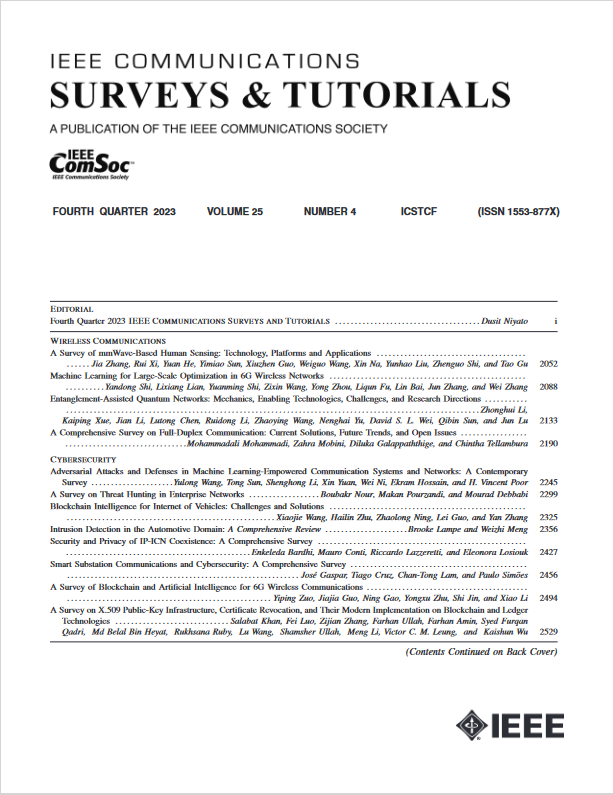
IEEE Communications Surveys & Tutorials is an online journal published by the IEEE Communications Society for tutorials and surveys covering all aspects of the communications field. Telecommunications technology is progressing at a rapid pace, and the IEEE Communications Society is committed to providing researchers and other professionals the information and tools to stay abreast. IEEE Communications Surveys and Tutorials focuses on integrating and adding understanding to the existing literature on communications, putting results in context. Whether searching for in-depth information about a familiar area or an introduction into a new area, IEEE Communications Surveys & Tutorials aims to be the premier source of peer-reviewed, comprehensive tutorials and surveys, and pointers to further sources. IEEE Communications Surveys & Tutorials publishes only articles exclusively written for IEEE Communications Surveys & Tutorials and go through a rigorous review process before their publication in the quarterly issues.
A tutorial article in the IEEE Communications Surveys & Tutorials should be designed to help the reader to become familiar with and learn something specific about a chosen topic. In contrast, the term survey, as applied here, is defined to mean a survey of the literature. A survey article in IEEE Communications Surveys & Tutorials should provide a comprehensive review of developments in a selected area, covering its development from its inception to its current state and beyond, and illustrating its development through liberal citations from the literature. Both tutorials and surveys should be tutorial in nature and should be written in a style comprehensible to readers outside the specialty of the article.




 京公网安备 11010802042870号
京ICP备2023020795号-1
京公网安备 11010802042870号
京ICP备2023020795号-1

 分享
分享
 求助内容:
求助内容: 应助结果提醒方式:
 扫码关注我们
