{"title":"Sulfur Vacancies Limit the Open-Circuit Voltage of Sb2S3 Solar Cells","authors":"Xinwei Wang, Seán R. Kavanagh, Aron Walsh","doi":"10.1021/acsenergylett.4c02722","DOIUrl":null,"url":null,"abstract":"Antimony sulfide (Sb<sub>2</sub>S<sub>3</sub>) is a promising candidate as an absorber layer for single-junction solar cells and the top subcell in tandem solar cells. However, the power conversion efficiency of Sb<sub>2</sub>S<sub>3</sub>-based solar cells has remained stagnant over the past decade, largely due to trap-assisted nonradiative recombination. Here we assess the trap-limited conversion efficiency of Sb<sub>2</sub>S<sub>3</sub> by investigating nonradiative carrier capture rates for intrinsic point defects using first-principles calculations and Sah–Shockley statistics. Our results show that sulfur vacancies act as effective recombination centers, limiting the maximum light-to-electricity efficiency of Sb<sub>2</sub>S<sub>3</sub> to 16%. The equilibrium concentrations of sulfur vacancies remain relatively high, regardless of growth conditions, indicating the intrinsic limitations imposed by these vacancies on the performance of Sb<sub>2</sub>S<sub>3</sub>.","PeriodicalId":16,"journal":{"name":"ACS Energy Letters ","volume":"14 1","pages":""},"PeriodicalIF":18.2000,"publicationDate":"2024-12-16","publicationTypes":"Journal Article","fieldsOfStudy":null,"isOpenAccess":false,"openAccessPdf":"","citationCount":"0","resultStr":null,"platform":"Semanticscholar","paperid":null,"PeriodicalName":"ACS Energy Letters ","FirstCategoryId":"88","ListUrlMain":"https://doi.org/10.1021/acsenergylett.4c02722","RegionNum":1,"RegionCategory":"材料科学","ArticlePicture":[],"TitleCN":null,"AbstractTextCN":null,"PMCID":null,"EPubDate":"","PubModel":"","JCR":"Q1","JCRName":"CHEMISTRY, PHYSICAL","Score":null,"Total":0}
引用次数: 0
Abstract
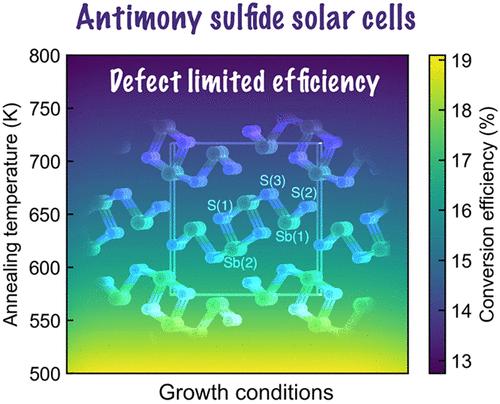
Antimony sulfide (Sb2S3) is a promising candidate as an absorber layer for single-junction solar cells and the top subcell in tandem solar cells. However, the power conversion efficiency of Sb2S3-based solar cells has remained stagnant over the past decade, largely due to trap-assisted nonradiative recombination. Here we assess the trap-limited conversion efficiency of Sb2S3 by investigating nonradiative carrier capture rates for intrinsic point defects using first-principles calculations and Sah–Shockley statistics. Our results show that sulfur vacancies act as effective recombination centers, limiting the maximum light-to-electricity efficiency of Sb2S3 to 16%. The equilibrium concentrations of sulfur vacancies remain relatively high, regardless of growth conditions, indicating the intrinsic limitations imposed by these vacancies on the performance of Sb2S3.
ACS Energy Letters Energy-Renewable Energy, Sustainability and the Environment
CiteScore
31.20
自引率
5.00%
发文量
469
审稿时长
1 months
期刊介绍:
ACS Energy Letters is a monthly journal that publishes papers reporting new scientific advances in energy research. The journal focuses on topics that are of interest to scientists working in the fundamental and applied sciences. Rapid publication is a central criterion for acceptance, and the journal is known for its quick publication times, with an average of 4-6 weeks from submission to web publication in As Soon As Publishable format.
ACS Energy Letters is ranked as the number one journal in the Web of Science Electrochemistry category. It also ranks within the top 10 journals for Physical Chemistry, Energy & Fuels, and Nanoscience & Nanotechnology.
The journal offers several types of articles, including Letters, Energy Express, Perspectives, Reviews, Editorials, Viewpoints and Energy Focus. Additionally, authors have the option to submit videos that summarize or support the information presented in a Perspective or Review article, which can be highlighted on the journal's website. ACS Energy Letters is abstracted and indexed in Chemical Abstracts Service/SciFinder, EBSCO-summon, PubMed, Web of Science, Scopus and Portico.



 京公网安备 11010802042870号
京ICP备2023020795号-1
京公网安备 11010802042870号
京ICP备2023020795号-1

 分享
分享
 求助内容:
求助内容: 应助结果提醒方式:
 扫码关注我们
